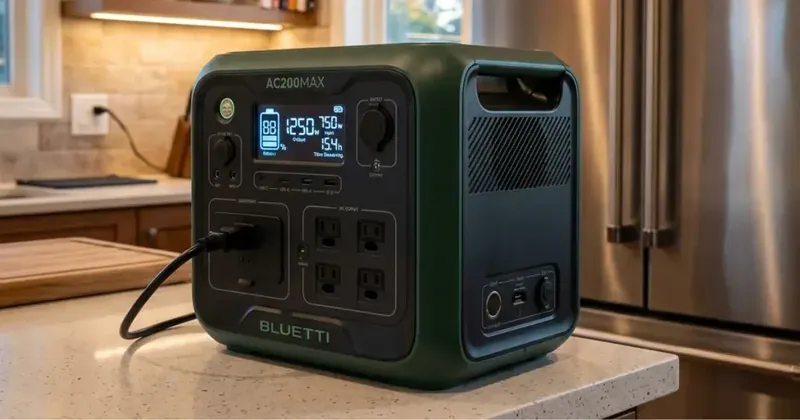
Will a 1000W Solar Generator Run a Refrigerator? (The Surge Math)
This post contains affiliate links. I earn a small commission if you buy through my links, at no extra cost to you. I only recommend gear I have researched in depth: manufacturer specifications, published teardowns, and aggregated owner reports.
If you have been searching for whether a 1,000W solar generator can run a refrigerator, you have probably found plenty of vague answers. Here is a precise one.
Short version: usually yes. A refrigerator draws far less than 1,000W while running. What decides the answer is the short startup surge, and that is a number you can check in two minutes.
This post contains affiliate links. We earn a small commission if you buy through our links, at no extra cost to you. Specifications come from manufacturer pages and runtimes are our own calculations, not lab tests.
The Short Answer
Yes, if you match the unit to the fridge and check the surge number.
Most modern refrigerators run at roughly 100 to 400 watts while the compressor is on. A 1,000W-class power station handles that easily. The compressor needs a brief startup burst, several times its running watts, and that burst is what trips an undersized unit.
A power station that cannot deliver that burst shuts off the moment the compressor tries to start, even though the fridge’s running draw is small. That is why the surge rating matters more than the headline wattage. Our guide to surge vs running watts explains the difference.
Check Your Fridge in Two Minutes
Step 1: Find the data plate inside the fridge or on the back. Note the running amps and the LRA (locked rotor amps) if it lists one.
Step 2: Startup surge in watts is roughly LRA × 120. A fridge with a 12A LRA needs about 1,440W for an instant. Add a 20% margin and you want a surge rating above about 1,700W.
Step 3: Compare that to the power station’s published surge rating. Our LRA guide shows how to read the plate.
If no LRA is listed, search the model number plus “specifications”, or use a conservative estimate and leave a wide margin.
Typical running watts by fridge type
These are rough ranges for the running draw. Your own label and a plug-in watt meter are better than any table.
| Fridge type | Typical running watts |
|---|---|
| Compact mini fridge | roughly 50 to 100W |
| Standard top-freezer | roughly 100 to 200W |
| Large French door with ice maker | roughly 200 to 400W |
| Chest freezer (7 cu ft) | roughly 70 to 150W |
A large fridge with an ice maker has the biggest running draw and often the biggest startup draw. Check it before assuming a 1,000W-class unit will start it.
How Long Will a 1,000Wh Unit Run a Fridge?
A fridge compressor cycles on and off, so the average draw is much lower than the label rating. We assume a 60W average for a typical fridge, which is 1.4 kWh a day. Runtime is capacity × 0.85 ÷ average watts, with the 0.85 keeping a 15% battery buffer.
| Battery capacity | Assumed average draw | Estimated runtime |
|---|---|---|
| 500Wh | 60W | about 7 hours |
| 1,000Wh | 60W | about 14 hours |
| 1,500Wh | 60W | about 21 hours |
| 2,000Wh | 60W | about 28 hours |
On the three units below:
| Unit | Capacity | Estimated fridge runtime |
|---|---|---|
| Jackery Explorer 1000 V2 | 1,070Wh | about 15 hours |
| EcoFlow DELTA 3 Plus | 1,024Wh | about 15 hours |
| Bluetti Elite 200 V2 | 2,073.6Wh | about 29 hours |
A fridge in a hot garage can use two to three times the electricity of the same fridge in a cool kitchen, so cut these numbers sharply in summer heat. Our chest freezer wattage chart shows how much the average draw varies.
The 3 Units We Would Look At for a Refrigerator
These figures are the manufacturers’ published specifications.
1. Jackery Explorer 1000 V2: Lightest
- 1,070Wh, 1,500W output, 3,000W surge, 23.8 lb.
- Recharges from the wall in about 1.6 hours, and accepts up to 400W of solar.
- A 3,000W surge covers most refrigerator startups. It does not expand.
2. EcoFlow DELTA 3 Plus: Fastest Recharge
- 1,024Wh, 1,800W output, 3,600W surge, 27.6 lb.
- About 56 minutes from the wall and two 500W solar inputs.
- Expandable up to 5 kWh, which is the better choice if you want a fridge to run for days.
3. Bluetti Elite 200 V2: Twice the Runtime
- 2,073.6Wh and 2,600W output, so about twice the fridge hours of the other two.
- Bluetti does not publish a motor surge rating, so check your fridge’s startup against it before relying on it.
- 53.4 lb and not expandable, so it suits a fixed spot beside the kitchen.
What About Running Other Things Too?
A fridge is your baseload. Everything else has to fit under the unit’s continuous rating minus the fridge’s running watts, and it also draws on the same battery.
| Additional appliance | Typical watts | Notes |
|---|---|---|
| LED lights (10 bulbs) | about 100W | Fine on any of the three |
| Phone and laptop charging | about 60 to 100W | Fine |
| Box fan | about 50 to 100W | Fine |
| Small TV | about 50W | Fine |
| Microwave | about 900 to 1,200W | Possible on a short run, but it drains the battery fast |
| Electric kettle | about 1,000 to 1,500W | Short runs only, and it may exceed the Jackery’s 1,500W with the fridge on |
| Window AC (5,000 BTU) | about 475W running, plus a startup surge | Heavy on a 1,000Wh battery: roughly 2 hours |
Tips That Stretch Your Runtime
- Keep the door shut. Every opening makes the compressor work harder to recover.
- Pre-cool. If a storm is coming, set the fridge colder ahead of time.
- Mind the room. A hot garage or kitchen shortens runtime a lot.
- Keep the battery buffer. Planning on 85% of rated capacity is safer than counting on every watt-hour.
- Check food safety. Our guide to food in a power outage covers the 40°F and 4-hour rules.
The Bottom Line
A 1,000W-class solar generator will run most standard refrigerators, as long as:
- The unit’s surge rating clears your fridge’s startup demand (LRA × 120 plus 20%).
- Your fridge’s running draw sits well under the continuous rating.
- The battery covers the hours you need, using the table above.
For a broader comparison, see our Best Solar Generator Under $1,000 guide and our chest freezer power station guide.
🔋 Solar Generator Buyer's Toolkit — $19
A sizing calculator, an appliance wattage reference sheet and a side-by-side comparison worksheet built from manufacturer specs.
Get the Toolkit — $19 →Frequently Asked Questions
Can a 1000W solar generator run a refrigerator all day? Yes, if the battery is large enough. With a 60W average draw and a 15% buffer, a 1,000Wh unit runs a typical fridge for about 14 hours. Solar panels recharging during the day can extend that.
Will a 1000W generator damage my refrigerator? Quality power stations output pure sine wave power, which is safe for compressor motors. Confirm the output type on the product page, and avoid inverters that list only modified sine wave.
How many watts does a refrigerator use? Most standard refrigerators run at roughly 100 to 400 watts while the compressor is on, with a much lower average because the compressor cycles. The startup surge is several times the running draw and lasts a fraction of a second.
Can I run a fridge and freezer on one 1000W generator? Often yes, if the combined running watts stay under the continuous rating and the startups do not land at the same moment. Check both appliances’ LRA against the unit’s surge rating, and start them one at a time if you can.
Specifications are the manufacturers’ published figures and can change. Runtimes are calculated, not measured. Last updated October 2026.