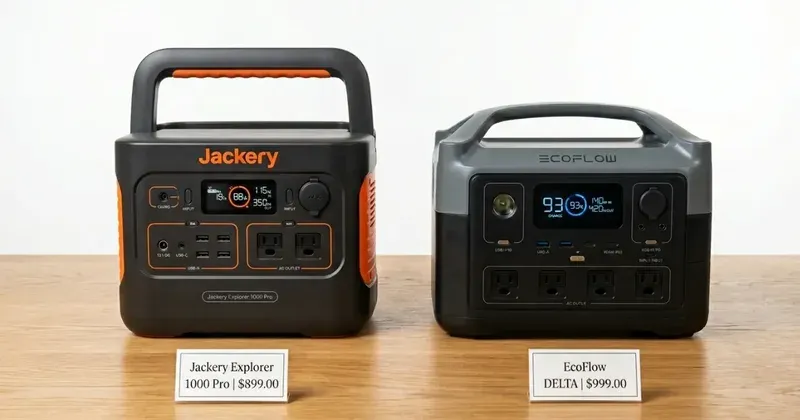
Best Solar Generator Under $1000 (2026): Compared and Ranked
This post contains affiliate links. I earn a small commission if you buy through my links, at no extra cost to you. I only recommend gear I have researched in depth: manufacturer specifications, published teardowns, and aggregated owner reports.
Around $1,000 is where portable power stations get serious. Below it you find units for phones, laptops and camping. Above it you start paying for capacity most households do not need.
This post contains affiliate links. We earn a small commission if you buy through our links, at no extra cost to you. Specifications come from manufacturer pages and runtimes are calculations, not our own tests. Prices change often, so check the current price on each page.
This guide compares the leading sub-$1,000 picks against the loads that matter most: a chest freezer, a refrigerator, and a few essentials.
The 3 Picks Compared
| Jackery Explorer 1000 V2 | EcoFlow DELTA 3 Plus | Bluetti EB3A | |
|---|---|---|---|
| Capacity | 1,070Wh | 1,024Wh | 268Wh |
| Continuous output | 1,500W | 1,800W | 600W |
| Surge | 3,000W | 3,600W | Check Bluetti’s page |
| Battery | LiFePO4 | LiFePO4 | LiFePO4 |
| Max solar input | 400W | 2 × 500W | 200W |
| Wall recharge | About 1.6 hours | About 56 minutes | Check Bluetti’s page |
| Weight | 23.8 lb | 27.6 lb | About 10 lb |
| Expandable | No | Yes, up to 5kWh | No |
| Best for | Home backup, portability | Fast recharge, growth | Camping, CPAP, devices |
These are manufacturers’ published figures and can change. Both larger units have generally sold under $1,000, but prices move, so check before you decide.
⏱️ Calculated Runtimes
Usable energy is 85% of capacity (inverter losses). Runtime is usable energy divided by average watts.
| Load (average draw) | Jackery 1000 V2 (~910Wh) | EcoFlow DELTA 3 Plus (~870Wh) | Bluetti EB3A (~230Wh) |
|---|---|---|---|
| Chest freezer, 45W | about 20 hours | about 19 hours | about 5 hours |
| Refrigerator, 60W | about 15 hours | about 14.5 hours | about 3.8 hours |
| Fridge + router + lights, 90W | about 10 hours | about 9.7 hours | about 2.5 hours |
| CPAP, 30W | about 30 hours | about 29 hours | about 7.6 hours |
Real average draw depends on your appliance, the room temperature and how often the door opens. A plug-in watt meter gives the best number. To check whether a unit will start your freezer, multiply its LRA by 120 and add 20%; see our surge vs running watts guide.
#1 Jackery Explorer 1000 V2 — Simple, Light, Good for One Freezer or Fridge
The Jackery gives you 1,070Wh in a 23.8 lb package, and its 3,000W surge rating covers a freezer or fridge with an LRA up to about 20. It accepts up to 400W of solar and takes about 1.6 hours to recharge from the wall.
Strengths: lighter than the EcoFlow, slightly more capacity, straightforward to use.
Trade-offs: 1,500W continuous limits how many large appliances you can run at once, wall charging is slower than the EcoFlow, and it cannot be expanded.
Read our full Jackery Explorer 1000 V2 review.
#2 EcoFlow DELTA 3 Plus — Faster Recharging and Room to Grow
The DELTA 3 Plus has 1,024Wh, 1,800W continuous and a 3,600W surge rating. It recharges from the wall in about 56 minutes, accepts up to 1,000W of solar (two 500W inputs), and can be expanded up to 5kWh with add-on batteries.
Strengths: fast charging, higher output and surge, expandable.
Trade-offs: heavier at 27.6 lb and usually priced above the Jackery. X-Boost lets it run some resistive loads such as heaters up to 2,200W, but it does not apply to motors.
#3 Bluetti EB3A — Budget Pick for Devices, Not for Home Backup
At 268Wh and 600W, the EB3A is a small unit. It is a fit for camping, a CPAP on a short outage, and keeping phones and laptops alive. It is not a fit for a full-size refrigerator or chest freezer, where it would last only a few hours.
| Use case | EB3A (calculated) |
|---|---|
| CPAP at 30W | about 7.6 hours |
| CPAP at 56W | about 4 hours |
| Laptop + phone charging | several hours |
| Full-size refrigerator or chest freezer | Not recommended |
Looking for more capacity from Bluetti? The Bluetti Elite 200 V2 (2,073.6Wh, 2,600W) is a step up in size, and its price may be above $1,000, so check.
⚡ Solar Generator Buyer's Toolkit - $19
The wattage math, a sizing calculator, and a runtime guide so you buy the right generator, not too much and not too little.
Get the Toolkit - $19 →3 Things That Matter More Than Price
1. Surge rating and continuous output, not just capacity
Watt-hours tell you how long a unit runs. Surge and continuous watts tell you what it can start. A freezer or fridge compressor briefly draws several times its running watts at startup, so check the appliance’s LRA × 120, add 20%, and compare to the surge rating.
2. Battery chemistry
All three picks use LiFePO4, which is generally the longer-lived chemistry for a unit that will sit and cycle for years. Confirm the chemistry and the rated cycle life on the manufacturer’s page before buying any unit.
3. Solar input capacity
For outages longer than a day, input capacity decides how much you can win back each day. Using panel watts × peak sun hours × 0.75, 400W of panels with 5 peak sun hours makes about 1,500Wh, more than a full charge of a 1,000Wh unit. Clouds and winter sun cut that sharply.
What $1,000 Cannot Buy
A sub-$1,000 power station will not run central AC, an electric water heater, an electric dryer, or most 240V well pumps. For those you need a generator on a transfer switch installed by a licensed electrician. See the home backup power guide for larger setups.
Jackery vs EcoFlow — How to Choose
Choose the Jackery Explorer 1000 V2 if:
- You are backing up one freezer or fridge plus small loads
- Weight and portability matter
- You mostly recharge from a wall outlet and do not plan to expand
Choose the EcoFlow DELTA 3 Plus if:
- You want faster wall and solar recharging
- You may want to add capacity later
- You run several appliances at once
For more detail, see the EcoFlow vs Jackery comparison.
Frequently Asked Questions
What is the best solar generator under $1000 for home backup? For one freezer or fridge, the Jackery Explorer 1000 V2 is a simple, light choice, and the EcoFlow DELTA 3 Plus is better if you want faster recharging and expandability. Both run a typical chest freezer for roughly 19 to 20 hours at a 45W average draw.
Can a solar generator under $1000 run a refrigerator? Usually yes. A fridge averaging 60W runs about 15 hours on the Jackery and about 14.5 hours on the EcoFlow. Check your fridge’s LRA × 120 plus 20% against the unit’s surge rating.
Is 1000Wh enough for home backup power? For essentials such as a refrigerator, router, phone charging and LED lights, a 1,000Wh unit gives roughly 10 to 20 hours depending on the load. For longer coverage you need solar recharging or a larger or expandable unit.
What is the difference between Wh and W in a solar generator? Wh (watt-hours) is capacity, the total energy the battery holds. W (watts) is output, the most it can deliver at once. Both matter: a large battery with a weak inverter may not start a compressor.
How does the Jackery 1000 V2 compare to the EcoFlow DELTA 3 Plus? The Jackery is lighter at 23.8 lb and has slightly more capacity. The EcoFlow has higher output (1,800W vs 1,500W), a higher surge rating (3,600W vs 3,000W), about 56-minute wall charging versus about 1.6 hours, and can be expanded.
How long does a solar generator battery last? LiFePO4 units are typically rated for thousands of charge cycles. EcoFlow rates the DELTA 3 Plus for 4,000 cycles to 80% capacity. Check each manufacturer’s page for its figure and warranty.
Specifications are the manufacturers’ published figures and can change. Runtimes are calculated, not measured. Last updated October 2026.