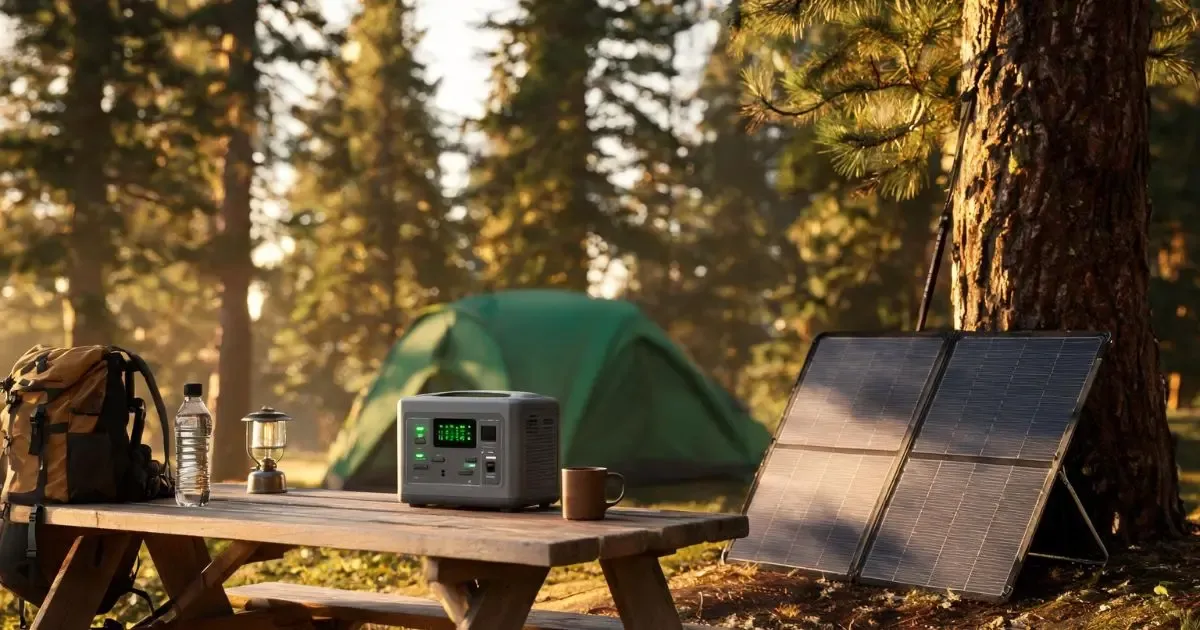
Best Solar Generator for Camping 2026: Runtime Compared
This post contains affiliate links. I earn a small commission if you buy through my links, at no extra cost to you. I only recommend gear I have researched in depth: manufacturer specifications, published teardowns, and aggregated owner reports.
Most camping generator advice ignores the two things that decide whether a unit works at a campsite: noise and cold.
A gas generator solves the power problem and creates two new ones. You cannot run it near a tent safely, and at 60 to 70 dB it is the loudest thing in the campground. For anyone running a CPAP overnight, that rules it out entirely.
Cold is the second trap. Lithium batteries lose 20 to 30 percent of usable capacity below freezing, and most refuse to charge at all under 0 degrees Celsius. A unit that runs a mini fridge comfortably in July can fall short on an October trip.
This guide compares 6 solar generators across the scenarios campers face - car camping, dispersed sites, RV nights without hookups, and cold-weather trips - using manufacturer specifications and calculated runtimes for everything from CPAP machines to electric skillets to mini fridges.
Here is what the numbers show.
⚡ Quick Answer: The EcoFlow DELTA 3 Plus is a strong all-rounder for most campers. It recharges from the wall in about 56 minutes, weighs 27.6 lb, and by our calculation runs a 45W CPAP, phone charging and LED lights for about 2 nights on one charge. If you’re RV camping or need more power, step up to the Bluetti Elite 200 V2.
Affiliate disclosure: We earn a commission if you buy through our links, at no extra cost to you. Specifications come from manufacturer pages and runtimes are calculations, not our own tests.
🏕️ What Makes a Solar Generator Good for Camping?
Camping demands different things than home backup power. These are the specs that matter:
Weight. You’re carrying this. Every pound matters. Gas generators average 45–80 lbs. The best solar generators for camping run 17–35 lbs.
Noise. Campgrounds have quiet hours. Solar generators run silent. This alone makes them worth it.
Recharge speed. You need the unit full by nightfall. Slow chargers (8–12 hours) are useless at a campsite unless you’re plugged into shore power.
Surge capacity. Your portable fridge or electric cooler needs 2–3x its running watts to start. A generator with weak surge wattage will trip every time.
Weather resistance. Not waterproof — but ruggedized enough to survive morning dew and a light drizzle.
⭐ Best Solar Generators for Camping — Comparison
| Generator | Capacity | Weight | Recharge Time | Surge Watts | Best For |
|---|---|---|---|---|---|
| Bluetti Elite 200 V2 | 2,073.6Wh | 53.4 lbs | About 1.2 hrs (calculated) | Not published (resistive loads up to 3,900W) | RV / base camp |
| Jackery Explorer 1000 v2 | 1,070Wh | 23.8 lbs | 1.6 hrs | 3,000W | Weekend campers |
| EcoFlow DELTA 3 Plus | 1,024Wh | 27.6 lbs | 56 min | 3,600W | Most campers |
| Jackery Explorer 500 | 518Wh | 13.3 lbs | 7.5 hrs | 1,000W | Ultralight / backpack |
| Bluetti EB3A | 268Wh | 10.2 lbs | 30 min | 600W | Day trips only |
🥇 #1 EcoFlow DELTA 3 Plus — Strong All-Rounder for Most Campers
Typical camp load, calculated:
- LED string lights (10W) × 8 hrs = 80Wh
- CPAP with humidifier (45W avg) × 3 nights × 8 hrs = 1,080Wh
- Phone charging × 3 nights = ~30Wh
- Portable fan (35W) × 6 hrs = 210Wh
- Total: ~1,400Wh over 3 nights
At 27.6 lb it fits in the back of an SUV without rearranging the cooler. The roughly 56-minute wall recharge means you can top it up quickly before a trip or from a campsite outlet. With about 870Wh usable (1,024Wh × 0.85), it covers about two nights of a 45W CPAP before it needs a recharge, so on the load above you would top up around day 2.
Its 3,600W surge rating leaves headroom for a 12V compressor cooler or an electric skillet (a skillet drawing 1,400W running is well inside the 1,800W continuous rating).
One limitation to plan for: solar input goes up to 1,000W (two 500W inputs), but most campers carry far less. With two 200W panels, 400W × 3 hours × 0.75 gives about 900Wh in a good 3-hour afternoon window, enough for lights and phone charging but not a full recharge from empty in one day.
🥈 #2 Bluetti Elite 200 V2 — Best for RV and Base Camp
If you’re RV camping, car camping with a group, or running a base camp for multiple days, the Bluetti Elite 200 V2 is the unit to look at.
Typical RV and base camp load, calculated:
- 12V compressor cooler (45W avg) × 24 hrs = 1,080Wh
- CPAP × 3 nights = 1,080Wh
- Laptop (65W) × 4 hrs/day × 3 days = 780Wh
- LED camp lights × 3 nights = 240Wh
- Phone charging × 4 people × 3 nights = ~120Wh
- Total: ~3,300Wh over 3 days (about 1,100Wh per day)
At about 1,100Wh per day, the Elite 200 V2’s roughly 1,762Wh of usable energy (with a 15% buffer) lasts about 1.6 days before it needs solar or a wall recharge. The DELTA 3 Plus (about 870Wh usable) lasts under a day on that load.
At 2,600W continuous, the Elite 200 V2 has the output to run a small 5,000 BTU window AC (roughly 450W running), but Bluetti does not publish a motor-start surge figure for it, so check the AC’s nameplate first. At 450W, about 1,762Wh of usable energy runs it for roughly 3.9 hours.
The downside: 53.4 lbs. This is not a unit you carry. It lives in your truck bed or RV bay.
→ Check Bluetti Elite 200 V2 price
🧰 Planning an RV trip? The RV Solar Sizing Kit ($19) helps you estimate the capacity you need based on your appliances and trip length. Includes an auto-calculating Excel sheet.
Stop guessing what size generator you need. Enter your appliance list and the calculator does the math to give you a sizing estimate.
Get the RV Solar Sizing Kit — $19
🥉 #3 Jackery Explorer 1000 v2 — Best for Weekend Campers
The Jackery is the most beginner-friendly unit in this comparison and is easy to carry. A plug-in watt meter or the unit’s own display is the fastest way to learn where your camping power goes.
At 23.8 lb it is the lightest 1,000Wh unit here, which helps if you have to carry it any distance to a dispersed site.
Worth knowing: its 3,000W surge rating is a little below the EcoFlow’s 3,600W and its continuous output is 1,500W versus 1,800W. For a 12V compressor cooler and a fan that is plenty. If you plan to run several large appliances at once, the EcoFlow has more headroom.
For weekend campers running phone charging, lights, a fan and a CPAP, the Jackery 1000 v2 is a good fit and usually costs less than the DELTA 3 Plus.
🛒 Check today’s price at Jackery →
🌞 How Much Solar Do You Actually Need?
Solar output at a campsite is usually well below the panel’s rated watts. Using a planning figure of 75% of rated output:
| Panel Size | Estimated output | Hours to add 500Wh |
|---|---|---|
| 100W panel | about 75W | about 7 hours |
| 200W panel | about 150W | about 3.3 hours |
| 400W (2×200W) | about 300W | about 1.7 hours |
The uncomfortable truth: Panels at campsites rarely hit their rated output. Trees, clouds, panel angle and temperature all reduce it, so plan on about 75% in good sun and much less in cloud.
For a 3-day camping trip with CPAP + fridge + lights, you need either:
- 1,000Wh+ capacity and one AC recharge at a trailhead, OR
- 1,000Wh capacity + 400W of solar panels + full sun for 2–3 hours daily
🏥 CPAP Users: What You Actually Need
CPAP power draw varies a lot by model and settings, from roughly 10W up to 60W or more with a heated humidifier and heated tube. As one example, a retailer lists the ResMed AirSense 11 at 56W typical and 73W maximum, while owners report far lower draw without the heated humidifier. Check your device’s power supply label and manual.
At an illustrative 45W average, a night is 360Wh and a 3-night trip is 1,080Wh just for the CPAP. Add lights (80Wh), phone charging (30Wh) and a fan (210Wh) and you are at about 1,400Wh.
For CPAP campers: plan on at least 1,000Wh of capacity and bring a 200W solar panel. Turning off the heated humidifier and heated tube can cut draw substantially; check your device’s manual. See our CPAP guide for nights per charge by wattage. For any life-supporting equipment, have a second plan.
👨👩👧 Family Camping Power Needs
Four people camping means four phones, probably a cooler, and someone running a hair dryer in the morning. Here is what that adds up to:
| Appliance | Running Watts | Daily Use | Daily Wh |
|---|---|---|---|
| 12V compressor cooler | 45W avg | 24 hrs | 1,080Wh |
| 4× phone charging | 20W × 4 | 2 hrs each | 160Wh |
| LED camp lights | 15W | 6 hrs | 90Wh |
| Portable fan | 35W | 8 hrs | 280Wh |
| Electric skillet (breakfast) | 1,400W | 20 min | 467Wh |
| Total daily | ~2,077Wh |
For a 2-night family trip you need 4,000Wh+ or a recharge source. The Bluetti Elite 200 V2 (2,073.6Wh) paired with 400W of solar is the realistic minimum for a family of four.
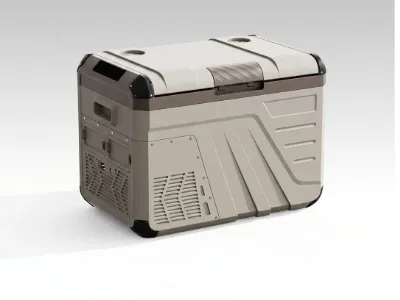
Traverseon lists this 110V portable air conditioner at 4,500 BTU (for about 54–86 sq ft) and 5,200 BTU (about 86–108 sq ft), with a listed power consumption of 350W/450W (the page does not say which figure belongs to which model). It weighs 28.7 lb (4,500 BTU) or 33.1 lb (5,200 BTU), is listed at about 45 dB, and is priced at $699.90 and $789.90. Traverseon states a 30-day return window and does not publish a warranty length, and does not say whether it is compatible with battery power stations.
Calculated runtime at the listed draw (usable = rated Wh × 0.85): at 450W, about 3.9 hours on a Bluetti Elite 200 V2, about 2.0 hours on a Jackery Explorer 1000 V2, and about 1.9 hours on an EcoFlow DELTA 3 Plus. At 350W those become roughly 5.0, 2.6 and 2.5 hours. The compressor’s startup surge is not published, so allow a generous surge margin before pairing it with a smaller station.
Check Traverseon Portable AC Price❄️ Cold Weather Camping: What Changes
Cold weather changes the picture. Lithium batteries lose usable capacity in the cold, and many units limit or refuse charging below freezing.
Battery capacity drops in cold. LiFePO4 handles cold better than some other chemistries, but check the operating and charging temperature limits in EcoFlow’s manual before a winter trip.
Charging slows in cold. Below 32°F, most units slow-charge or refuse to charge to protect the battery. Plan to store the unit inside your tent or vehicle overnight.
A common planning rule: In temperatures below 32°F, add 20% to your capacity estimate and store the unit somewhere above freezing when not in use.
Power is only part of a camp setup. These are listed specs from Traverseon’s own product pages; prices change, so check the current listing.
- AeroDuo 2P tunnel tent: 3-season, about 3.5 lb, from $109.90 (trekking poles not included).
- 1-person trekking-pole tent: about 2.2 lb, from $123.03 (front trekking pole not included).
- Down mummy sleeping bag: five fill weights; the 1,200 g option lists a lower limit of 9°F (-13°C), the 400 g option 45°F. From $119.96.
Use code Mohamed10 at checkout for 10% off.
🚐 RV Camping Without Shore Power
Running an RV without hookups for multiple nights requires a different calculation than tent camping.
Take a 24-foot travel trailer over four nights with the Bluetti Elite 200 V2 as the sole power source. The load:
- 12V refrigerator (55W avg): 1,320Wh/day
- LED interior lights: 60Wh/day
- Water pump (60W × 10 min/day): 10Wh/day
- Phone/tablet charging: 80Wh/day
- CPAP: 360Wh/night
- Total: ~1,830Wh/day
The Elite 200 V2 (2,073.6Wh, about 1,762Wh usable) covers about 23 hours between charges on that load. With 400W of solar in good sun you gain roughly 1,200Wh/day — a deficit of about 630Wh/day, meaning an AC top-up every 3 days.
The honest math: For true off-grid RV camping for 5+ days, you need either a 3,000–4,000Wh system or to be conservative with your usage.
💰 Budget Option: What $500 Buys You
Not everyone needs 1,000Wh. If you’re a solo or couple camper running phones, lights, and a fan — you can spend under $500 and be completely fine.
The Jackery Explorer 500 (518Wh, 13.3 lbs) is the right call here. Over a 2-night solo trip:
- Phone × 3 nights ✅
- LED lights × 2 nights ✅
- Fan × 2 nights ✅
- CPAP × 1 night at 45W ✅ (about 360Wh of roughly 440Wh usable; two nights only at a lower draw)
It handles the basics. The 7.5-hour solar recharge time is the main limitation — you need to start charging at dawn to have a full unit by dark.
What $500 can’t do: Run a compressor cooler, electric skillet, or multiple high-draw appliances simultaneously. For that, you need 1,000Wh+.
🛡️ Emergency Preparedness at Camp
A medical need at a remote campsite is the kind of problem a power station can help with: powering a glucometer, charging a phone to call for help, and keeping lights on.
If you or someone in your group has a medical condition, a solar generator is emergency preparedness gear, not just a convenience. Build your capacity estimate around worst-case medical needs, not average camping use.
Our 72-Hour Power Outage Survival Kit applies to remote camping too — same principles, same gear list.
Get the Survival Kit — $27
🔗 Related Articles
- Best Solar Generator for CPAP Machine
- Best Solar Generator for RV
- Surge vs Running Watts Explained
- How Long Does Food Last Without Power
- Best Solar Generator Under $1,000
- Off-grid solar for a small cabin with a portable power station
❓ Frequently Asked Questions
Can a solar generator run a mini fridge while camping? Yes — if you have the right unit. A 12V compressor cooler draws 45W average and needs 1,000Wh+ capacity for 24-hour operation. The EcoFlow DELTA 3 Plus or Bluetti Elite 200 V2 handle this comfortably. A standard 120V refrigerator draws 150–200W and needs 2,000Wh+ for 24 hours.
How long does a solar generator last camping? At typical camping use (lights, phone charging, fan, CPAP), a 1,000Wh unit lasts 2–3 nights. A 2,000Wh unit lasts 4–5 nights. Add a 200W solar panel to extend that in good sun.
Are solar generators safe to use inside a tent? Solar generators produce no exhaust, so there is no carbon monoxide risk like with a gas generator. Still keep the unit dry, ventilated and with its vents uncovered.
Can I charge a solar generator with my car while camping? Yes. Most solar generators include a 12V car charging cable. Charge time via 12V is slow (8–15 hours) but useful for topping up. Run your engine for 2–3 hours while driving to camp and you’ll arrive with a meaningful charge.
What size solar panel do I need for camping? For a 1,000Wh generator, a 200W panel gives roughly 750Wh on a good summer day (200W × 5 hours × 0.75). Two 200W panels give about 1,500Wh a day in good sun, which covers the typical camp load, but cloud and shade cut that sharply.
Do solar generators work in cloudy weather? Yes, but output drops significantly. In heavy overcast, panels typically deliver 15–25% of rated output. Plan for cloud days by carrying more capacity or accepting you’ll need an AC recharge every 2–3 days.
What is the best solar generator for backpacking? For true backpacking where weight is critical, the Jackery Explorer 500 (13.3 lbs) is the lightest capable option. Pair it with a foldable 100W panel (3–4 lbs). Total system weight under 20 lbs with real capability.
🛒 Quick Buy Links
| Need | Generator | Link |
|---|---|---|
| Best overall | EcoFlow DELTA 3 Plus | Amazon |
| RV / base camp | Bluetti Elite 200 V2 | Bluetti |
| Weekend campers | Jackery Explorer 1000 v2 | Jackery |
| Cold weather | EcoFlow DELTA 3 Plus (check low-temperature limits) | Amazon |
Our Solar Generator Buyer's Toolkit includes a printable appliance watt checklist and a sizing calculator built specifically for camping and emergency use.
Get the Toolkit — $19
Every camper should carry a proper emergency kit. SurviveX makes emergency kits — built for real scenarios, not just a box to check.
Free shipping on orders $50+. 10% off your first order with newsletter signup.
Shop SurviveX Kits →
Specifications are manufacturers’ published figures and can change; runtimes are calculated, not measured. Affiliate-supported. Last updated October 2026.