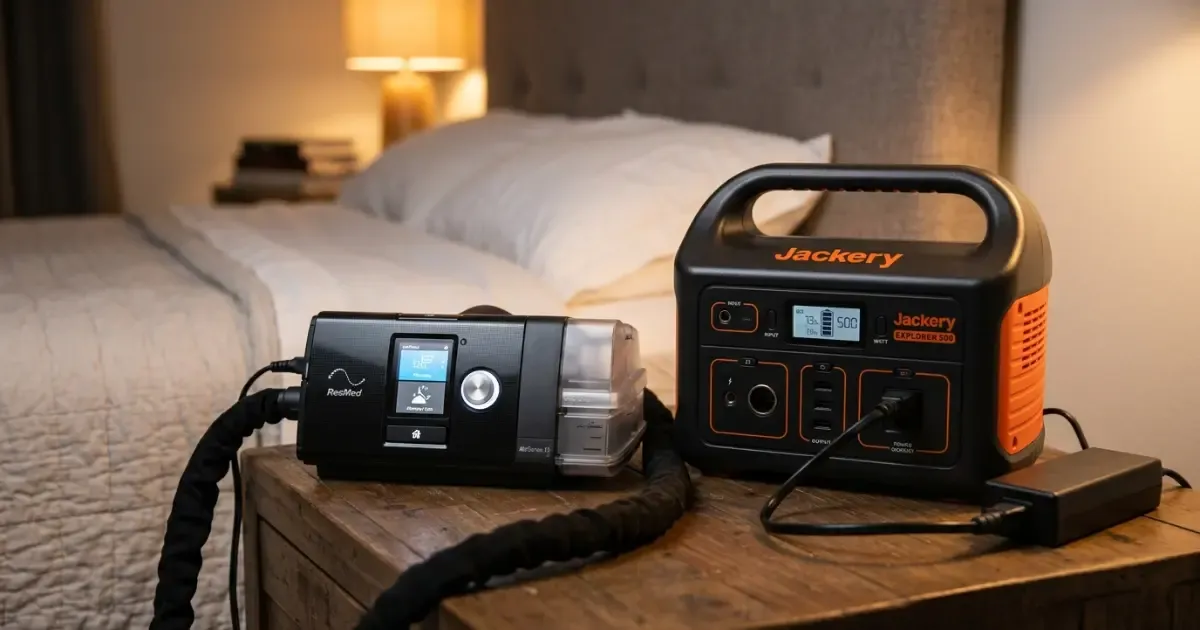
Best Solar Generator for CPAP Machine (2026): Watt Math
This post contains affiliate links. I earn a small commission if you buy through my links, at no extra cost to you. I only recommend gear I have researched in depth: manufacturer specifications, published teardowns, and aggregated owner reports.
A CPAP machine is not optional equipment for the people who use one. If the power goes out at night, the question is simple: will the machine still run at 3 a.m.?
A solar generator (a large portable battery with an AC inverter and optional solar panels) can answer that, but only if it is sized against your machine’s real power draw. This guide shows how to do that math, which two 1,000Wh units fit most households, and where the common advice goes wrong.
This post contains affiliate links. We earn a small commission if you buy through our links, at no extra cost to you. Specifications come from manufacturer pages; runtimes are our own calculations, not overnight lab tests. This is general information, not medical advice. Ask your sleep clinician or equipment supplier about backup power for your therapy.
The 2 Best Solar Generators for CPAP in 2026
| Jackery Explorer 1000 V2 | EcoFlow DELTA 3 Plus | |
|---|---|---|
| Capacity | 1,070Wh | 1,024Wh |
| AC output | 1,500W | 1,800W |
| Weight | 23.8 lb | 27.6 lb |
| Solar input | up to 400W | two 500W inputs |
| Wall recharge | about 1.6 hours | about 56 minutes |
| Expandable | No | Yes, up to 5 kWh |
| Nights at 30W (calculated) | 3.8 | 3.6 |
| Nights at 56W (calculated) | 2.0 | 1.9 |
| Best for | Lighter, simpler home backup | Longer outages, faster recharge |
Nights are calculated as capacity × 0.85 ÷ (average watts × 8 hours). The 0.85 keeps a 15% battery buffer. We have not run either unit overnight with a CPAP ourselves, so treat these as planning figures.
How Much Power Does a CPAP Machine Really Use?
This is where most CPAP-and-solar advice goes wrong, because the number you find depends on where you look.
- The power supply rating is a ceiling, not your draw. The ResMed AirSense 11 ships with a 65W supply. That is the most it can deliver.
- Spec sheets list higher figures. Retailer spec listings for the AirSense 11 show about 56W typical and 73W maximum. Those figures are at the high end and likely include the heated humidifier.
- Owners report far lower draw without heating. With the heated humidifier and heated tube off, owners commonly report single digits to low tens of watts, with around 5 to 8W mentioned for the AirSense 11.
Your machine, pressure setting and humidifier use all change the answer. The reliable method is to plug your CPAP into a plug-in watt meter for one full night, then divide the watt-hours by the night’s hours to get your own average.
What your number means in nights per charge
| Average draw | What it looks like | Jackery 1000 V2 | EcoFlow DELTA 3 Plus |
|---|---|---|---|
| 10W | Machine only, humidifier and heated tube off | 11.4 nights | 10.9 nights |
| 30W | Moderate heating | 3.8 nights | 3.6 nights |
| 56W | Listed typical figure, humidifier on | 2.0 nights | 1.9 nights |
| 73W | Listed maximum, worst case | 1.6 nights | 1.5 nights |
All figures assume 8 hours a night and a 15% buffer. An AC inverter also uses a little power just by being switched on, which matters more at low loads like 10W, so real AC runtimes at the low end will be shorter than the table shows.
The humidifier is the lever
The heated humidifier and heated tubing are the biggest extra draw on most machines. For an outage, switching them off is the single easiest way to stretch your battery. If you need some moisture, a waterless humidifier filter (a heat-and-moisture exchanger) adds no power draw. Running without heated humidification for a few nights is a comfort trade-off, not a risk to the machine, but check your manual and ask your clinician if you are unsure.
#1 Jackery Explorer 1000 V2: Best for Most Households
The Jackery Explorer 1000 V2 is the simpler, lighter choice. At 23.8 lb it is the easier one to move to the bedroom, and its 1,070Wh battery covers about 3.8 nights at a 30W average with a 15% buffer.
- Capacity: 1,070Wh, which is the whole story for CPAP. Output (1,500W) is far more than a CPAP needs, so the extra headroom is for running a fridge or lights alongside it.
- Solar: accepts up to 400W of panels, enough to top up during the day if an outage runs long.
- Battery: LiFePO4 chemistry, which suits nightly cycling.
- Limit to know: it does not expand. If you expect outages of a week or more, a unit that can add battery capacity is a better fit.
#2 EcoFlow DELTA 3 Plus: Best for Longer Outages
The EcoFlow DELTA 3 Plus has about the same capacity (1,024Wh, roughly 3.6 nights at 30W), so for CPAP alone the two are close. It wins on recharge speed and growth.
- Recharge: about 56 minutes from the wall, and two 500W solar inputs for fast daytime top-ups.
- Expandable: extra batteries can take it up to 5 kWh, which turns a few nights into a week or more.
- Output: 1,800W, with X-Boost for resistive loads.
- Cost of that flexibility: it is 3.8 lb heavier than the Jackery.
Read the full EcoFlow DELTA 3 Plus review or the Jackery 1000 V2 review for the details behind these two picks.
DC Cable or AC Outlet?
Your CPAP’s power brick converts wall AC to the DC the machine uses. A solar generator stores DC, converts it up to AC through its inverter, and then your brick converts it back down again. Every step loses some energy, and the inverter also draws power just by being on.
Many CPAP makers sell a DC cable or converter that connects the machine to a 12V or 24V vehicle-style socket. ResMed, for example, sells an AirSense 11 DC/DC converter for 12V or 24V vehicle sockets. Using a DC route can stretch runtime, but by how much depends on your unit and your machine, so we do not quote a percentage.
Before relying on it:
- Use the cable made for your exact model. Do not guess at voltage or connectors.
- Check the DC port’s rating on the power station covers your machine’s maximum draw, not just its average.
- Do a full-night trial while the grid is on. Note the battery percentage at bedtime and at wake-up, and you have a real number for your own setup.
Travelling With a CPAP Battery
A 1,000Wh generator cannot go on a plane. Airline rules generally allow lithium batteries up to 100Wh in carry-on bags, 101 to 160Wh with airline approval, and nothing above 160Wh. Both units above are far over that limit. For flying, you need a CPAP-specific travel battery within the limit, and you should confirm the rules and any medical-device allowances with your airline before the trip.
Emergency Kit for CPAP Users
Power is only part of the plan. Keep spare filters, a hose, distilled water if you use a humidifier, and a printed copy of your prescription settings with your emergency supplies.
⚡ Solar Generator Buyer's Toolkit - $19
The watt-hour math, a DC-vs-AC runtime guide, and a sizing calculator to help you pick the right generator for your CPAP.
Get the Toolkit - $19 →Related Guides
- Best solar generator for medical equipment
- Surge vs running watts explained
- Best solar generator for home backup
- Emergency power at home
Frequently Asked Questions
What is the best solar generator for a CPAP machine? For most households, a 1,000Wh-class unit. The Jackery Explorer 1000 V2 is the lighter, simpler pick, and the EcoFlow DELTA 3 Plus is the better choice for long outages because it recharges faster and can expand.
How long will a solar generator run a CPAP machine? It depends on your machine’s average draw. On a 1,000Wh unit with a 15% buffer and 8 hours of use a night, a 30W average gives about 3.6 to 3.8 nights, a 56W average about 2 nights, and a 10W average more than 10 nights. Measure your own draw with a plug-in watt meter for the most accurate answer.
Can I use a solar generator for my CPAP every night? Yes, these units are built to be charged and used repeatedly, and both use LiFePO4 batteries, which suit regular cycling. For outage planning, recharge from the wall or from solar panels during the day.
Do I need a special cable to run a CPAP on a solar generator? Not strictly, since you can plug the CPAP’s normal power brick into the generator’s AC outlet. A DC cable made for your machine can stretch runtime by avoiding the inverter, but check the voltage, connector and the DC port’s rating first.
Will turning off the humidifier damage my CPAP? No. Running without the heated humidifier is safe for the machine for a few nights. It is a comfort trade-off. If dryness bothers you, ask your clinician about alternatives that do not need power.
What size solar generator do I need for a CPAP machine? Multiply your average watts by 8 hours and divide by 0.85 to get the capacity you need per night, then multiply by the number of nights you want to cover. A 1,000Wh unit covers most machines for two nights or more. Add margin if you also want to run a fridge or lights.
Specifications are the manufacturers’ published figures and can change. Runtimes are calculated, not measured overnight. Last updated October 2026.