Surge Watts vs Running Watts: What Every Homeowner Must Know
This post contains affiliate links. I earn a small commission if you buy through my links, at no extra cost to you. I only recommend gear I have researched in depth: manufacturer specifications, published teardowns, and aggregated owner reports.
If you have ever plugged in a refrigerator and watched a power station shut off, even though it was “big enough” on paper, surge watts is almost always the reason.
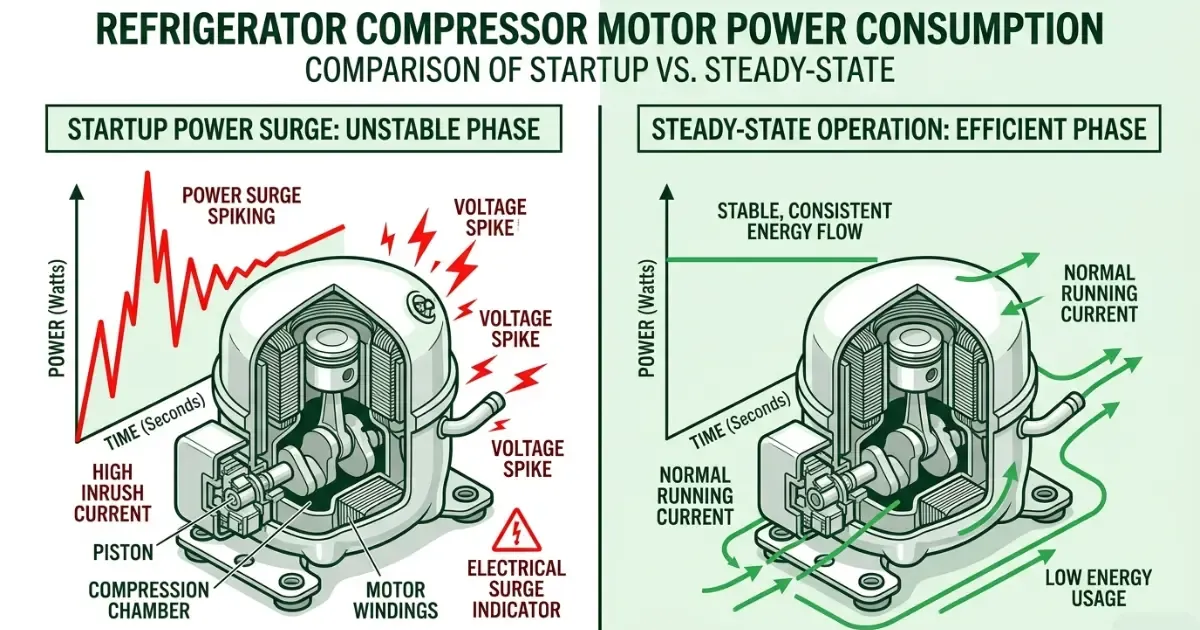
The number on the box is only half the story. A refrigerator or freezer compressor needs a short burst of power to start, far more than it uses while running. This guide explains the difference, how to find your appliance’s real startup number, and how to check a power station against it.
This post contains affiliate links. We earn a small commission if you buy through our links, at no extra cost to you. Specifications come from manufacturer pages and the figures here are calculations, not our own lab tests.
Quick Answer
Running watts is the steady power an appliance draws while it operates. Surge watts (also called starting watts) is the brief burst it needs to start. For refrigerator and freezer compressors the startup burst is commonly 6 to 10 times the running draw, lasting a fraction of a second. If a power station cannot deliver that burst, it trips at the moment the compressor tries to start, even when the running load is small.
What Are Running Watts?
Running watts, also called continuous watts, is the steady draw of an appliance during normal operation. It is the number most labels list, and it is what you use to estimate battery life.
Battery capacity (Wh) × 0.85 ÷ average watts = hours of runtime
The 0.85 keeps a 15% battery buffer. Use the average draw, not the label rating. A compressor only runs part of the time, so a freezer whose label says 172W running can average far less over a day. Our chest freezer wattage chart shows typical averages by size.
What Are Surge Watts?
Electric motors in refrigerators, freezers, air conditioners, well pumps and sump pumps need a burst of power to overcome inertia and start turning. That peak is the surge.
For compressors, the label usually lists it as LRA, locked rotor amps. Multiply LRA by the voltage (about 120 in the US) to get surge watts.
Typical chest freezers draw roughly 70 to 240 watts while the compressor runs, and need roughly 500 to 1,800 watts at startup depending on size. Other motors, such as window air conditioners, well pumps and sump pumps, also have startup spikes that can be several times their running draw. Check the label or the manufacturer’s specification for their LRA or starting watts rather than relying on a rule of thumb.
Why This Catches People Off Guard
Ads lead with the running-watt number. A power station might handle 1,500W continuously but have a surge rating of only 3,000W. Two motors starting at the same moment can add up to more than that. The result is an instant shutdown.
The fix is simple: size to the highest startup demand of any single appliance, then check that the sum of everything running together stays under the continuous rating.
How to Check a Power Station Against Your Appliances
Step 1: List every appliance you want to run during an outage.
Step 2: Find each one’s running watts and, for motors, its LRA or starting watts (label, manual or manufacturer page).
Step 3: Find the appliance with the highest startup demand. Multiply LRA by 120 if only amps are listed.
Step 4: Make sure the power station’s surge rating is at least 20% above that figure.
Step 5: Add up the running watts of everything that will run together. That total must stay under the continuous (AC output) rating.
Step 6: Start big motors one at a time, not all at once.
How the Three Units Compare on Surge
These figures are the manufacturers’ published specifications:
| Jackery Explorer 1000 V2 | EcoFlow DELTA 3 Plus | Bluetti Elite 200 V2 | |
|---|---|---|---|
| Continuous output | 1,500W | 1,800W | 2,600W |
| Surge | 3,000W | 3,600W | No motor surge rating published |
| Resistive loads | Not published | up to 2,200W with X-Boost | up to 3,900W |
| Capacity | 1,070Wh | 1,024Wh | 2,073.6Wh |
Jackery Explorer 1000 V2: 3,000W surge is more than enough for a typical refrigerator or freezer startup. It is the lighter of the three at 23.8 lb.
EcoFlow DELTA 3 Plus: 3,600W surge, the highest published surge of the three. X-Boost lets it run some resistive appliances above its 1,800W rating, up to 2,200W. X-Boost applies to resistive loads such as heaters, not to motors.
Bluetti Elite 200 V2: the largest battery and output, at 2,600W continuous and up to 3,900W for resistive loads. Bluetti does not publish a motor surge rating, so for a motor load plan around the 2,600W continuous figure and check the specification before relying on it for a large pump or air conditioner. The AC200L this guide used to list is discontinued.
Air Conditioners and Well Pumps Need Extra Care
A window air conditioner or well pump can have a startup draw several times its running watts, and they often start while a refrigerator is also cycling. Do not size from a rule of thumb. Read the nameplate for LRA or starting watts, add the loads that could start together, and keep a margin. If the numbers do not clearly fit, choose a larger unit or leave the big motor off the power station.
Who This Matters Most For
🚐 RV owners: rooftop air conditioners have large startup demands. Check the unit's nameplate before you plan around a power station.
👨👩👧 Parents: baby monitors and breast pumps are low-wattage, but a shutdown matters. Check the running watts and keep the unit charged.
🌾 Homesteaders: well pumps are often the biggest startup load. Read the pump nameplate and confirm it is a 120V model.
🔧 DIY builders: power tools with motors can have a high startup draw. Check the tool's rating before running it from a power station.
Don’t Forget Your Emergency Kit
A power station keeps the lights on, but a complete outage plan also covers medication storage, first aid and 72-hour supplies.
The Bottom Line
Surge watts versus running watts is the difference between a power station that works when the grid goes down and one that shuts off the moment your compressor starts.
The rule: find the startup demand of your biggest motor (LRA × 120), make sure the power station’s surge rating clears it by at least 20%, and make sure the running total stays under its continuous rating.
🔋 Solar Generator Buyer's Toolkit — $19
A sizing calculator, an appliance wattage reference sheet and a side-by-side comparison worksheet built from manufacturer specs.
Get the Toolkit — $19 →Frequently Asked Questions
What is the difference between surge watts and running watts? Running watts is the continuous power an appliance needs during normal operation. Surge watts is the brief peak needed at startup. For refrigerator and freezer compressors the startup burst is commonly 6 to 10 times the running draw and lasts a fraction of a second.
Why does my solar generator shut off when I plug in my refrigerator? The refrigerator’s startup surge is probably exceeding the unit’s surge rating, or the combined running load is over its continuous rating. The unit trips as a protective measure. You need a unit whose surge rating clears the appliance’s startup demand.
How do I find the surge watts of my appliance? Check the label or manual for “starting watts,” “peak watts” or LRA (locked rotor amps). Multiply LRA by 120 to get surge watts. If no figure is listed, look up the model’s specification page and keep a generous margin.
Is 1,500W enough for a refrigerator and chest freezer? Often yes for the running load, and the Jackery Explorer 1000 V2 (1,500W, 3,000W surge) can cover typical startups. Check each appliance’s LRA, add the running watts of everything on at once, and start the motors one at a time.
Which solar generator has the best surge capacity? Of the three we compare, the EcoFlow DELTA 3 Plus has the highest published surge at 3,600W. The Bluetti Elite 200 V2 has the highest continuous output at 2,600W but publishes no motor surge rating, so confirm your specific appliance before relying on it for large motors.
Related: Best Solar Generator for Home Backup | Will a 1000W Solar Generator Run a Refrigerator? | What Appliances Can a Solar Generator Run?