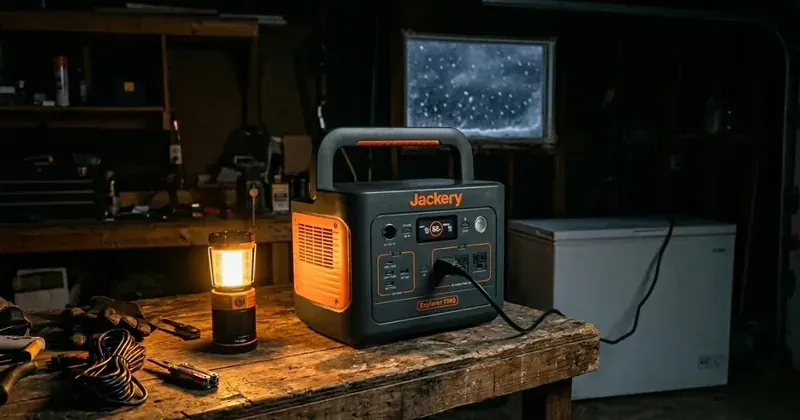
Jackery Explorer 1000 V2 Review: Can It Run a Chest Freezer?
This post contains affiliate links. I earn a small commission if you buy through my links, at no extra cost to you. I only recommend gear I have researched in depth: manufacturer specifications, published teardowns, and aggregated owner reports.
The Jackery Explorer 1000 V2 is a 1,070Wh LiFePO4 power station that is light enough to carry and big enough for a chest freezer or refrigerator through an overnight outage. This review uses Jackery’s published specifications and calculated runtimes. We have not lab-tested the unit, and you will not find invented test results here.
This post contains affiliate links. We earn a small commission if you buy through our links, at no extra cost to you. Specifications come from manufacturer pages and runtimes are calculations, not our own tests.
⚡ Quick Answer: The Jackery Explorer 1000 V2 is a good fit for one chest freezer or one refrigerator, a router, lights and phone charging. It is rated for 1,500W continuous and 3,000W surge, which covers a freezer with an LRA up to about 20 after a 20% margin. It is not expandable and recharges from the wall more slowly than the EcoFlow DELTA 3 Plus. Check current price at Jackery →
📦 Specs at a Glance
| Spec | Jackery Explorer 1000 V2 |
|---|---|
| Battery | 1,070Wh LiFePO4 |
| AC output | 1,500W continuous |
| Surge | 3,000W |
| Weight | 23.8 lb (10.8 kg) |
| Solar input | Up to 400W |
| Wall charge | About 1.6 hours (published figure) |
| Expandable | No |
Figures are Jackery’s published numbers and can change with new production runs. Check the product page before you buy.
🧮 Will It Start Your Freezer? The Surge Math
Find the LRA (locked rotor amps) on the freezer’s data plate. Multiply by 120 for startup watts, then add a 20% margin. Our LRA guide shows where to find it.
Example with a typical value: an LRA of 8.3 gives 8.3 × 120 = about 996W, or roughly 1,195W with margin. That is well under the Jackery’s 3,000W surge rating. The unit’s surge rating allows an LRA up to about 20 (3,000 ÷ 1.2 ÷ 120), so most household chest freezers and refrigerators are in range. Check your own nameplate rather than relying on this example.
⏱️ Calculated Runtimes
We use 85% of capacity as usable energy to allow for inverter losses: 1,070Wh × 0.85 = about 910Wh. Runtime is usable energy divided by average watts.
| Load (average draw) | Estimated runtime |
|---|---|
| Chest freezer, 45W average | about 20 hours |
| Chest freezer, 65W average (warm garage) | about 14 hours |
| Refrigerator, 60W average | about 15 hours |
| Freezer + refrigerator, 90W combined | about 10 hours |
Average draw is lower than the running watts on the nameplate because the compressor cycles on and off. Your appliance may differ, so a plug-in watt meter gives the best number.
☀️ Recharging
Wall: Jackery publishes about 1.6 hours for a wall recharge. That is slower than the EcoFlow DELTA 3 Plus, which matters if the grid only comes back briefly.
Solar: The unit accepts up to 400W of panels. Using our solar rule of thumb (panel watts × peak sun hours × 0.75), 400W of panels with 5 peak sun hours makes about 1,500Wh in a day, which is more than a full recharge in good conditions. Cloud and winter sun cut that sharply, so treat it as a best case. See how to charge a solar generator without sun for backup options.
⚡ Jackery Explorer 1000 V2 vs EcoFlow DELTA 3 Plus
| Feature | Jackery 1000 V2 | EcoFlow DELTA 3 Plus |
|---|---|---|
| Capacity | 1,070Wh | 1,024Wh |
| Continuous output | 1,500W | 1,800W |
| Surge | 3,000W | 3,600W |
| Weight | 23.8 lb | 27.6 lb |
| Wall charge | About 1.6 hours | About 56 minutes |
| Max solar input | 400W | 2 × 500W |
| Expandable | No | Yes, up to 5kWh |
The EcoFlow has more output, faster charging and room to grow. The Jackery is lighter and has slightly more capacity. For one freezer or fridge, both work. Our full head-to-head is here: EcoFlow DELTA 3 Plus vs Jackery 1000 V2.
🚐 RV and Van Use
At 23.8 lb it is easy to move between a garage, kitchen and vehicle. For a rig, 1,500W continuous covers a 12V compressor fridge, lights, a water pump and device charging, and 400W of solar input is a sensible match for roof or portable panels. Our RV guide goes through the sizing.
🏥 CPAP Use
CPAP power draw varies a lot by model and settings, usually between about 10W and 60W or more with a heated humidifier. For the Jackery’s 910Wh of usable energy and an 8-hour night:
| CPAP average draw | Nights per charge |
|---|---|
| 10W | about 11 |
| 30W | about 3.8 |
| 56W | about 2.0 |
| 73W | about 1.6 |
Check your device’s power supply label and manual. Our CPAP guide has airline limits and more detail. For any life-supporting equipment, have a second backup plan and talk to your equipment provider.
👍 What We Like
- LiFePO4 battery is the more durable chemistry for a unit that sits in a garage for years.
- Light for its capacity at 23.8 lb, so you can move it to where the load is.
- 3,000W surge rating gives real headroom for freezer and fridge compressors.
👎 What to Weigh
- Not expandable, so if your needs grow you buy a second unit.
- Slower wall charge than the EcoFlow DELTA 3 Plus.
- 1,500W continuous limits how many large appliances you can run at once.
🎯 Who Should Buy It?
A good fit if: you want to back up one freezer or fridge plus small loads, you value lower weight, and you do not expect to expand later.
Consider the EcoFlow instead if: you want faster charging, more output, or the option to add batteries.
Not sure of your numbers? Use the free Solar Generator Sizing Calculator before buying.
🔋 Solar Generator Buyer's Toolkit — $19
Sizing calculator, appliance wattage reference sheet, and a side-by-side comparison worksheet built from manufacturer specs.
Get the Toolkit — $19 →A power station keeps the lights and fridge on. A kit covers first aid and the basics that batteries cannot.
Shop SurviveX Kits →
❓ Frequently Asked Questions
How long does the Jackery Explorer 1000 V2 last on one charge? It depends on your load. With about 910Wh of usable energy, a chest freezer averaging 45W runs about 20 hours, and a freezer plus refrigerator at 90W combined runs about 10 hours.
Can the Jackery Explorer 1000 V2 run a refrigerator? Usually yes. Multiply the fridge’s LRA by 120 and add 20%, then compare it to the 3,000W surge rating. An LRA up to about 20 fits.
How many solar panels do I need? It accepts up to 400W. With 400W of panels and about 5 peak sun hours you could make roughly 1,500Wh a day in good conditions, more than one full charge. Smaller arrays work, just slower.
Does it work for CPAP machines? Yes, and nights per charge depend on your device: about 11 nights at 10W, about 2 nights at 56W. Check your device’s label.
Will it switch on automatically during an outage? No. It is not a transfer switch, so you plug appliances in yourself. Do not connect it to household wiring without a properly installed transfer switch or interlock.
What happens if an appliance exceeds the surge rating? The unit shuts off its output to protect itself and the appliance loses power until you restart it.
🔗 Related Reading
- EcoFlow DELTA 3 Plus vs Jackery 1000 V2
- What Is LRA on a Freezer?
- Best Solar Generator for RV
- Will a 1000W Solar Generator Run a Refrigerator?
Specifications are the manufacturer’s published figures and can change. Runtimes are calculated, not measured. Last updated October 2026.