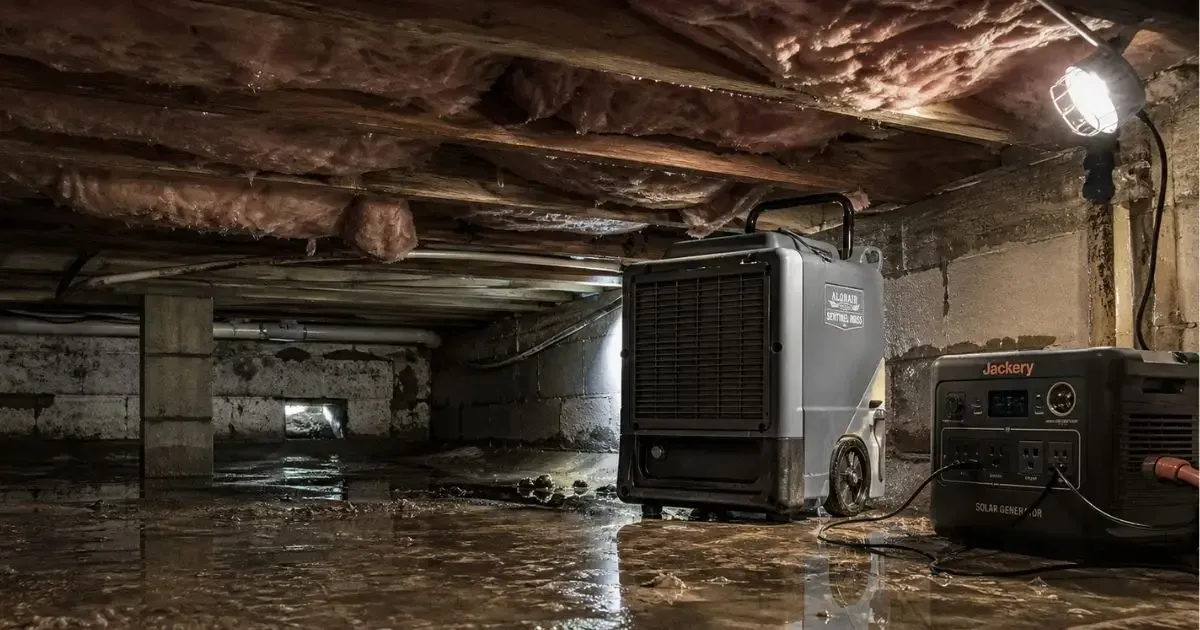
Can a Solar Generator Run a Dehumidifier? (Flood Recovery Math)
This post contains affiliate links. I earn a small commission if you buy through my links, at no extra cost to you. I only recommend gear I have researched in depth: manufacturer specifications, published teardowns, and aggregated owner reports.
Quick Answer: Yes, but not indefinitely. A 70-pint crawl-space dehumidifier drawing about 334W will run roughly 3 hours on a 1,000Wh solar generator or 6 hours on a 2,048Wh unit, before losses. That is not enough to dry a flooded crawl space on its own, but it is enough to run the critical first cycles while you wait for grid power - and in the 24 to 48 hours before mould establishes, those hours matter.
🌊 Why This Question Only Matters After a Storm
Most appliance-and-generator questions are hypothetical. This one is not.
The sequence is always the same. A storm knocks out power. Water gets into the crawl space, the basement, or under the floor. And then nothing happens - because the pumps need power, the fans need power, and the dehumidifier that would normally handle it is sitting dead.
Mould begins establishing on damp organic material within 24 to 48 hours. That is the actual clock. Not the inconvenience of a warm fridge - structural damage that costs thousands to remediate and can affect air quality for years.
So the question is not really “can my solar generator run a dehumidifier.” It is: can I do anything useful in the window before help arrives?
⚡ The Real Numbers
The Argendon Shield 35M is a 70-pint crawl-space unit rated for roughly 1,000 sq ft. Its spec sheet lists 115V at 2.9A.
334W running draw (115 x 2.9).
That is meaningfully lower than the 500 to 700W people assume for a unit this size, and it changes the answer.
| Solar generator capacity | Runtime at 334W | Realistic runtime* |
|---|---|---|
| 500Wh | 1.5 hrs | ~1.2 hrs |
| 1,000Wh | 3.0 hrs | ~2.5 hrs |
| 1,500Wh | 4.5 hrs | ~3.8 hrs |
| 2,074Wh (Bluetti Elite 200 V2) | 6.2 hrs | ~5.3 hrs |
| 3,600Wh | 10.8 hrs | ~9.2 hrs |
*Realistic runtime accounts for roughly 15% inverter loss when running through an AC outlet.
The surge number nobody publishes
Here is where I have to be straight with you: Argendon does not publish a startup surge figure, and neither do most dehumidifier manufacturers.
Compressor-driven appliances typically draw 2 to 3 times their running wattage for a fraction of a second at startup. For a 334W unit that suggests roughly 700 to 1,000W of surge - but that is a category rule of thumb, not a measured figure for this model.
What to do with that: size your generator with at least 1,000W of surge headroom, and call the manufacturer for the real number before you rely on it. Argendon’s support line is 888-770-8483. Any guide that states a precise surge figure for an appliance without citing where it came from is guessing.
Duty cycle: the part that hurts
A fridge cycles on and off, running perhaps 30 to 50% of the time. A dehumidifier in a genuinely wet crawl space runs 60 to 90% of the time - it does not stop until the air reaches its target humidity, and after flooding that takes days.
So unlike a fridge, you cannot assume the compressor rests. Plan for near-continuous draw.
🔧 What This Actually Means for Flood Recovery
Being honest: a portable solar generator will not dry out a flooded crawl space. Full remediation runs days of continuous operation, and that means grid power or a fuel generator.
What it does buy you:
- The first cycles. Getting a dehumidifier running within hours instead of days meaningfully slows mould establishment.
- Solar recharging. With 400W of panels in good sun you harvest roughly 1,500Wh per day - close to 4 more hours of runtime, repeated daily. That turns a one-shot battery into a limited but renewable cycle.
- Targeted drying. Running it in the wettest zone for a few hours a day beats nothing across the whole space.
- A pump-and-dry rotation. Most people need the generator for a sump pump too. Alternating pump and dehumidifier on one unit is a realistic strategy.
If you want the full outage playbook this fits into, the 72-hour power outage survival guide covers the room-by-room sequence, and the hurricane preparedness checklist covers what to have in place before the storm rather than after.
🕐 The Clock That Actually Matters
Mould begins establishing on wet building materials within 24 to 48 hours, according to EPA and FEMA flood guidance. Not weeks. Two days.
That window is why flood drying is urgent in a way most homeowners underestimate. Once mould takes hold in drywall, insulation or subfloor, you are no longer drying a space - you are removing material.
The target is relative humidity below 50%. Above 60%, growth continues. Between those two numbers is where every decision below sits.
🚪 Hour One: Before Power Even Matters
The first hour has nothing to do with your generator.
- Get standing water out. A dehumidifier removes moisture from air, not puddles. Pump, shop-vac or bucket - whatever you have.
- Open everything. Doors, vents, crawl space access, cabinet doors. Trapped air stays saturated.
- Pull up what is soaked. Wet carpet, padding and cardboard hold water against the floor and will not dry in place.
- Start airflow immediately, even before dehumidification.
None of this needs electricity except the last step, and that step is far cheaper than most people assume.
💨 Airflow Does Half the Job at a Tenth of the Cost
This is the part that changes the power equation.
A dehumidifier pulls moisture out of air. A fan moves saturated air away from wet surfaces so more moisture can evaporate into it. Neither works well alone. Run a dehumidifier in a still room and it dries the air near itself while the far corner stays wet.
The cost difference is dramatic:
| Equipment | Power draw | Job it does |
|---|---|---|
| Box fan | 40-75W | Moves saturated air off wet surfaces |
| Air mover / carpet blower | 150-250W | Directed high-velocity drying |
| Argendon Shield 35M dehumidifier | 334W | Removes moisture from the air itself |
| Refrigerator (average, 40% duty cycle) | ~60W | Keeps food safe |
On limited power, fans are the highest-value watts you can spend. Two box fans running continuously cost less than a quarter of one dehumidifier and prevent the stagnant pockets where mould starts.
⚖️ Power Triage: What to Run When You Cannot Run Everything
This is the question nobody answers, and after a flood with the grid down it is the only question that matters.
Assume a 2,000Wh battery, roughly 85% usable after inverter losses:
| What you run | Combined draw | Realistic runtime |
|---|---|---|
| Two box fans only | ~100W | ~17 hours |
| Fridge only | ~60W average | ~28 hours |
| Dehumidifier only | 334W | ~5 hours |
| Fridge + two fans | ~160W | ~10.6 hours |
| Dehumidifier + fridge | ~394W | ~4.3 hours |
| Everything together | ~494W | ~3.4 hours |
The honest conclusion: on battery alone you cannot run a dehumidifier continuously and keep a fridge cold. Something has to give.
The order that makes sense for most households:
- Fans first. Cheapest watts, prevents the worst mould outcomes, runs almost a full day.
- Fridge second, in cycles. A closed fridge holds safe temperature roughly 4 hours unpowered, so run it in bursts rather than continuously.
- Dehumidifier in short cycles when the other two allow, or once grid power returns.
Full remediation of a flooded space needs days of continuous dehumidifier operation. Battery backup buys you the critical first hours and slows the damage. It does not replace grid power for the actual drying job - and anyone telling you otherwise is selling something.
🛒 Which Dehumidifier for This Job
For crawl-space and flood recovery on battery power, the deciding factor is efficiency, not capacity. A bigger unit dries faster but drains your generator proportionally faster. A unit that pulls less per pint removed is worth more when your energy is finite.
Argendon Shield 35M - the sensible starting point
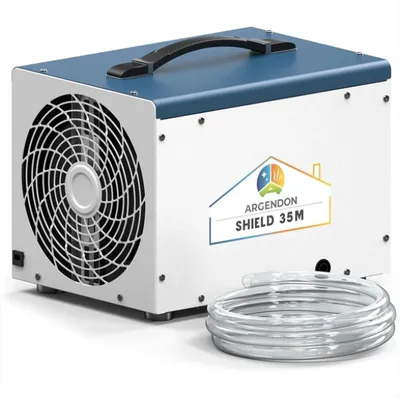
Argendon Shield 35M
70-pint capacity · 334W running draw · up to 1,000 sq ft · 39.7 lbs
Rated to operate down to 33°F, where most consumer dehumidifiers stop working around 41°F. That matters in an unheated crawl space.
70-pint capacity, roughly 1,000 sq ft coverage, 334W draw. This is the size where solar backup remains practical: about 3 hours from a 1,000Wh unit, 6 from a 2,048Wh one. Built for crawl-space conditions rather than a living-room unit pressed into service.
Argendon reader discounts
Sitewide: PRELUV for 5% off anything
Shield 35M specifically: AW35M for 3% off
Use PRELUV for the better saving on the Shield 35M. Codes provided by Argendon for Eco Living Journey readers.
Argendon Guardian 85P - when the space is bigger
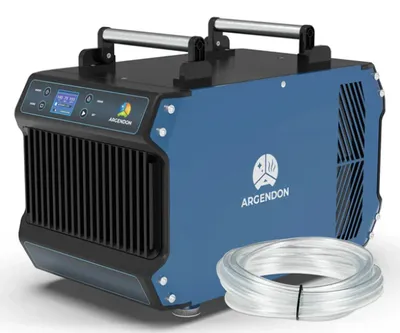
Argendon Guardian 85P
180-pint capacity · 610W running draw · up to 2,300 sq ft · 57.3 lbs
610W continuous puts this firmly in grid-power territory. Realistic for restoration work, not for battery backup.
180-pint commercial unit. Considerably more capacity, and considerably more draw - realistically this is a grid-power or fuel-generator appliance, not something you run meaningfully from a portable battery. Worth it if your space demands it; understand that battery backup becomes a token gesture at this size.
🔌 Sizing the Generator Side
To run a 334W dehumidifier you need a unit that clears three bars:
- Continuous output above 400W - nearly all units qualify
- Surge headroom of 1,000W or more - this is the one that trips people
- Capacity that matches your needed runtime - see the table above
Pure sine wave output matters here too; compressors run hot and inefficient on modified sine, and cheap units still ship with it. For the full breakdown of how surge headroom actually works, see surge watts vs running watts - it is the single most misunderstood spec in backup power, and it is why generators trip on appliances they should handle.
🌀 The flooding is the second problem. The plan is the first.
Water in the crawl space is what you deal with after the storm. What you do in the 48 hours before it decides how bad that gets - which pumps are staged, what is charged, and who does what. Our 72-Hour Kit is the printable version of that plan: power, water, food, medical, hour by hour.
72-Hour Power Outage Survival Kit — $27
Get the 72-Hour Kit →A dehumidifier is the hardest load in flood recovery
334W continuous with no cycling is brutal on battery backup. If you are sizing a unit that has to handle this plus a fridge, the surge math matters more than capacity.
What a portable unit can actually run →
Surge vs running watts → · Best units under $1,000 → · Full hurricane prep guide →
❓ Frequently Asked Questions
How many watts does a crawl space dehumidifier use?
A 70-pint crawl-space dehumidifier such as the Argendon Shield 35M draws approximately 334W running, calculated from its rated 115V at 2.9A. Larger commercial units of 180 pints draw considerably more. Startup surge is typically 2 to 3 times running wattage, though most manufacturers do not publish this figure.
Can a 1000W solar generator run a dehumidifier?
Yes, for roughly 2.5 to 3 hours accounting for inverter loss. A 1,000W continuous rating comfortably handles the 334W running draw; the limiting factor is stored capacity, not output. Confirm the unit also offers at least 1,000W surge capability.
How long does a solar generator run a dehumidifier?
Divide usable capacity by running watts and subtract roughly 15% for inverter loss. At 334W: about 2.5 hours from 1,000Wh, 5.2 hours from 2,048Wh, and 9.2 hours from 3,600Wh. Unlike a refrigerator, a dehumidifier in wet conditions runs 60 to 90% of the time rather than cycling off, so treat draw as near-continuous.
Is it worth running a dehumidifier after a flood if I only have battery power?
Yes, within limits. Mould begins establishing within 24 to 48 hours, so early partial drying is materially better than none. A portable generator will not complete remediation, but running the wettest zone for a few hours daily, recharged by solar, slows damage while you wait for grid power.
What size solar generator do I need for flood recovery?
For meaningful dehumidifier runtime, 2,000Wh or more paired with at least 400W of solar. That combination gives roughly 5 hours of runtime per charge plus about 4 hours of daily solar recovery. Below 1,000Wh you get a single short cycle and little else.
Wattage figures are calculated from manufacturer-published voltage and current ratings and cross-checked against aggregated owner reports. Surge estimates are category rules of thumb, not measured figures for a specific model - confirm with the manufacturer before relying on them. Researched and compiled by Ethan Reynolds at ecoliving-journey.com. Affiliate-supported; independently researched. Last updated August 2026.