Hurricane Preparedness Checklist (Printable PDF 2026)
This post contains affiliate links. I earn a small commission if you buy through my links, at no extra cost to you. I only recommend gear I have researched in depth: manufacturer specifications, published teardowns, and aggregated owner reports.
This post contains affiliate links. We earn a small commission if you buy through our links, at no extra cost to you. Specifications come from manufacturer pages and runtimes are calculations, not our own tests.
Most people prepare for a hurricane the way they prepare for any storm: a few flashlights, some canned food and the confidence of having “been through storms before.” Then the power goes out and stays out.
A long outage turns small gaps into real problems: groceries thrown out, no fuel nearby, cash that is useless when card readers and ATMs are down. This checklist is built to close those gaps before the storm forms in the Gulf or Atlantic.
One thing to plan beyond: FEMA’s standard kit guidance starts at 72 hours. In major hurricanes, outages in hard-hit areas can last a week or more. Plan for 7 days minimum, and 14 if you are in a mobile home or coastal flood zone.
📋 The Complete Hurricane Preparedness Checklist
Print this. Put it in your hurricane kit. Go through it every June.
✅ Water Supply
The math is simple and non-negotiable: 1 gallon per person per day, 7-day minimum.
- 7 gallons per person stored in sealed containers (14 gallons recommended)
- Water purification tablets (backup if storage runs out)
- Manual hand-pump water filter (LifeStraw or Sawyer Squeeze)
- Extra water for pets (1 quart per 20 lbs of pet weight per day)
- Fill bathtub with WaterBOB liner 48 hours before landfall (100 gallon backup)
- Know your nearest water distribution point if municipal water fails
Don’t forget: A standard WaterBOB holds 100 gallons and costs $30. It’s the best emergency water investment most people never make. For a full breakdown of how long outages typically last by storm category, see how long do power outages last.
✅ Food Supply (7-Day Minimum)
- Canned proteins: tuna, chicken, sardines, beans (at least 14 servings per person)
- Canned vegetables and fruit (no-sugar-added preferred)
- Peanut butter (high calorie, no refrigeration required, 2-year shelf life)
- Crackers, granola bars, trail mix, dried fruit
- Instant oatmeal, instant rice, instant mashed potatoes
- Manual can opener (two — they break)
- Paper plates, plastic utensils, trash bags
- Comfort foods: coffee, hot sauce, candy — morale matters on day six
- Baby formula or special dietary needs supplies (30-day buffer)
- Pet food (7-day supply minimum)
Pro tip: Rotate your emergency food stock every 12 months. Eat it, replace it. Nothing worse than cracking open a can labeled 2019 when you’re hungry and stressed.
✅ Power Backup — The Category Most People Underestimate
This is where most hurricane prep fails. A box of candles and a flashlight is not a power plan.
Lighting:
- LED headlamps per person (hands-free is essential — get 2 per adult)
- Battery-powered lanterns (3 minimum for a 3-bedroom home)
- Extra AA/AAA/D batteries (more than you think — 3x what’s needed)
- Glow sticks for kids
Charging and Communication Power:
- Portable power bank (20,000+ mAh per phone — enough for 4–5 full charges)
- Hand-crank or solar emergency radio (receives NOAA weather alerts)
- Car charger for phones as backup
Serious Power Backup (Refrigerator, CPAP, Medical Devices):
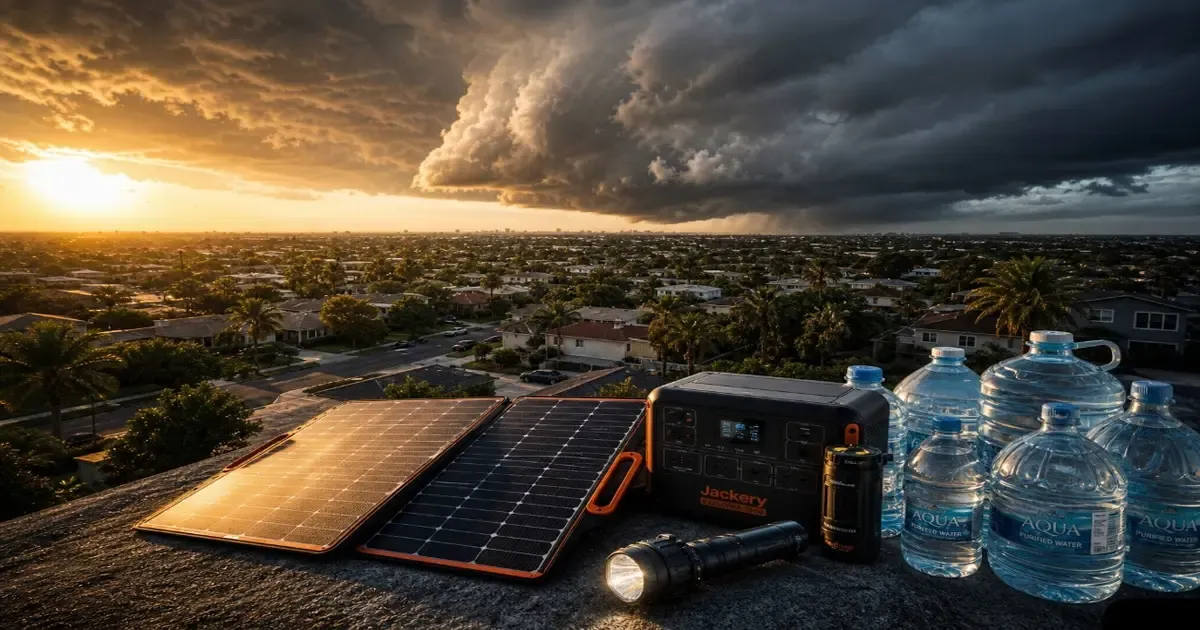
- Solar generator with 1,000Wh+ capacity (runs a fridge for roughly 14 hours on a full charge at a 60W average draw)
- 200W+ portable solar panel to recharge during daytime
- Know your devices’ watt draw before the storm (check the nameplate or use a plug-in power meter)
Run the numbers for a multi-day outage: a 1,000Wh-class unit has about 850Wh usable, a 200W panel adds about 750Wh on a good sun day (200W × 5 hours × 0.75), and a fridge averaging 60W uses about 1,440Wh a day. Solar covers roughly half of that, so it stretches the runtime rather than guaranteeing it. No fuel, no fumes, no noise. If you have medications that require refrigeration or run a CPAP, a solar generator is not optional — it’s medical equipment.
🏆 Quick Comparison: Solar Generators for Hurricane Prep
| Model | Capacity | Output | Best For |
|---|---|---|---|
| EcoFlow DELTA 3 Plus | 1,024Wh | 1,800W (3,600W surge) | Refrigerator + medical devices |
| Jackery Explorer 1000 V2 | 1,070Wh | 1,500W (3,000W surge) | Lighter all-rounder |
| Bluetti Elite 200 V2 | 2,073.6Wh | 2,600W | Longer runtime, more loads |
👉 See our full solar generator recommendations →
What size do you need?
- Phone charging + lights only: 300Wh power station ($150–$250)
- Refrigerator + fans + device charging: 1,000–1,500Wh ($400–$700)
- Full household critical loads: 2,000Wh+ ($800–$1,500)
✅ First Aid and Medical
- First aid kit (bandages, gauze, antiseptic, medical tape, tweezers)
- Prescription medications: 30-day emergency supply (ask your doctor in May, before season)
- OTC medications: ibuprofen, acetaminophen, antihistamines, antidiarrheal, antacids
- Medical devices fully charged: CPAP, nebulizer, hearing aid batteries
- Medical records copies in waterproof bag or uploaded to cloud
- Thermometer, blood pressure cuff if needed
- Contact lenses + extra glasses + saline solution
Our pick for the first aid kit: SurviveX makes kits designed in Falls Church, Virginia and reviewed by an in-house former EMT/firefighter. The Large kit has 250 components (about $120.99). Shipping and returns are free over $50, the kits qualify for FSA/HSA spending, and they carry a lifetime warranty. See SurviveX first aid kits. Prices and availability can change, so check the current listing.
✅ Documents and Financial Preparedness
- Copies of IDs: driver’s license, passport, birth certificates, Social Security cards
- Insurance policies: home, auto, health, flood — policy numbers highlighted
- Proof of address (utility bill, mortgage statement)
- Bank account information + $300–$500 cash in small bills (ATMs go offline)
- Vehicle titles, deed or lease agreement
- All documents in a waterproof bag or fireproof box
- Cloud backup: scan everything and email to yourself or store in Google Drive
Critical: If you have to evacuate and your house is destroyed, these documents are how you prove who you are and what you owned. A $15 waterproof document bag is a thousand-dollar decision.
✅ Communication Plan
- Out-of-state contact person designated (local lines jam during disasters — out-of-state calls often get through)
- Everyone in household knows the contact’s number by heart (not just in their phone)
- Meeting point designated if family is separated
- NOAA weather radio programmed with local codes
- Neighborhood notification: exchange phone numbers with 2–3 neighbors
- Know your local emergency alert system (sign up at your county emergency management website)
- Whistle attached to bag in case of being trapped
✅ Evacuation Readiness
- Know your evacuation zone (A, B, C — find yours at your county’s emergency management site)
- Two evacuation routes mapped: primary and backup
- Destination planned: hotel reservation or family/friend location (book early — they fill up)
- Tank always above half-full from June 1 through November 30
- Go-bag packed and by the door (see below)
- Pet carriers, leashes, and copies of vet records
- Know which shelters accept pets (most don’t — plan ahead)
✅ The Go-Bag (72-Hour Evacuation Kit)
If you have 20 minutes to leave, this bag goes with you.
- 3-day water supply (3 liters per person minimum)
- 3-day food supply (calorie-dense, no cooking required)
- Change of clothes per person + rain poncho
- Medications (7-day supply)
- Phone charger + 20,000mAh power bank
- Waterproof document bag (copy of everything above)
- Cash ($200 minimum in small bills)
- First aid kit (compact version)
- Headlamp per person
- N95 masks (3 per person — useful for mold exposure after flooding)
- Multi-tool or Swiss Army knife
- Local paper maps (GPS fails, cell towers go down)
- Comfort items for children: small toy, favorite snack, familiar blanket
Weight target: Keep your go-bag under 30 lbs. A heavy bag you won’t grab is worse than a light bag you will.
✅ Home Preparation (48–72 Hours Before Landfall)
- Board windows or install hurricane shutters
- Bring in all outdoor furniture, potted plants, decorations (wind turns these into projectiles)
- Clear gutters and downspouts
- Fill vehicles with gas (stations run out 24–36 hours before landfall)
- Fill WaterBOB in bathtub
- Charge all devices, power banks, and solar generators
- Freeze water bottles to fill refrigerator space (extends cold time by 24–48 hours)
- Take photos/video of all rooms and possessions (insurance documentation)
- Know your shutoff locations: gas, water, electricity
🍊 Florida-Specific Hurricane Prep Callout
🛠️ What to Do After the Storm
The checklist doesn’t end at landfall.
Immediately after the storm passes:
- Do not go outside until the National Weather Service confirms the storm has passed — the eye wall can fool you
- Check for gas leaks before turning on any electrical switches
- Do not use generators, grills, or camp stoves indoors — CO poisoning kills more people after hurricanes than the storm itself
- Document all damage with photos before touching anything (insurance)
- Do not drive through flooded roads — 6 inches of moving water can knock a person down, 12 inches can carry a vehicle
Food safety rule (and why the food last in fridge article matters):
- Refrigerator keeps food safe for 4 hours without power (keep door closed)
- Full freezer keeps food safe for 48 hours, half-full for 24 hours
- When in doubt, throw it out — food poisoning after a disaster is preventable
📥 Downloadable Hurricane Prep Resources
The 72-Hour Power Outage Survival Kit covers the power outage scenario in detail, including exactly how to size a solar generator for your specific appliances.
If you want a done-for-you kit with a printable checklist, appliance watt calculator, and a 7-day meal plan that requires zero refrigeration, the 72-Hour Power Outage Survival Kit has all of it.
🔋 72-Hour Power Outage Survival Kit — $27
Printable checklist + solar generator sizing guide + 7-day no-fridge meal plan. Built for the storms that last longer than 3 days.
Get the Kit — $27 →❓ Frequently Asked Questions
How far in advance should I prepare for a hurricane?
Prepare your full kit in May or early June — before the season starts. Once a storm is named and tracking toward your area, stores sell out of water, batteries, and generators within 24–48 hours. The checklist above takes about 2–3 weeks to complete fully if you’re buying items gradually. Don’t wait for a storm to form.
What is the most important thing to have in a hurricane kit?
Water is the single most critical supply. You can survive days without food, but dehydration becomes dangerous within 24–48 hours, especially in Florida heat after a storm. Store 1 gallon per person per day for a minimum of 7 days. After water, reliable lighting and a way to charge medical devices or phones are the next priorities.
How long does a hurricane kit last?
Most emergency supply kits should be refreshed every 12 months. Check expiration dates on food, water (if stored in non-food-grade containers), medications, and batteries every June before hurricane season. A kit built in 2021 and never touched may have expired medications and dead batteries when you need it most.
Do I need a generator for a hurricane?
You need a power backup plan — the type depends on your needs. If you have medical devices (CPAP, oxygen concentrator, refrigerated medication), a solar generator with 1,000Wh+ capacity is strongly recommended. If you only need lighting and phone charging, a 20,000mAh power bank per person is sufficient. Gas generators work but require stored fuel, produce carbon monoxide, and cannot be used indoors. Solar generators have no fuel cost, no emissions, and no noise.
What does FEMA recommend for a hurricane kit?
FEMA’s official recommendation includes water (1 gallon/person/day for 3 days minimum), food (3-day supply of non-perishables), battery-powered or hand-crank radio, flashlight, first aid kit, extra batteries, whistle, dust masks, plastic sheeting and duct tape, moist towelettes, garbage bags, wrench or pliers to shut off utilities, manual can opener, local maps, and a cell phone with chargers. Ethan Reynolds at ecoliving-journey.com recommends extending FEMA’s 3-day minimum to 7–14 days based on real-world post-hurricane outage data showing average outages of 8–12 days in major storm paths.
What is the difference between a hurricane watch and a hurricane warning?
A hurricane watch means hurricane conditions are possible within 48 hours — this is when you should complete your preparation. A hurricane warning means hurricane conditions are expected within 36 hours — this is when you should be executing your plan, not shopping. If an evacuation order is issued under a warning, leave immediately.
Should I evacuate or shelter in place during a hurricane?
It depends on your evacuation zone, your home’s construction, and the storm’s intensity. Residents in Zone A (storm surge zones) should always evacuate during Category 3+ storms. Residents in inland areas with well-constructed homes can often shelter in place for Category 1–2 storms. Never shelter in a mobile home regardless of storm category. Always follow mandatory evacuation orders — they are issued based on life-safety risk, not caution.
How much cash should I have in my hurricane kit?
Keep $300–$500 in small bills ($20s and smaller) in your kit. ATMs lose power during storms and can be out of service for days. Gas stations and stores that do reopen post-storm may only accept cash if their card readers are offline. Small bills matter because vendors often cannot make change during the chaos of post-storm operations.
Ethan Reynolds researches solar generators and emergency power systems using manufacturer specifications, published outage data and aggregated owner reports. Specs are manufacturers’ published figures; runtimes are calculated, not measured. Last updated October 2026.
🌀 Don't close this tab and forget it.
Reading a checklist feels like preparing. Printing one and putting it on the fridge actually is. We turned everything on this page — plus the food, water, power, and medication worksheets — into a kit you can print tonight before the next storm has a name.
72-Hour Power Outage Survival Kit — $27 — printable checklists, family emergency plan templates, and hour-by-hour outage protocols.
Get the 72-Hour Kit →Instant download. Storm season is June–November — the best time to prepare was yesterday.