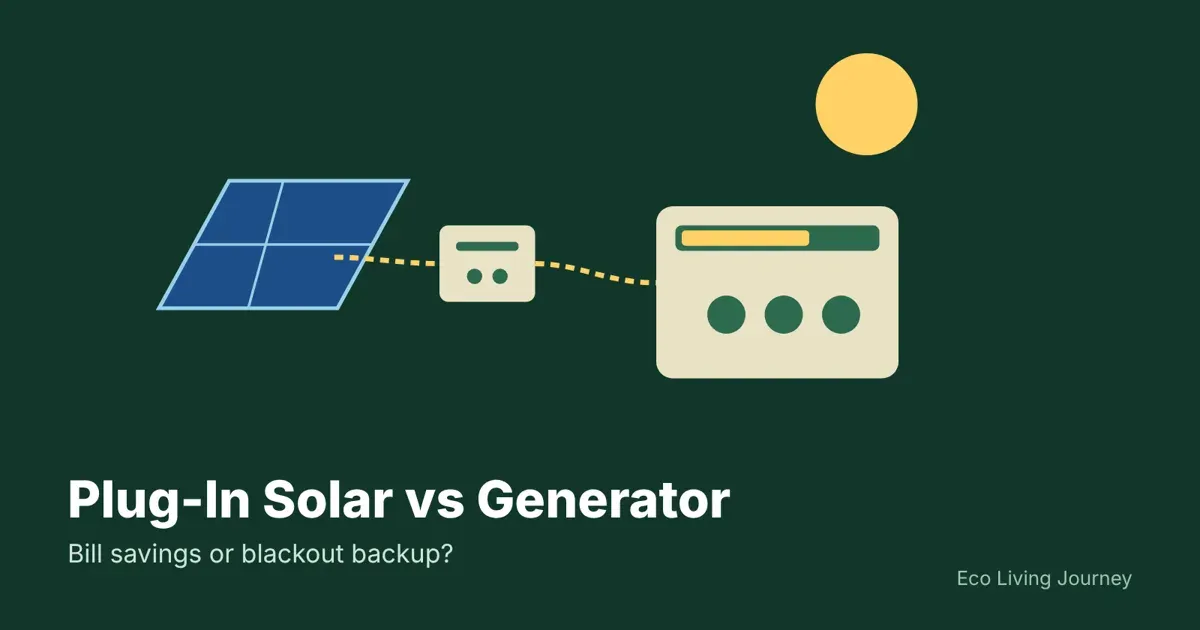
Plug-In Solar Panels vs a Solar Generator: Which Fits Your Home?
This post contains affiliate links. I earn a small commission if you buy through my links, at no extra cost to you. I only recommend gear I have researched in depth: manufacturer specifications, published teardowns, and aggregated owner reports.
Plug-in solar panels lower your electric bill but do nothing for you in a blackout. A solar generator (power station plus panels) costs you more per kWh but keeps your fridge and phone running when the grid is down. They solve different problems, so the right choice depends on whether you want savings or backup.
How the numbers work: wattages are typical ranges from manufacturer spec sheets and efficiency labels, so check the label on your own appliance. Runtimes are calculated, not lab-tested: usable energy = rated Wh × 0.85, divided by average watts.
⚡ Quick Answer
| Plug-in (balcony) solar | Solar generator | |
|---|---|---|
| What it is | Panels and a microinverter that feed power into a wall outlet | Panels charging a battery power station |
| Main job | Cut grid use during the day | Backup power and portable power |
| Works in a blackout? | Normally no. Grid-tied inverters shut off when the grid goes down | Yes. Runs from stored energy |
| Stores energy? | No | Yes |
| Legal to use? | Depends on state and utility. Utah has a specific law; many other states are still considering bills | Yes, no grid connection involved |
| Best for | Renters and homeowners wanting small bill savings | Outage prep, RV, camping, cabins |
🔌 What Is Plug-In Solar?
Plug-in solar (also called balcony solar) is a small kit, usually one to four panels and a microinverter, that you connect to a standard 120V outlet. The solar power flows into your home wiring and offsets what your appliances would otherwise take from the grid. It is common in Germany, where more than one million registered systems are in use, according to a policy summary from the National Caucus of Environmental Legislators (NCEL).
In the US, the rules are still catching up:
- Utah passed H.B. 340 in 2025, creating a legal category for plug-in systems up to 1,200W. According to EcoFlow’s explainer on the law, the microinverter must be UL 1741 compliant and components must carry UL or equivalent certification.
- Other states had bills in progress (for example Virginia and Oregon) at the time of the sources we read, and more than half of states had introduced bills. Status changes quickly, so check your state and your utility before buying.
Not legal advice: this page is general information. Ask your utility, landlord or local electrician before connecting anything to your wiring.
🌑 Why Plug-In Solar Shuts Off in a Blackout
Grid-tied inverters are built to stop sending power when the grid is down, so line workers are not exposed to power coming back through the wires. The same rule is why a plain plug-in kit cannot keep your fridge running in an outage. EcoFlow’s Utah page says the same: plug-and-play systems can’t replace whole-home backup. If you want backup too, you need a battery or a power station.
💰 How Much Could Plug-In Solar Save?
A rough calculation, using our assumptions (not a manufacturer claim):
- 400W of panels × 4 sun hours × 0.75 real-world factor = 1.2 kWh a day, about 36 kWh a month.
- At an assumed electricity price of $0.17 per kWh, that is about $6 a month.
- With 800W (the practical size for two to four panels) double those numbers, about $12 a month, if you can use all of it while it is produced.
So plug-in solar is a small saver, not a way to eliminate a bill. Your actual rate, your sun hours and how much power your home uses at midday all change the result.
🔋 What a Solar Generator Does Instead
A solar generator connects panels directly to a battery power station. It does not feed the grid. It stores energy and powers what you plug into it, which is why it works in an outage. For how long that lasts, see how long a solar generator lasts, and for how many panels refill a unit, see the panel sizing guide.
Quick picks
If your goal is backup power you can use during an outage, a power station beats a plug-in kit. Both units below accept solar panels, so you can add panels later.
Bluetti Elite 200 V2 (2,073.6Wh, 2,600W): longest runtime of the three in this guide. Check Bluetti Elite 200 V2 Price
Jackery Explorer 1000 V2 (1,070Wh, 1,500W, 3,000W surge): lighter and cheaper. Check Jackery Explorer 1000 V2 Price
🧭 Which One Should You Buy?
- You want lower bills and live where plug-in solar is allowed: plug-in solar, with a certified kit and your utility’s approval where required.
- You want your fridge, router and phones running in an outage: a solar generator. See what appliances a solar generator can run.
- You rent and cannot modify wiring: a solar generator, since it does not connect to your home wiring at all.
- You want both: they do not conflict. Many people start with a power station for outages and add a plug-in kit later if their state allows it.
✅ Bottom Line
Plug-in solar is for savings, a solar generator is for resilience. If outages are what worry you, spend the money on the power station first.
A first aid kit belongs next to your backup power. SurviveX kits are designed in Falls Church, VA, reviewed in-house by a former EMT/firefighter, qualify for FSA/HSA spending, carry a lifetime warranty, and ship free over $50 (per survive-x.com). See SurviveX First Aid Kits
🔗 Related Guides
- How many solar panels to recharge a power station
- Solar generators explained
- What appliances can a solar generator run?
- Can you plug a power station into a wall outlet?
- Best solar generator 2026
- Solar generator for whole house
❓ Frequently Asked Questions
Does plug-in solar work during a power outage?
Normally no. Grid-tied microinverters shut off when the grid is down for safety. To have power in an outage you need a battery or a power station.
Is plug-in solar legal in the US?
It depends on your state and utility. Utah passed H.B. 340 in 2025 allowing plug-in systems up to 1,200W, and other states have bills in progress. Check your state and utility before buying, and this is not legal advice.
How much can a plug-in solar kit save?
By our estimate, a 400W kit makes about 1.2 kWh on a decent day, roughly $6 a month at $0.17 per kWh. Your rate and sun hours will change that.
Can I plug solar panels into a power station instead?
Yes. Power stations have a solar input and charge from panels directly. They do not push power into your home wiring.
Do I need a permit for a solar generator?
A portable solar generator does not connect to your home’s electrical system, so it generally does not need a grid-connection permit. Local rules for fixed installations differ.