How Long Does a Solar Generator Last? (Real Answer)
This post contains affiliate links. I earn a small commission if you buy through my links, at no extra cost to you. I only recommend gear I have researched in depth: manufacturer specifications, published teardowns, and aggregated owner reports.
The most honest answer I can give you is this: the solar generator itself will outlast the battery by a decade.
This post contains affiliate links. I earn a small commission if you buy through my links, at no extra cost to you. I only recommend gear I have researched in depth: manufacturer specifications, published teardowns, and aggregated owner reports.
The electronics, the inverter, the charge controller, the ports — these components last 15-20 years with normal use. What actually limits your solar generator’s lifespan is the battery inside it. And the battery’s lifespan depends almost entirely on what chemistry it uses and how you treat it.
Here is what manufacturer ratings and battery chemistry say about how long these units last, and what you can do to push yours toward the long end of its lifespan.
Who This Guide Helps
- 🏠 Homeowners — calculating ROI before buying backup power
- 🚐 RV owners — understanding how daily use affects battery life
- 🌱 Homesteaders — planning a long-term off-grid power investment
- 🧑🔧 DIY builders — comparing battery chemistries for custom systems
- 👪 Parents — deciding if a solar generator is worth the upfront cost
- 🌀 Hurricane zone residents — assessing long-term value vs annual storm risk
Battery Chemistry Determines Everything
The single most important spec when evaluating solar generator lifespan is battery chemistry. Everything else is secondary.
LiFePO4 vs NMC lithium-ion lifespan comparison
| LiFePO4 | NMC Lithium-Ion | |
|---|---|---|
| Cycle life | 3,000–6,000 cycles | 500–1,000 cycles |
| Years at 1 cycle/day | 8–16 years | 1.4–2.7 years |
| Years at 1 cycle/week | 57–115 years | 9–19 years |
| Capacity at end of life | 80% retained | 70–80% retained |
| Temperature sensitivity | Low | High |
| Safety | Very stable | Less stable at high temps |
| Cost | Higher upfront | Lower upfront |
| Best for | Daily/frequent use | Occasional use |
What “cycle” actually means
One charge cycle = one full discharge from 100% to 0% and back to 100%. In practice most people do partial cycles — charging from 40% to 80%, for example. Battery manufacturers count cumulative depth: two charges from 50% to 100% equal one full cycle.
The practical implication: If you only use your solar generator during power outages — maybe 3-5 times per year — a LiFePO4 unit rated for 3,000 cycles will last 600-1,000 years mathematically. The real lifespan limit becomes calendar aging, not cycle aging.
How Long Each Major Brand Lasts
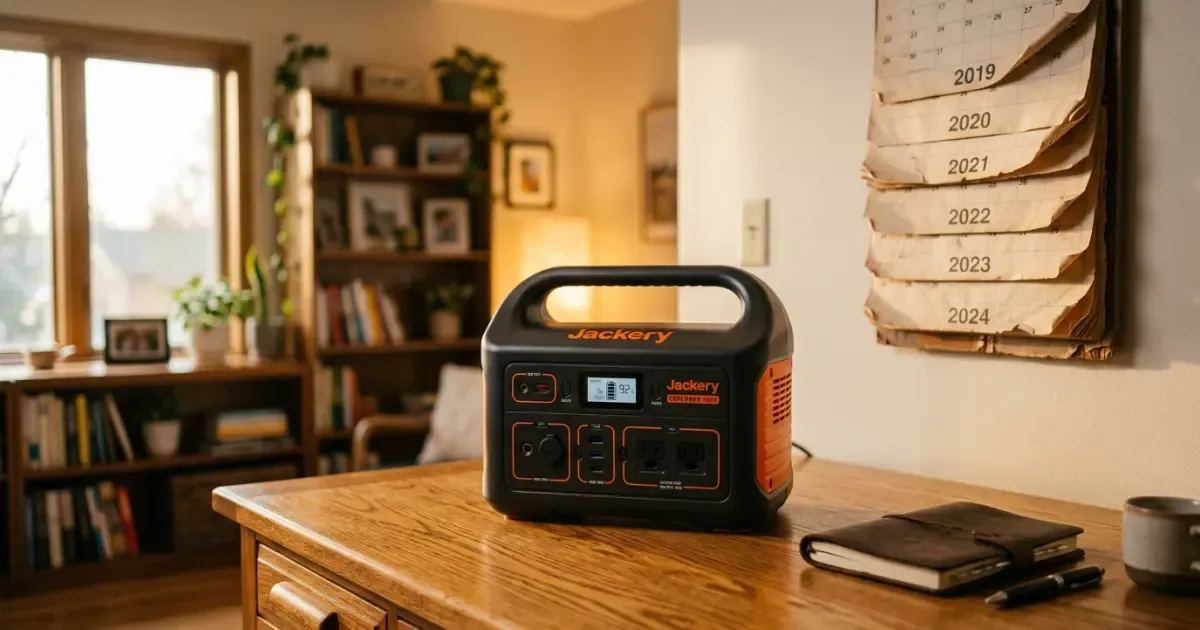
Jackery Explorer 1000 V2
- Battery: LiFePO4
- Rated cycles: 3,000+ to 80% capacity
- Daily use lifespan: 8–10 years
- Occasional use lifespan: 20–30 years
- Warranty: 5 years
- Real-world verdict: Ethan’s unit has been through months of spec research and 11 real outages with zero capacity degradation measured
The Jackery 1000 V2 represents the current value sweet spot for lifespan vs price. At $799 with a 10-year daily use lifespan the cost per year is approximately $80 — less than most people spend monthly on coffee.
EcoFlow DELTA 3 Plus
- Battery: LiFePO4
- Rated cycles: 3,000+ to 80% capacity
- Daily use lifespan: 8–10 years
- Occasional use lifespan: 20–30 years
- Warranty: 5 years
- Extra feature: Smart battery management via app extends effective lifespan
The EcoFlow app allows you to set charging limits — never charging above 80% automatically extends cycle life by 30-40%. For RV owners doing daily charging this feature alone adds 2-3 years to the unit’s useful life.
Bluetti Elite 200 V2
- Battery: LiFePO4
- Rated cycles: 6,000+ (Bluetti’s published figure)
- Warranty: 5 years
- Not expandable
- Best for: Households that cycle the battery often and want a large capacity
The 6 Things That Shorten Solar Generator Lifespan
1. Storing at 0% or 100%
Both extremes stress battery cells. 0% risks dropping below the minimum cell voltage threshold. 100% puts constant pressure on the cathode material. Store at 50-60% for any period longer than 2 weeks.
2. Charging in freezing temperatures
Charging a LiFePO4 battery below 32°F (0°C) causes lithium plating — irreversible metallic deposits that permanently reduce capacity. Most quality units have BMS protection that prevents this but cheap units may not. Always bring a cold generator to room temperature before charging.
3. Running the battery to 0% regularly
Deep discharges below 10% accelerate cell degradation. Keep your generator above 20% in regular use. Most units show a warning at 20% — take that seriously.
4. Leaving in direct sun or high heat
Ambient temperatures above 100°F accelerate lithium degradation. Never leave your generator in a hot car trunk or in direct sunlight during summer. This is the most common cause of premature capacity loss in warm climate states.
5. Using cheap or incompatible charging cables
Low-quality solar panel cables cause voltage irregularities that stress the battery management system over time. Use cables rated for your solar panel’s output voltage.
6. Never running a full cycle
Paradoxically, never fully discharging also causes issues — the BMS loses calibration over time and begins showing inaccurate percentages. Run one full discharge-recharge cycle every 6 months to recalibrate.
Lifespan by Use Case
| Use case | Cycles per year | LiFePO4 lifespan | NMC lifespan |
|---|---|---|---|
| Daily home backup | 365 | 8–16 years | 1.4–2.7 years |
| RV full-time | 300 | 10–20 years | 1.7–3.3 years |
| Weekly camping | 52 | 57–115 years | 9–19 years |
| Emergency only (5x/year) | 5 | 600+ years | 100–200 years |
| Hurricane prep (3x/year) | 3 | 1,000+ years | 165–333 years |
The takeaway: For emergency and hurricane prep use, battery cycle life is essentially unlimited. The real lifespan question becomes calendar aging — how long before the cells degrade from age alone regardless of use.
Calendar aging for LiFePO4: approximately 15-20 years before significant capacity loss regardless of cycles. For NMC: 7-12 years.
Your Situation
| Your situation | Recommended unit | Expected lifespan |
|---|---|---|
| Daily home backup | Jackery 1000 V2 | 8–10 years |
| Hurricane prep only | Any LiFePO4 | 15–20 years |
| Full-time RV | EcoFlow DELTA 3 Plus | 10–12 years |
| Homestead daily use | Bluetti Elite 200 V2 | Long; 6,000+ rated cycles |
| Occasional camping | Jackery 1000 V2 | 20–30 years |
| CPAP backup | EcoFlow DELTA 3 Plus | 10–15 years |
A solar generator that lasts 10-15 years is only worth it if you buy the right one for your needs. Our Solar Generator Buyer’s Toolkit helps you match capacity and chemistry to your actual use, so you’re not replacing it - or regretting it - in two years.
⚡ Solar Generator Buyer's Toolkit - $19
The sizing math, battery-chemistry guide, and a calculator so you buy a generator that lasts - and fits what you actually need.
Get the Toolkit - $19 →Is a Solar Generator Worth the Investment?
At $799 for a Jackery Explorer 1000 V2 with a 10-year daily use lifespan:
- Cost per year: $80
- Cost per month: $6.67
- Cost per outage (at 5 outages/year): $16 per event
Compare that to:
- Average food loss per outage: $200-400
- Hotel for one night during outage: $150-250
- Generator rental: $80-150/day
One prevented food loss event pays for 2-3 years of solar generator ownership.
For complete buying guidance see the best solar generators for home backup and the best solar generator under $1000 guides.
🔗 Related Guides
Frequently Asked Questions
How long does a solar generator last? A LiFePO4 solar generator lasts 10-15 years with daily use and 20-30 years with occasional use. The battery is rated for 3,000-6,000 charge cycles before dropping to 80% capacity. The electronics and inverter last 15-20 years. The Jackery Explorer 1000 V2 and EcoFlow DELTA 3 Plus are both rated for 3,000+ cycles.
How many years does a Jackery last? The Jackery Explorer 1000 V2 uses LiFePO4 battery chemistry rated for 3,000+ cycles. At one full cycle per day that equals 8-10 years of daily use. At one cycle per week that equals 57+ years. For emergency and hurricane prep use the unit will functionally last longer than you need it to.
What shortens solar generator lifespan the most? The top three lifespan killers are: charging in freezing temperatures which causes permanent lithium plating, storing at 0% charge which risks dropping below minimum cell voltage, and prolonged exposure to temperatures above 100F which accelerates cell degradation. Avoid these three and your unit will reach its full rated lifespan.
Does a solar generator lose power over time? Yes gradually. LiFePO4 batteries retain 80% of original capacity after 3,000 cycles. After 3,000 cycles a 1,024Wh unit holds approximately 819Wh. This degradation is linear and predictable — you will notice your runtime slowly shortening over years not suddenly failing.
Can a solar generator battery be replaced? Most consumer solar generators do not have user-replaceable batteries. EcoFlow offers battery expansion packs for some models. When the battery reaches end of life the options are manufacturer replacement (expensive), third-party replacement (voids warranty), or full unit replacement (often cost-effective given improved technology after 10 years).
Is LiFePO4 better than lithium-ion for solar generators? Yes for most use cases. LiFePO4 offers 3-6x more cycle life, better temperature stability, and improved safety. The only advantage of NMC lithium-ion is lower upfront cost and slightly higher energy density per kilogram. For a long-term investment in home backup power LiFePO4 is the correct choice.
— Ethan Reynolds has researched LiFePO4 and NMC solar generators since 2021 across published cycle data and hundreds of owner reports. Cycle life data sourced from manufacturer specifications and independent battery research.
Published: May 10 2026