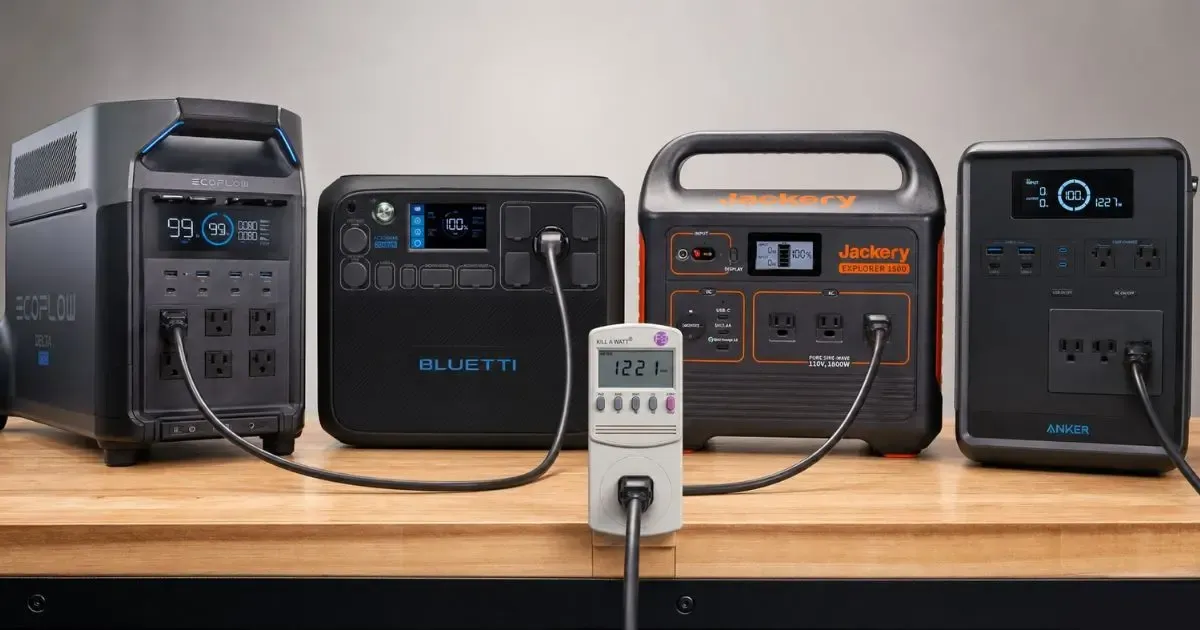
Best Solar Generator 2026: Ranked by Surge, Runtime and Price
This post contains affiliate links. I earn a small commission if you buy through my links, at no extra cost to you. I only recommend gear I have researched in depth: manufacturer specifications, published teardowns, and aggregated owner reports.
Most “best solar generator” lists repeat manufacturer specs or test with a lamp and a phone charger. This one compares the published specifications of the three units we recommend most against the loads homeowners actually run: a refrigerator, a CPAP machine and a window air conditioner. The figures come from manufacturer specifications and calculations, not lab testing, and each one is explained so you can check it. Last updated October 2026.
🏆 Best Solar Generators of 2026: Quick Comparison
| Model | Capacity | AC output | Surge | Weight | Typical freezer runtime* | Best for |
|---|---|---|---|---|---|---|
| EcoFlow DELTA 3 Plus | 1,024Wh (expandable to 5 kWh) | 1,800W | 3,600W | 27.6 lb | about 19 hours | Best overall |
| Bluetti Elite 200 V2 | 2,073.6Wh | 2,600W | Not published (resistive loads up to 3,900W) | 53.4 lb | about 39 hours | Longer outages, several appliances |
| Jackery Explorer 1000 V2 | 1,070Wh | 1,500W | 3,000W | 23.8 lb | about 20 hours | Best budget pick |
*Calculated for a chest freezer averaging 45W, with a 15% battery buffer. See the chest freezer wattage chart. Prices change often, so compare current prices at the links below.
🥇 Best Overall: EcoFlow DELTA 3 Plus
The DELTA 3 Plus has the highest published surge of the three (3,600W), refills from the wall in 56 minutes, weighs 27.6 lb and can be expanded later with extra batteries up to 5 kWh. Its X-Boost mode can run resistive loads such as heaters up to 2,200W on US models. That combination covers a refrigerator, a CPAP machine and device charging for the largest number of households.
Calculated runtimes (15% battery buffer, not measured):
- Refrigerator averaging 60-90W: about 10-14 hours per charge
- CPAP averaging 40W for 8 hours (about 320Wh a night): about 2-3 nights
- Recharge from 400W of panels at 75% real-world output: about 3.4 hours
Trade-offs: half the capacity of the Bluetti, and a higher price per watt-hour. See our full EcoFlow DELTA 3 Plus review.
🥈 Best for Longer Outages: Bluetti Elite 200 V2
The Elite 200 V2 stores twice the energy of the other two units (2,073.6Wh) and supplies 2,600W continuously, so it can run a refrigerator, a freezer and a few devices together for a day or more. Bluetti has discontinued the AC200L this guide used to recommend, and the Elite 200 V2 is its closest current counterpart.
Calculated runtimes (15% battery buffer, not measured):
- Refrigerator averaging 60-90W: about 20-29 hours per charge
- CPAP at 320Wh a night: about 5 nights
- A 5,000 BTU window AC drawing about 450W: about 4 hours
Trade-offs: at 53.4 lb it is a stationary backup unit, not one you move around casually, and it cannot be expanded. Bluetti does not publish a motor-start surge figure for it, so check an appliance’s nameplate before relying on it for a well pump or a large AC.
🥉 Best Budget Pick: Jackery Explorer 1000 V2
The Explorer 1000 V2 is the lightest of the three (23.8 lb) and typically the cheapest. Its 3,000W surge rating clears the startup surge of common refrigerators, chest freezers and small window AC units.
Calculated runtimes (15% battery buffer, not measured):
- Refrigerator averaging 60-90W: about 10-15 hours per charge
- CPAP at 320Wh a night: about 2-3 nights
- Recharge from 400W of panels (its maximum solar input) at 75% output: about 3.6 hours
Trade-offs: 1,500W of continuous output leaves less room to add other appliances, and it cannot be expanded. See our Jackery Explorer 1000 V2 review.
How Long Each Unit Runs Common Loads
| Load | EcoFlow DELTA 3 Plus | Jackery Explorer 1000 V2 | Bluetti Elite 200 V2 |
|---|---|---|---|
| Refrigerator (60-90W average) | 10-14 hours | 10-15 hours | 20-29 hours |
| CPAP (40W, 8 hours) | 2-3 nights | 2-3 nights | about 5 nights |
| 5,000 BTU window AC (about 450W) | about 2 hours | about 2 hours | about 4 hours |
A refrigerator compressor cycles on and off, so its daily average is much lower than the running watts printed on the label. A window AC is the hardest load of the three: all three units can start a typical 5,000 BTU unit, but none runs it for long without solar. For air conditioner specifics see solar generator for air conditioner.
How We Compare These Units
None of these units was lab-tested for this guide. The comparison uses:
- Manufacturer specifications: capacity, continuous output, published surge, weight, recharge times and battery type, taken from each maker’s product pages and major retailer listings for the US versions.
- Appliance nameplates and averages: the surge a motor needs to start is its LRA multiplied by 120, as explained in our guide to LRA. Runtime uses the average draw of each appliance over a day.
- A 15% battery buffer, because no unit delivers 100% of its rated watt-hours to your appliances.
- Calculations you can repeat: usable watt-hours divided by average watts gives hours. Every runtime on this page is labelled as calculated.
Real-world results vary with temperature, appliance age and how often a door is opened, so treat the numbers as planning figures.
What Size Solar Generator Do You Actually Need
This question matters more than which brand to buy.
300-500Wh: phone charging, LED lighting and a small fan. Not enough for a refrigerator.
1,000-1,500Wh (EcoFlow DELTA 3 Plus, Jackery Explorer 1000 V2): runs a refrigerator for most of a day, handles a CPAP for a couple of nights and charges your devices. This covers the majority of households.
2,000Wh and up (Bluetti Elite 200 V2): runs a refrigerator, a freezer and several devices together, or stretches a single appliance’s runtime significantly. Worth the extra cost if you have several critical loads.
For a full breakdown of appliance watt figures, including well pumps, sump pumps and window units, see the emergency power at home guide. For two units head to head, read EcoFlow vs Bluetti.
What We’d Buy for Each Situation
- Most households (a refrigerator, devices, a CPAP): EcoFlow DELTA 3 Plus.
- A refrigerator plus a freezer, or outages longer than a day: Bluetti Elite 200 V2.
- A tight budget and mostly short outages: Jackery Explorer 1000 V2.
Don’t buy on capacity numbers alone. A plug-in power meter costs about $25 and tells you the real draw of your own appliances before you spend hundreds on a unit.
🔋 Solar Generator Buyer's Toolkit — $19
Sizing calculator, appliance wattage reference sheet and a side-by-side comparison worksheet built from manufacturer specs.
Get the Toolkit — $19 →🔗 Related Guides
Frequently Asked Questions
What is the best solar generator for 2026? For most households, the EcoFlow DELTA 3 Plus: it combines 1,024Wh of capacity, 1,800W of output, the highest published surge of the three (3,600W) and a 56-minute wall recharge. For longer outages or several appliances at once, the Bluetti Elite 200 V2 (2,073.6Wh) is the stronger choice.
Is EcoFlow or Jackery better in 2026? It depends on what you value. EcoFlow’s DELTA 3 Plus has a higher surge rating (3,600W against 3,000W), a faster wall recharge and room to expand. The Jackery Explorer 1000 V2 is lighter (23.8 lb against 27.6 lb) and typically costs less. Budget buyers should lean Jackery; those who want the most headroom should lean EcoFlow.
How much capacity should I buy? For a refrigerator and device charging, 1,000-1,500Wh covers most households. Buy 2,000Wh or more only if you need to run several high-draw appliances together or want longer runtime without daily recharging. Prices change often, so compare current prices before you decide.
What is the difference between Wh and W on a solar generator? Wh (watt-hours) measures how much energy the battery stores, like the size of a fuel tank. W (watts) measures how much power the unit can deliver at once, like an engine’s horsepower. A large battery with low output can store plenty of energy but cannot start a high-surge appliance, so you need both numbers to match your loads.
Do solar generators lose capacity over time? Yes, all lithium batteries degrade gradually. LiFePO4 batteries, used in these three units, are typically rated to keep about 80% of their capacity after 3,000 to 6,000 charge cycles, which is many years of regular use.
Can I leave a solar generator plugged in all the time? Generally yes. Modern LiFePO4 units have battery management systems that stop charging once the battery is full, so keeping one topped up means it is ready for an unexpected outage. Check your unit’s manual for its own guidance.
What is the best solar generator for a CPAP machine? Any of the three runs a standard CPAP (about 30-60W) for a full night with room to spare. At 320Wh a night, the EcoFlow DELTA 3 Plus and Jackery Explorer 1000 V2 cover about 2-3 nights and the Bluetti Elite 200 V2 about 5 nights, before recharging. See our CPAP guide.
About These Figures
Specifications come from manufacturer product pages and retailer listings for the US versions. Runtimes marked as calculated are derived from battery capacity, a 15% efficiency buffer and typical appliance draws, and are estimates, not test results. Compiled by Ethan Reynolds. Affiliate-supported; independently researched.
Last updated: October 2026