Best Emergency Power for Home: Backup Options 2026
This post contains affiliate links. I earn a small commission if you buy through my links, at no extra cost to you. I only recommend gear I have researched in depth: manufacturer specifications, published teardowns, and aggregated owner reports.
This post contains affiliate links. We earn a small commission if you buy through our links, at no extra cost to you. Specifications come from manufacturer pages and runtimes are calculations, not our own tests.
A long outage is mostly a math problem: how many watts your essentials draw, and how many watt-hours you can store and recharge.
This guide covers every type of emergency power system - solar generators, gas generators, power banks, whole-home battery systems - using manufacturer output ratings and typical appliance draws.
It explains what each option can and cannot run, so you can match your own appliances to the right setup.
📏 Step 1: Know Your Power Needs
Before buying anything, find out what you actually need to run.
The single most useful tool in emergency power planning is a plug-in power meter (around $25). Plug it between your appliance and the wall and it measures actual watt draw — not the theoretical maximum on the label. The table below shows typical values; yours will differ.
Typical household draws:
| Appliance | Running Watts | Startup Surge |
|---|---|---|
| 18 cu ft refrigerator | 150W | 400W |
| 20 cu ft refrigerator | 180W | 500W |
| Window AC (5,000 BTU) | 450W | 900W |
| Box fan (medium) | 55W | 65W |
| CPAP (no heat) | 30W | 45W |
| CPAP (with heat) | 60W | 75W |
| Oxygen concentrator | 300W | 350W |
| Well pump (1HP) | 750W | 2,000W |
| Sump pump (1/2HP) | 400W | 1,050W |
| Laptop | 45W | 60W |
| Phone charging | 18W | 20W |
| LED lamp | 8W | 8W |
| 55” TV | 80W | 85W |
The startup surge matters. Your backup power system needs to handle the surge wattage, not just the running wattage. A solar generator rated at 1,000W output needs to handle the 400W startup surge of a refrigerator — which it can. But it cannot handle the 2,000W surge of a well pump.
SurviveX discount: 10% off everything
Use code GETREADY10 at checkout
Plus free shipping on orders over $50
Code valid through 30 November 2026. Cannot be combined with other offers.
⚡ The Four Types of Emergency Home Power
Type 1: Portable Power Banks
Best for: Phone charging, small devices, short outages Cost: $30–$150 Capacity: 10,000–40,000mAh (37–148Wh)
A 20,000mAh power bank charges a smartphone 4–5 times. That’s it. Power banks are not backup power for appliances — they’re backup power for communication devices.
My recommendation: Every household member should have a 20,000mAh power bank. Cost is ~$30–$50 each. Keep them charged. This is your minimum baseline, not your complete solution.
🏆 Solar Generators to Consider for Home Emergency Power
| Model | Capacity | Continuous output | Best for |
|---|---|---|---|
| EcoFlow DELTA 3 Plus | 1,024Wh | 1,800W (3,600W surge) | Fridge, CPAP and devices; expandable |
| Bluetti Elite 200 V2 | 2,073.6Wh | 2,600W | Longer runtime, several loads at once |
| Jackery Explorer 1000 V2 | 1,070Wh | 1,500W (3,000W surge) | Lighter, simpler all-rounder |
Figures are manufacturers’ published specs. Check current prices on each page.
Type 2: Portable Solar Generators (Power Stations)
Best for: Refrigerator, medical devices, device charging, fans and lighting Cost: $300–$1,500 Capacity: 300Wh–2,100Wh
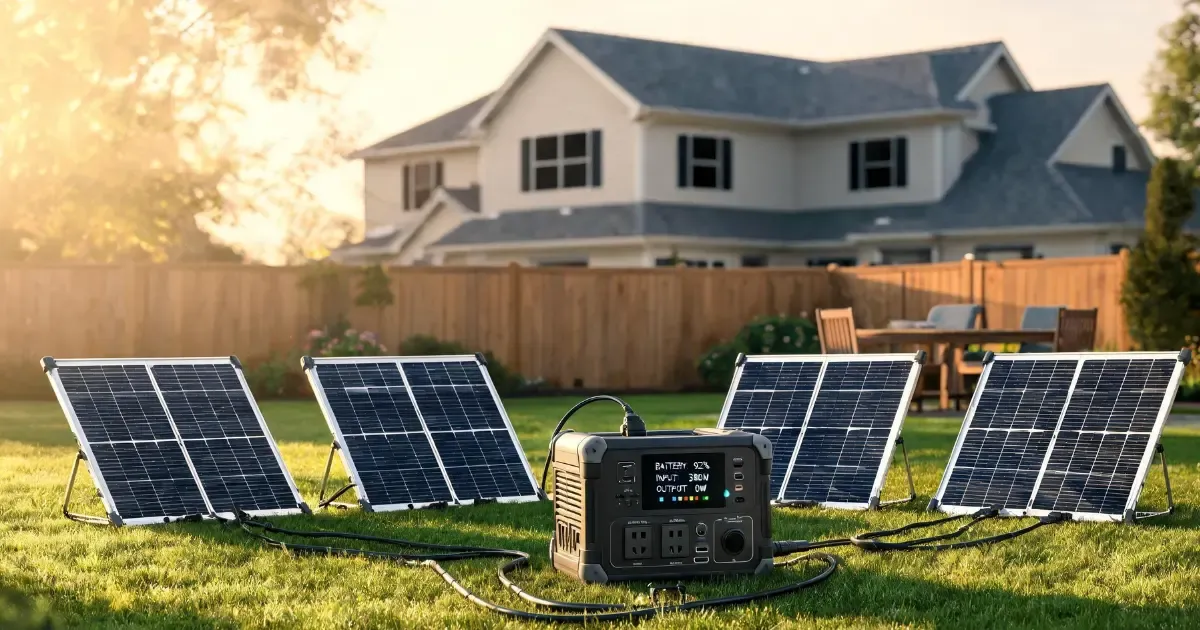
Portable solar generators (also called power stations) are large lithium battery packs with multiple AC outlets, USB ports, and DC outputs. They charge from solar panels, wall outlets, or car outlets.
Advantages over gas generators:
- Safe indoors — no carbon monoxide
- Silent operation
- No fuel storage required
- Recharges from free solar energy
- Works in apartments and condos
- Low maintenance
Disadvantages:
- Higher upfront cost
- Cannot run high-draw appliances (central AC, electric dryer, well pump)
- Recharge takes time (4–8 hours solar, 1–2 hours AC)
What size do you need?
300–500Wh ($150–$350): Phone charging, LED lights, small fan. 2–4 full phone charges. Cannot run a refrigerator reliably.
1,000–1,500Wh ($400–$800): Runs a refrigerator for roughly 14 hours at a 60W average draw (usable energy is about 85% of capacity, so 850Wh ÷ 60W). Charges all devices. Powers a CPAP for a night or more, depending on the model. A good size for most households.
2,000–2,400Wh ($800–$1,500): Runs a refrigerator plus freezer for roughly 19 hours at a combined 90W average (a 2,073Wh unit has about 1,760Wh usable). Extended runtime for multiple appliances. Oxygen concentrators draw far more and need their own plan; see our medical equipment guide.
👉 See our full solar generator comparison →
Type 3: Gas/Propane Generators
Best for: High-power loads, whole-home backup, extended outages with fuel supply Cost: $400–$3,000+ Capacity: 3,000–10,000W output
Gas generators produce serious power. A 5,000W gas generator can run a window AC, refrigerator, sump pump, and several other appliances simultaneously. They’re the right tool for high-power needs.
The non-negotiable rules:
- Never run indoors — including garages, even with the door open
- Keep 20+ feet from any window or door
- Store fuel safely — use fuel stabilizer if storing more than 30 days
- Run on a dry surface — never in rain or wet conditions
- Carbon monoxide detector in your home when running any gas generator
Fuel storage: Most households can safely store 5–10 gallons of fuel. At 0.5–1 gallon/hour, a 10-gallon supply runs a mid-size generator for 10–20 hours. Before a major hurricane, gas is impossible to find — stock fuel in May before season starts.
Type 4: Whole-Home Battery Systems
Best for: Whole-home backup, solar-powered homes, permanent installation Cost: $8,000–$20,000 installed Capacity: 10–27kWh
Tesla Powerwall, Enphase IQ Battery, Franklin WH10 — whole-home battery systems store solar energy and provide seamless backup power when the grid goes down.
These are excellent solutions but outside the budget range of most emergency planning discussions. If you own your home, have solar panels, and are in a hurricane-prone area, the math may work out. If you’re renting or looking for portable emergency power, stick with Type 2 or Type 3.
🏠 Suggested Setup by Household Type
Apartment or Condo Dweller
Gas generator: not an option — no outdoor space, building rules, CO risk
Recommended:
- 1,000Wh solar generator ($400–$600)
- 200W portable solar panel ($150–$250) — charges through window or on balcony
- 2× 20,000mAh power banks ($60)
Total: $610–$910 Runs: refrigerator roughly 14 hours per charge, all device charging, CPAP
Single-Family Home, No Medical Equipment
Recommended:
- 1,500Wh solar generator ($600–$800)
- 200W solar panel ($150–$250)
- 2× 20,000mAh power banks ($60)
Total: $810–$1,110 Runs: refrigerator, device charging, fans and lighting; solar recharging helps in good sun but a 200W panel covers only about half a fridge’s daily use
Single-Family Home, CPAP or Medical Device User
Recommended:
- 2,000Wh solar generator ($800–$1,200)
- 400W solar panel setup ($250–$400)
- 20,000mAh power bank per person ($30–$50 each)
Total: $1,080–$1,650 Runs: CPAP overnight, refrigerator, and devices, with a 400W array covering a fridge’s daily use in good sun
Home with Well Pump or Sump Pump
Recommended:
- Gas generator 3,500W+ on a transfer switch, or a solar generator only if the pump is 120V and its startup demand fits
- Check LRA × 120 plus 20% against the unit’s surge rating; see our well pump guide
- If gas: 3,500W generator minimum, fuel storage plan
Check your pump’s surge rating before buying — well pumps vary widely.
RV or Extended Travel
Recommended:
- 1,000Wh portable solar generator
- 200W foldable solar panel
- See the RV solar generator guide for specific recommendations
☀️ The Solar Panel Question
A solar generator without a solar panel is a battery that runs out. A solar generator with a solar panel is a renewable power system.
How much solar do you need?
Rule of thumb: panel watts × peak sun hours × 0.75 gives daily watt-hours, so a panel of about one fifth of your generator capacity recharges it in roughly a day of good sun.
- 1,000Wh generator → 200W panel (about 750Wh on a 5-sun-hour day, so roughly 1.3 days for a full charge)
- 1,500Wh generator → 300W panel (about 1,125Wh per day)
- 2,000Wh generator → 400W panel (about 1,500Wh per day)
A fridge at a 60W average uses about 1,440Wh a day, so a 200W panel in good sun covers roughly half of it and a 400W array covers it. Clouds, shade and winter sun reduce this a lot, so treat these as best-case figures. For food safety rules during the outage itself, see how long does food last in the fridge without power.
Positioning: Portable solar panels can be placed in a sunny yard, on a balcony, or angled in a window. They don’t need to be permanently mounted — that’s the whole point of portable emergency power.
💰 Budget Breakdown: What $200, $500, and $1,000 Gets You
$200 Emergency Power Budget
- 2× 20,000mAh power banks: $60
- 300Wh power station: $120
- Hand-crank NOAA radio: $30
What this covers: Phone charging for 8–10 full charges, LED lighting for several nights, emergency communication. Does not run appliances.
$500 Emergency Power Budget
- 1,000Wh solar generator: $400
- 2× 20,000mAh power banks: $60
- Hand-crank radio: $30
What this covers: Refrigerator for roughly 14 hours per charge, all device charging, CPAP for one night per charge. Limited to one charge without solar.
$1,000 Emergency Power Budget
- 1,000–1,500Wh solar generator: $500–$700
- 200W solar panel: $150–$200
- 2× 20,000mAh power banks: $60
What this covers: Refrigerator with partial solar recharging in good sun, all device charging, fans, and a CPAP. A solid baseline for most households, though a long cloudy outage will still need a second plan.
⚠️ Carbon Monoxide: The Silent Killer
Every year, people die from carbon monoxide poisoning after storms — not from the storms themselves.
CO is produced by any fuel-burning device: gas generators, propane heaters, charcoal grills, gas stoves used for heat. It is colorless, odorless, and lethal at low concentrations with extended exposure.
Rules that save lives:
- Never run a gas generator inside — including garages with open doors
- Never use a charcoal or propane grill indoors for heat or cooking
- Never use a gas stove for home heating
- Install a battery-powered CO detector on every floor of your home
- Know the symptoms: headache, dizziness, nausea, confusion — get outside immediately
This is the primary reason we recommend solar generators for apartment and condo dwellers — the CO risk from gas-powered backup in enclosed spaces is too high.
🔋 72-Hour Power Outage Survival Kit — $27
Includes a solar generator sizing calculator, appliance watt reference sheet, and complete backup power checklist.
Get the Kit — $27 →🎒 SurviveX 72-Hour Emergency Kit
Pre-assembled food, water purification, first aid, and communication gear — the supply side of your outage kit, done for you.
Check SurviveX Kit →📚 More Guides to Help You Prepare
- Can a solar generator run a whole house?
- Best solar generators for apartments
- How much emergency water to store
- How to charge a solar generator without sun
- Chest freezer wattage chart: running and surge watts
- EcoFlow vs Bluetti compared
- LiFePO4 vs lithium-ion batteries
- Running a dehumidifier on a solar generator
❓ Frequently Asked Questions
What is the best emergency power source for home use?
For most households, a 1,000–1,500Wh solar generator paired with a 200W solar panel is the best emergency power source. It runs a refrigerator, charges medical devices and phones, is safe indoors, requires no fuel, and can recharge from solar in good sun. Gas generators are better for high-power loads (well pumps, window AC units) but require outdoor use, fuel storage, and careful CO management.
How long will a solar generator power my refrigerator?
A 1,000Wh solar generator has about 850Wh usable. A refrigerator averaging 60W runs roughly 14 hours; at a continuous 150W it would be closer to 6 hours. A 200W panel produces about 750Wh on a good sun day, which covers roughly half a fridge’s daily use, so pair it with a larger array or a second plan for long outages.
Can I use a solar generator to power my whole house?
Not a portable one. Whole-home solar backup requires a permanently installed system like a Tesla Powerwall (13.5kWh, $8,000–$12,000 installed). Portable solar generators (300Wh–2,400Wh) are designed for essential circuits — refrigerator, medical devices, device charging — not whole-home coverage. For whole-home backup, a standby gas or propane generator (7,500W+) is the traditional solution.
What size generator do I need for a power outage?
It depends on what you need to run. For phones, lights, and a refrigerator: a 1,000Wh solar generator is sufficient. For window AC or a sump pump: you need a gas generator rated at least 3,500W with startup surge capacity of 5,000W+. Check your appliances with a manufacturer specification sheet before buying — startup surge wattage is what determines minimum generator size, not running wattage.
Is a solar generator worth it for emergency power?
Yes, for most households. The break-even calculation: if you lose $200–$400 of refrigerated food in one major outage, a $600 solar generator that prevents this loss pays for itself in 2–3 outages. Add the value of powering medical devices, charging phones for communication, and running lights and fans, and the math can favor owning one if you live in a hurricane or severe weather zone. Food-loss figures vary a lot, so use your own.
How do I charge a solar generator during a power outage?
Use a portable solar panel — typically 100W to 400W — placed in direct sunlight. Most solar generators accept input from solar panels via a dedicated solar input port. Position the panel in a sunny location, angle it toward the sun, and connect to your generator. On a good day, a 200W panel produces about 750Wh (panel watts × 5 peak sun hours × 0.75), so a full recharge of a 1,000Wh unit takes roughly a day and a half. You can also pre-charge from a wall outlet before an outage and use solar for recharging during the outage.
Can I run a generator in my apartment during a power outage?
You can run a solar generator (battery-based power station) in an apartment — they produce no emissions and are completely safe indoors. You cannot safely run a gas, propane, or dual-fuel generator in an apartment. Most apartments also prohibit gas generators due to fire and CO risk. For apartment dwellers, a solar generator is the only practical backup power option.
Wattage figures are manufacturer specifications and typical appliance draws. Runtimes are calculated, not measured. Last updated October 2026.