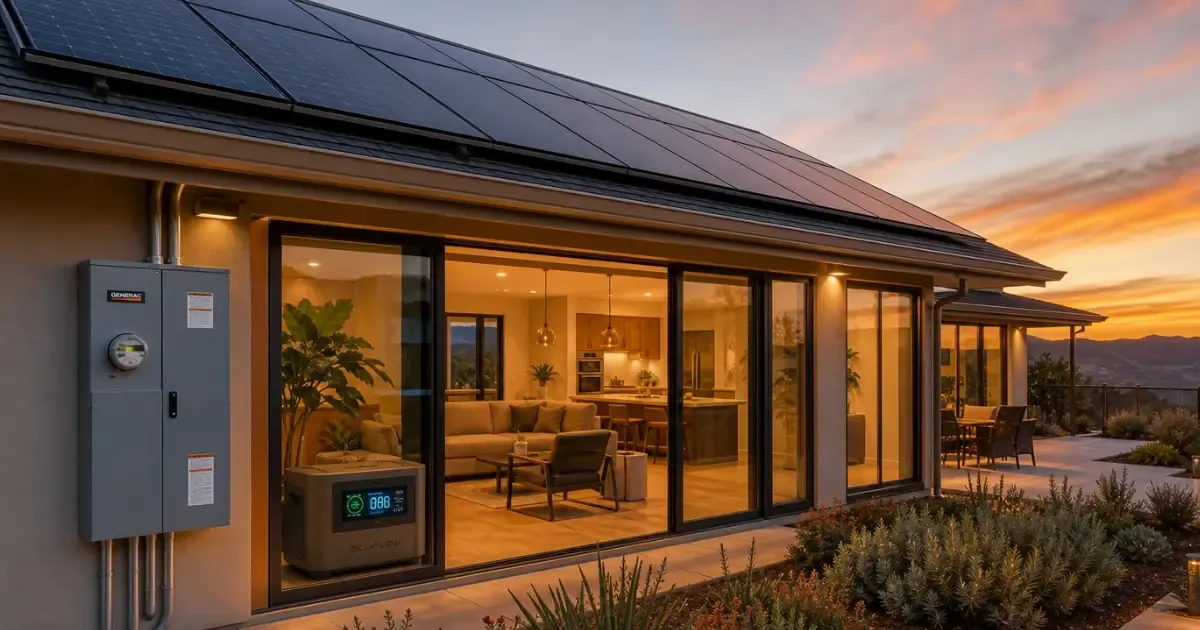
Solar Generator for Whole House: What Size Do You Need?
This post contains affiliate links. I earn a small commission if you buy through my links, at no extra cost to you. I only recommend gear I have researched in depth: manufacturer specifications, published teardowns, and aggregated owner reports.
This post contains affiliate links. I earn a small commission if you buy through my links, at no extra cost to you. I only recommend gear I have researched in depth: manufacturer specifications, published teardowns, and aggregated owner reports.
Every week someone asks me: “Can I run my whole house on a solar generator?”
The honest answer is: probably not — but you can run everything that actually matters, and that’s more useful than the marketing answer most articles give you.
I worked through exactly what is possible using published appliance draws, EIA household consumption data, and the rated output of every major portable unit on the market. Here’s the real math, not the spec sheet version.
🏠 What “Whole House” Actually Uses
Before buying anything, you need to know your home’s actual power consumption. Here is a typical 1,800 sq ft US home, using EIA averages and manufacturer-rated draws:
Daily energy breakdown (typical US household):
| Load | Running Watts | Hours/Day | Daily Wh |
|---|---|---|---|
| Central AC (2-ton) | 2,400W | 8 hours | 19,200Wh |
| Electric water heater | 4,500W | 2 hours | 9,000Wh |
| Refrigerator | 150W | 24 hours | 3,600Wh |
| Lighting (LED whole house) | 200W | 6 hours | 1,200Wh |
| Washer/Dryer | 5,000W | 1 hour | 5,000Wh |
| Dishwasher | 1,200W | 1 hour | 1,200Wh |
| TV + devices | 300W | 4 hours | 1,200Wh |
| CPAP machine | 60W | 8 hours | 480Wh |
| Misc (pumps, fans, charging) | 200W | 8 hours | 1,600Wh |
| TOTAL | ~42,480Wh/day |
That’s 42 kWh per day. The largest portable solar generator you can buy today — the EcoFlow DELTA Pro Ultra — holds 6,144Wh. You’d drain it in about 3.5 hours running a typical home normally.
The math doesn’t lie: whole-house backup with a portable solar generator is marketing fiction.
⚡ What You Can Actually Run — The Realistic Approach
The smarter question isn’t “can I run my whole house” — it’s “what do I actually need to keep running during an outage?”
The critical loads approach:
| Load | Running Watts | Why It Matters |
|---|---|---|
| Refrigerator | 150W | Food safety |
| Freezer | 100W | Food preservation |
| CPAP machine | 60W | Medical necessity |
| LED lights (4 rooms) | 60W | Safety + function |
| Phone + laptop charging | 100W | Communication |
| Internet router | 20W | Information access |
| Box fans (2) | 110W | Comfort in heat |
| TOTAL CRITICAL | ~600W running |
Running these critical loads: 600W × 24 hours = 14,400Wh/day. A 2,000Wh solar generator with 400W of solar panels runs these loads in a cycle — 3 hours of AC power, 2 hours of solar recharging — giving you nearly continuous coverage of what actually matters.
This is the approach that holds up in a multi-day outage. You do not run the AC, water heater, or dryer. You run everything that matters, and it is enough.
🏆 Best Solar Generators for Whole House Critical Loads
| Model | Capacity | Output | Best For |
|---|---|---|---|
| EcoFlow DELTA Pro | 3,600Wh | 3,600W | Larger critical-loads coverage |
| Bluetti Elite 200 V2 | 2,073.6Wh | 2,600W | Critical loads, long runtime |
| EcoFlow DELTA 2 Max | 2,048Wh | 2,400W | Faster recharging |
Figures are manufacturers’ published specs; check current prices.
📏 Sizing Guide by Home Size and Goal
Small home / apartment (under 1,000 sq ft) — critical loads only:
- Daily critical load: ~8,000Wh
- Solar generator needed: 2,000–3,000Wh with 400W solar
- What you can run: fridge, lights, devices, CPAP, fans
- Best match: a 2,000Wh-class unit such as the Bluetti Elite 200 V2 + 2× 200W panels
- Runtime strategy: 3 hours on / 2 hours solar recharge cycle
Medium home (1,000–2,000 sq ft) — critical loads + comfort:
- Daily critical load: ~12,000Wh
- Solar generator needed: 3,000–5,000Wh or two units in parallel
- What you can run: everything small home can run + window AC (5,000 BTU)
- Best match: EcoFlow DELTA Pro ($2,400) + 400W solar
- Runtime strategy: prioritize AC during hottest hours, run other loads rest of day
Large home (2,000+ sq ft) — true whole home:
- Daily load: 30,000–50,000Wh
- What you actually need: Tesla Powerwall 3 (13.5kWh × 3 units = $25,000+) or Generac PWRcell
- Portable solar generators: not viable at this scale
- Realistic portable approach: buy a 3,600Wh generator for critical loads only, ignore the rest
🔌 The Whole House Transfer Switch Option
One option most articles skip: a generator transfer switch. This is a panel-level switch (installed by an electrician, $200–500) that lets you connect a large portable solar generator to your home’s electrical system, powering specific circuits rather than individual appliances.
Why this matters for whole-house backup:
- Instead of running extension cords to every appliance, you power selected circuits (kitchen fridge circuit, bedroom circuit, living room circuit)
- A 3,600W solar generator can power 5–8 circuits simultaneously
- Looks and feels like your normal home, just with limited circuits active
- Installer cost: $500–1,500 depending on your panel
This is what I’d recommend for anyone who wants a “whole house feel” from a portable solar generator — it’s not actually whole house, but it feels like it, and it covers everything that matters.
💰 True Whole-Home Battery Systems — What They Cost
If you genuinely need whole-house backup, here’s the real cost picture:
| System | Capacity | Installed Cost | Runtime (avg home) |
|---|---|---|---|
| Tesla Powerwall 3 | 13.5kWh | $12,000–15,000 | ~8 hours |
| Tesla Powerwall 3 × 2 | 27kWh | $22,000–28,000 | ~16 hours |
| Generac PWRcell | 9–18kWh | $15,000–20,000 | 6–12 hours |
| Enphase IQ Battery 10T | 10.1kWh | $10,000–14,000 | ~6 hours |
| EcoFlow DELTA Pro Ultra | 6.1kWh | $3,500–4,500 | ~3.5 hours |
The honest takeaway: true whole-home battery backup starts at $10,000 installed and goes up from there. It’s a home improvement investment, not a product purchase. For 95% of people asking “can I run my whole house on a solar generator” — the critical loads approach with a $1,500–2,500 portable unit covers everything that actually matters during a real outage.
☀️ How Many Solar Panels for Whole House Backup?
If you’re investing in a serious backup system, solar panels determine how long you can sustain it.
For the critical loads approach (600W running load, 2,000Wh battery):
- 200W panel: produces 1,000–1,200Wh/day (5-6 hours sun) — barely keeps up
- 400W panel: produces 2,000–2,400Wh/day — matches daily critical load
- 600W panel array: produces 3,000–3,600Wh/day — exceeds daily use, builds reserve
For a whole-home battery system (13.5kWh+):
- Minimum 4,000W (4kW) solar array for meaningful daily recharging
- Typical residential solar install: 6–10kW, $15,000–25,000 before incentives
- Federal solar tax credit: 30% — brings that to $10,500–17,500 net
🏡 A Suggested Setup for a Hurricane-Belt Homeowner
Here is a sensible starting point for critical loads:
A 2,000Wh-class unit such as the Bluetti Elite 200 V2 plus about 400W of solar panels.
Connect it to your refrigerator, your CPAP, your phone chargers, and four LED lights. Run box fans instead of AC during the day. On a 60W average, a fridge runs about 29 hours from the Elite 200 V2’s roughly 1,760Wh usable, and 400W of panels makes about 1,500Wh in good sun (400W × 5 hours × 0.75), close to a fridge’s daily use. A CPAP and devices on top need more, and cloudy days cut solar sharply, so treat this as a starting point and have a second plan for medical needs.
For anything more than that — a 2-week+ outage, running central AC, powering the whole house — you’re looking at a $10,000+ whole-home system, and at that point you’re making a different kind of decision.
For full guidance on sizing your specific setup, see the Solar Generator Sizing Calculator → or the best solar generator for home backup →.
🔋 Solar Generator Buyer's Toolkit — $19
Includes a whole-house critical loads worksheet, appliance watt reference, and a sizing calculator built from manufacturer specs and owner-reported performance. Know your numbers before you spend $1,500+.
Get the Toolkit — $19 →🎒 SurviveX 72-Hour Emergency Kit
Pre-assembled food, water purification, first aid, and communication gear — the supply side of your outage plan, done for you.
📦 Free shipping on orders $50+ · 10% off your first order when you sign up
Check SurviveX Kit →🔗 Related Guides
- Off-grid solar for a small cabin with a portable power station
- Plug-in solar panels vs a solar generator
❓ Frequently Asked Questions
Can a solar generator power a whole house?
Not a typical US home. A whole house uses 30–50 kWh (30,000–50,000 Wh) per day. The largest portable solar generators hold 2,000–6,000 Wh — about 10–15% of daily home usage. A portable solar generator can power critical loads (refrigerator, lights, CPAP, devices, fans) which covers everything that matters during an outage. True whole-house backup requires a whole-home battery system starting at $10,000+ installed.
What size solar generator do I need for a house?
For critical loads only (refrigerator + lights + CPAP + devices = ~600W): a 2,000–3,000 Wh solar generator with 400W solar panels handles this in a cycle mode, providing nearly continuous power to everything that matters. For critical loads + window AC: a 3,600 Wh unit. For genuine whole-home backup: a Tesla Powerwall 3 system (13.5 kWh, $12,000–15,000 installed) or equivalent.
How long will a solar generator power a house?
A 2,000 Wh solar generator running critical loads (600W) lasts about 3 hours on a full charge before needing recharging. With a 400W solar panel recharging during daylight, you can cycle power indefinitely — 3 hours on, 2 hours charging, repeat. This provides 8–10 hours of powered appliances daily from solar input alone.
Is a solar generator better than a gas generator for home backup?
For critical loads backup: solar generators are quieter, require no fuel storage, produce no carbon monoxide (can be used indoors safely), and have lower long-term costs. Gas generators produce more power cheaply and refuel quickly. The practical answer: a solar generator handles the critical loads most people actually need (fridge, devices, CPAP) without the noise, fumes, or fuel management of gas. For whole-home backup of high-draw appliances (AC, water heater), a gas generator or whole-home battery is more practical.
How many solar panels do I need to power a house during an outage?
For critical loads only (1,400 Wh/day): 400W of solar panels provides enough daily input to sustain indefinite operation. For a whole-home battery system (13.5 kWh): a 4,000–6,000W solar array is needed for meaningful daily recharging. A full residential solar + battery system typically uses 6–10kW of panels costing $15,000–25,000 before the 30% federal tax credit.
Can I connect a solar generator to my home’s electrical panel?
Yes, with a transfer switch installed by a licensed electrician ($500–1,500 installed). This allows a portable solar generator to power selected circuits in your home rather than individual appliances via extension cords. It does not bypass your utility meter safely — a proper transfer switch isolates your home from the grid when the generator is running. Never backfeed power into your panel without a proper transfer switch — it is dangerous and illegal.
What is the cheapest way to backup power a whole house?
The most cost-effective approach for most homeowners: a 2,000 Wh portable solar generator ($1,200–1,600) + two 200W solar panels ($300) = $1,500–1,900 total. This covers critical loads indefinitely using solar cycling. A whole-home battery system starts at $10,000+ installed. The critical loads approach covers 95% of real-world outage scenarios at 15% of the cost of a whole-home system.
How do I calculate what size solar generator I need for my home?
Step 1: List every appliance you need during an outage with its running wattage. Step 2: Multiply running watts by hours used per day to get daily Wh per appliance. Step 3: Sum all daily Wh — this is your total daily load. Step 4: Your battery capacity should equal 1.5× your daily load. Step 5: Your solar panel wattage should equal daily load ÷ daily sun hours ÷ 0.75. Use the free solar calculator → for exact numbers based on your location.
All wattage figures are compiled from manufacturer specification sheets, Energy Star product data, and EIA residential energy statistics, then cross-checked against aggregated owner reports. Researched and compiled by Ethan Reynolds at ecoliving-journey.com. Affiliate-supported; independently researched. Last updated August 2026.
🧰 Made it this far? You're serious about getting this right.
Sizing a whole-house system is where most people overspend by $1,000+ or under-buy and regret it. I put every worksheet, wattage table, and sizing formula from months of spec research and owner reports into one toolkit so you can skip the guesswork.
Solar Generator Buyer's Toolkit — $19 — sizing calculator, model comparison sheets, and the exact checklist I use before recommending any unit.
Get the Buyer's Toolkit →Instant download. If it doesn't save you at least the $19 on your purchase, email me at ethan@ecoliving-journey.com.