How to Prepare for a Hurricane: 2026 Survival Guide
This post contains affiliate links. I earn a small commission if you buy through my links, at no extra cost to you. I only recommend gear I have researched in depth: manufacturer specifications, published teardowns, and aggregated owner reports.
This post contains affiliate links. We earn a small commission if you buy through our links, at no extra cost to you. Specifications come from manufacturer pages and runtimes are calculations, not our own tests.
Picture the version of this where you are ready: water stored, a charged power station and a panel set up, documents in a waterproof bag by the door, a full gas tank, and enough no-refrigeration food for two weeks.
If the storm turns away, you lost nothing. If it does not, you are the household that is comfortable instead of scrambling.
That’s the mindset shift that separates people who survive hurricanes comfortably from people who suffer through them: you prepare for the worst version of the storm, not the most likely version.
This guide gives you a preparation timeline and checklist built from official hurricane guidance and published product specifications.
⏰ The Hurricane Preparation Timeline
30 Days Before Hurricane Season (May 1)
This is the preparation most people skip entirely — and it’s the most important window.
- Assemble your full hurricane kit — water, food, medications, documents, power backup. See the complete hurricane preparedness checklist for the full list.
- Check and rotate emergency food supply — replace anything expired from last year
- Test your backup power — charge your solar generator, test all lights and devices
- Review your insurance policies — home, flood, auto. Know your deductible and what’s covered before you need to file a claim
- Identify your evacuation zone — find yours at your county emergency management website
- Book a backup hotel or identify family/friend destination — prices triple and availability disappears once a storm is named
- Fill all prescriptions to 30-day supply — ask your doctor in May, not August
- Photograph every room and possession — store in cloud for insurance documentation
7 Days Before Projected Landfall
A storm has formed and is tracking toward your area. Now you shift from preparation to activation.
- Review your hurricane kit — fill any gaps
- Top off vehicle fuel (stations run out 36–48 hours before landfall)
- Withdraw $300–$500 cash in small bills
- Confirm your evacuation route and destination
- Notify out-of-state contact of your plan
- Check local emergency management website for shelter locations and mandatory evacuation zones
72 Hours Before Landfall
The storm track is becoming clearer. This is your last comfortable preparation window.
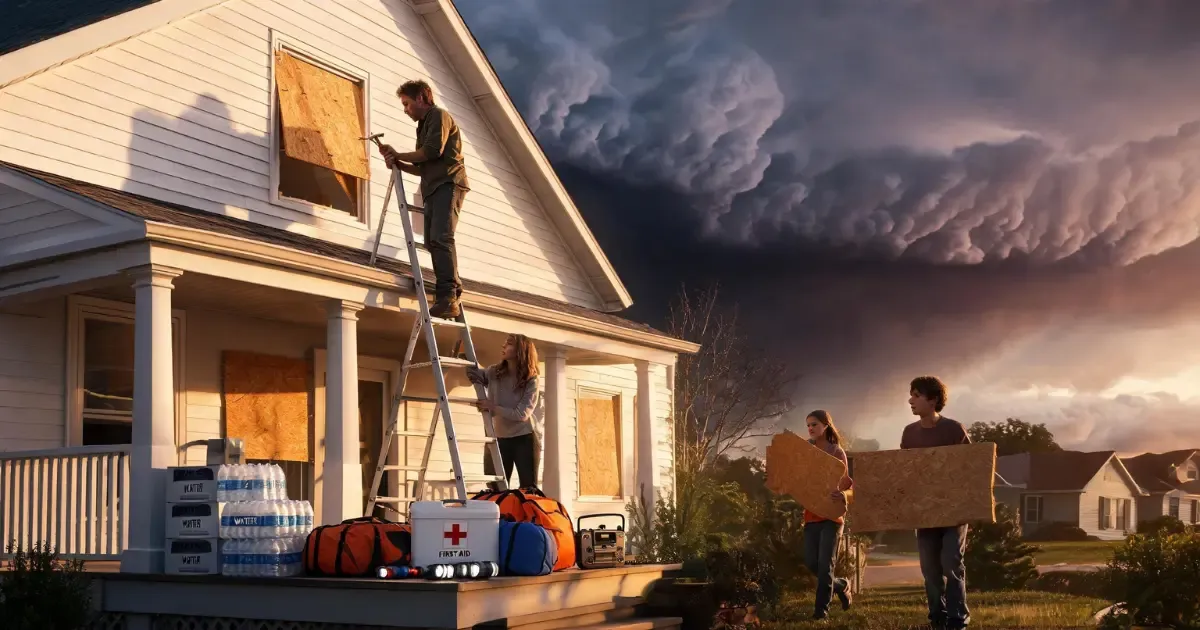
- Board windows or install hurricane shutters
- Bring ALL outdoor items inside — furniture, pots, decorations, grills. Wind turns these into projectiles
- Clear gutters and downspouts
- Fill WaterBOB in bathtub (100 gallon backup water supply)
- Fill vehicles with gas if not done already
- Charge all devices: phones, laptops, power banks, solar generators
- Freeze water bottles and fill empty freezer space — extends food safety time by 24–48 hours
- Move important documents to waterproof bag
- Fill prescriptions if not done
48 Hours Before Landfall
If you’re in an evacuation zone and a Category 3+ is forecast: leave now.
Do not wait for a mandatory evacuation order if you’re in Zone A or a mobile home. By the time the order is issued, traffic will be backed up for hours.
- If sheltering in place: fill bathtub with WaterBOB, charge everything, move valuables to highest floor
- If evacuating: load go-bag, important documents, medications, pets and their supplies
- Confirm hotel reservation or destination
- Text your out-of-state contact your destination and route
- Turn refrigerator and freezer to maximum cold settings
24 Hours Before Landfall
- Final check of all preparations
- Charge solar generator to 100%
- Fully charge all power banks
- Download offline maps for your evacuation route
- Fill every container with water
- Cook and eat perishable food now before power goes out
- Know your shutoff locations: gas main, water main, electrical panel
SurviveX discount: 10% off everything
Use code GETREADY10 at checkout
Plus free shipping on orders over $50
Code valid through 30 November 2026. Cannot be combined with other offers.
⚡ Power Backup — The Preparation Most People Get Wrong
The standard advice is “get a generator.” That advice is incomplete.
Gas generators require stored fuel. Fuel is impossible to find 24 hours before a major hurricane. Gas generators produce carbon monoxide — they cannot be used indoors or in a garage. They’re loud. They require maintenance.
Our recommendation is a solar generator as primary backup, with a gas generator as a secondary option only if you have safe outdoor space and stored fuel.
What size solar generator do you need?
For phone charging + lighting only: A 300–500Wh power station handles 4–5 full phone charges, LED lanterns for multiple nights, and a small fan. Cost: $150–$300.
For refrigerator + fans + device charging: A 1,000–1,500Wh solar generator keeps an 18 cu ft refrigerator running through the day when paired with a 200W solar panel. Cost: $400–$700.
For medical devices (CPAP, oxygen concentrator, nebulizer): A 1,000Wh+ solar generator is not optional if you depend on powered medical equipment. A CPAP draws 30–60W and runs 8–16 hours on a 1,000Wh battery. Pair with a solar panel for indefinite runtime during daylight hours.
For serious household loads (sump pump, window AC, refrigerator + freezer): 2,000Wh+ with 400W+ solar input. Cost: $800–$1,500.
👉 Full solar generator sizing guide and recommendations →
🏆 Quick Comparison: Solar Generators for Hurricane Prep
| Model | Capacity | Output | Best For |
|---|---|---|---|
| EcoFlow DELTA 3 Plus | 1,024Wh | 1,800W (3,600W surge) | Refrigerator + CPAP + devices |
| Jackery Explorer 1000 V2 | 1,070Wh | 1,500W (3,000W surge) | Lighter all-rounder |
| Bluetti Elite 200 V2 | 2,073.6Wh | 2,600W | Longer runtime, more loads |
A sample hurricane-season power kit:
- A 1,000Wh power station — about 14 hours of refrigerator at a 60W average (850Wh usable ÷ 60W)
- A 200W portable solar panel — about 750Wh on a good sun day (200W × 5 hours × 0.75), so a full recharge takes roughly a day and a half
- 2× 20,000mAh power banks — dedicated to phones and small devices
- 3× LED headlamps — one per adult, hands-free essential
- Battery-powered NOAA radio — receives emergency alerts when cell towers fail
Costs vary by model and sale, so check current prices. For comparison, losing a full fridge and freezer of food is a real cost too; see how long food lasts without power.
🚗 Evacuation: How to Decide
The decision to evacuate or shelter in place is the most important decision you’ll make during a hurricane. Here’s a simple framework:
Always evacuate if:
- You’re in Evacuation Zone A or B and storm is Category 2+
- You live in a mobile home or manufactured home — regardless of storm category
- Your home has flooded before
- You have medical needs that require powered equipment and no solar generator backup
- Local authorities issue a mandatory evacuation order
Sheltering in place may be acceptable if:
- You’re in an inland area, Zone C or higher
- Your home is well-constructed (concrete block, not wood frame)
- Storm is Category 1–2 with no major storm surge threat
- You have 14+ days of water, food, and reliable power backup
A good rule: If you are asking yourself whether you should evacuate, evacuate. The cost of an unnecessary evacuation is one uncomfortable night in a hotel. The cost of staying when you should have left can be your life.
🌪️ What to Do When the Storm Hits
Once the storm arrives, your job is simple: stay inside and stay safe.
- Stay away from windows and glass doors
- If wind becomes extreme, shelter in an interior room, closet, or bathroom on the lowest floor (not basement if storm surge is possible)
- Do not go outside during the eye — the storm is not over. The eye wall will return.
- Monitor NOAA radio for official updates
- Do not use generators, grills, or camp stoves indoors — carbon monoxide kills more people after hurricanes than the storm itself
🛠️ After the Storm: The First 24 Hours
The storm has passed. Now the real work begins.
Before going outside:
- Wait for official all-clear from National Weather Service
- Check for gas leaks — if you smell gas, open windows and leave immediately
- Do not touch downed power lines — assume all lines are live
Documenting damage:
- Photograph and video everything before touching anything
- Call your insurance company to start the claim process
- Do not sign any contracts with repair companies until your insurer has assessed the damage
Food safety:
- Refrigerator keeps food safe for 4 hours without power (keep door closed)
- Full freezer: 48 hours. Half-full freezer: 24 hours
- When in doubt, throw it out
For a detailed breakdown of which foods survive a power outage and which don’t, see how long does food last in the fridge without power.
🍊 Florida Hurricane Preparation: Special Considerations
💰 Hurricane Preparation on a Budget
Full hurricane preparation doesn’t require spending $1,000 at once. Here’s how to build your kit over 8 weeks on $25/week:
- Week 1 ($25): 7 gallons of water, manual can opener, 2 LED flashlights
- Week 2 ($25): 3-day canned food supply, batteries
- Week 3 ($25): First aid kit, waterproof document bag
- Week 4 ($25): Power banks (20,000mAh), hand-crank radio
- Week 5 ($25): Remaining food to 7-day supply, extra medications
- Week 6 ($25): WaterBOB, cash withdrawal
- Week 7–8 ($50): Entry-level power station (300Wh) for phone charging and lights
Total: $200 over 8 weeks. A complete basic hurricane kit built before the season starts.
🎒 The SurviveX Hurricane Kit — Pre-Built Option
If you want everything done for you, the SurviveX 72-Hour Emergency Kit covers the essential supplies in one pre-assembled package. It won’t replace a solar generator for power backup, but it handles food, water purification, first aid, and communication gear.
🎒 SurviveX 72-Hour Emergency Kit
Pre-assembled food, water purification, first aid, and communication gear — the supply side of your hurricane kit, done for you.
Check SurviveX Kit →❓ Frequently Asked Questions
When should I start preparing for hurricane season?
May 1 is the ideal start date — one month before the June 1 official season start. This gives you time to build your kit gradually without the price spikes and stock shortages that happen once storms are named. The worst time to prepare is when a storm is already forming.
How much water do I need for a hurricane?
Store 1 gallon per person per day as a minimum, for 7 days. That’s 7 gallons per person. For a family of four, that’s 28 gallons. Add extra for cooking, basic hygiene, and pets. In Florida heat, consider 1.5 gallons per person per day. A WaterBOB bathtub liner adds 100 gallons of backup water for $30.
What is the most important thing to prepare for a hurricane?
Water is the single most critical supply — you can survive days without food but dehydration becomes dangerous within 24–48 hours, especially in post-storm heat. After water, a reliable power backup for medical devices and communication, and a clear evacuation plan with an identified destination.
How do I prepare my home for a hurricane?
Board or shutter all windows, bring all outdoor items inside, clear gutters, move valuables to upper floors, and know your utility shutoff locations. Fill your car with gas and withdraw cash. The structural preparation matters less than the supply preparation — a well-stocked home with shuttered windows in a non-surge zone is generally safe for Category 1–2 storms.
Should I buy a generator for hurricane season?
Yes — with caveats. A solar generator is the best option for most households: no fuel required, no carbon monoxide, works indoors, silent operation. A 1,000Wh solar generator with a 200W panel handles refrigerator, device charging, and lighting for most outage scenarios. Gas generators are appropriate for higher power loads but require outdoor use, stored fuel, and regular maintenance.
How do I prepare for a hurricane in an apartment?
Apartment hurricane prep focuses on supplies rather than home hardening: water (store in bathtub with WaterBOB), food (7-day non-perishable supply), power backup (solar generator or large power bank), and documents. Know your building’s evacuation policy. If your building is in a storm surge zone, evacuate — don’t rely on the building for protection.
What should I do if I can’t afford to evacuate?
Contact your county emergency management office — most counties have programs to assist residents without transportation or funds for evacuation. Many counties operate free evacuation transportation and open free emergency shelters. Call 211 for local resources. Do not stay in a surge zone because of cost — there are assistance programs specifically for this situation.
How do I prepare pets for a hurricane?
Most public emergency shelters do not accept pets. Prepare by: identifying pet-friendly hotels along your evacuation route, finding a friend or family member outside the storm path who can host you and your pets, having carrier and leash ready to grab, and keeping copies of vaccination records in your go-bag. The Humane Society maintains a list of pet-friendly emergency shelters by state.
Ethan Reynolds researches solar generators and emergency power systems for hurricane season. Specs are manufacturers’ published figures; runtimes are calculated, not measured. Last updated October 2026.
🎒 SurviveX 72-Hour Emergency Kit
Pre-assembled food, water purification, first aid, and communication gear — built for real outages, not just camping weekends.
📦 Free shipping on orders $50+ · 10% off your first order when you sign up
Check SurviveX Kit →