Chest Freezer Wattage Chart: Watts by Size (2026)
This post contains affiliate links. I earn a small commission if you buy through my links, at no extra cost to you. I only recommend gear I have researched in depth: manufacturer specifications, published teardowns, and aggregated owner reports.
This page lists typical running watts, startup surge and daily energy use for 5 to 25 cu ft chest freezers, then shows what that means when you size a solar generator or portable power station. The figures are ranges compiled from manufacturer specification sheets, ENERGY STAR criteria and EnergyGuide labels. They are not lab measurements, so treat your own freezer’s nameplate as the final word.
⚡ Quick Answer
A chest freezer draws roughly 70-240 watts while the compressor is running (depending on size), but the compressor only runs about a third of the time. What decides whether a generator works is the startup surge: roughly 500-1,800 watts. The running-watts number on the label is almost useless for backup planning. The surge number is what trips a generator at 2AM.
Quick pick (check your freezer's LRA first)
Freezer plus a fridge, lights and a router, or a larger or older freezer: Bluetti Elite 200 V2, 2,073.6Wh, the most headroom of the three below.
One modern freezer plus small loads: Jackery Explorer 1000 V2, 1,070Wh, as long as the surge rating Jackery publishes clears your freezer's LRA x 120.
📊 Chest Freezer Wattage Chart by Size
Wattage varies mainly with capacity. These ranges are compiled from manufacturer specification sheets (Frigidaire, GE, Midea, Whirlpool, Danby), ENERGY STAR criteria and EnergyGuide labels.
| Freezer size | Running watts | Startup surge | Daily kWh | Est. annual cost* |
|---|---|---|---|---|
| 5 cu ft | 70-90W | 500-700W | 0.5-0.7 kWh | $24-33 |
| 7 cu ft | 85-110W | 600-800W | 0.6-0.8 kWh | $28-38 |
| 10 cu ft | 100-130W | 700-1,000W | 0.7-0.9 kWh | $33-43 |
| 15 cu ft | 120-160W | 900-1,200W | 0.9-1.2 kWh | $43-57 |
| 20 cu ft | 150-200W | 1,100-1,500W | 1.1-1.4 kWh | $52-66 |
| 25 cu ft | 180-240W | 1,300-1,800W | 1.3-1.8 kWh | $62-85 |
*Annual cost at about $0.13/kWh. Older freezers (15+ years) and units in hot garages can use well above these ranges. The yellow EnergyGuide label on your freezer gives its actual kWh per year; divide by 365 for daily kWh.
The number that matters for backup power is startup surge, not running watts. A compressor can briefly draw roughly 6-10 times its running wattage on startup. A 15 cu ft freezer running at 140W can spike past 1,100W, which is why a “1,000W” generator can fail to start a freezer it could easily run.
How to find your freezer’s exact numbers
Three places, in order of reliability:
- The nameplate label, inside the lid or on the back. Look for amps; multiply by 120 (US) or 230 (EU/UK) for running watts.
- The manual or manufacturer spec page. Search your model number plus “specifications” and look for LRA (locked rotor amps), which gives you surge: LRA x voltage.
- The EnergyGuide label, which gives annual kWh. Divide by 365 for daily kWh.
If your label shows 1.2A at 120V, that is 144W running, and an LRA of 9.0 means a 1,080W surge requirement.
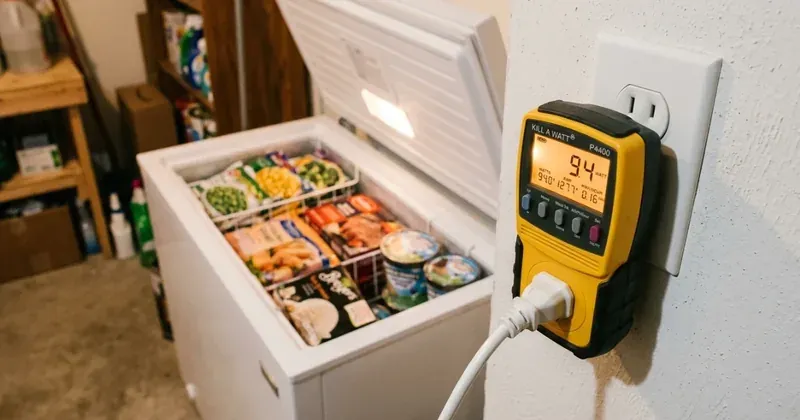
Age and size both matter. Older, larger freezers draw noticeably more running watts and have higher LRA ratings than efficient modern units, so a unit that is 15+ years old should be measured before you buy backup power. A plug-in watt meter will show you the real number in a day or two.
🔍 Why Running Watts and Surge Watts Are Completely Different
This is the most important thing to understand about freezer power, and most guides skip it.
A chest freezer compressor does not run continuously. It cycles on and off to hold temperature. While it is off, the freezer draws almost nothing, only a few watts for the thermostat and any interior light.
When the compressor kicks on, two things happen:
First, the startup surge. For a fraction of a second the motor demands a large burst of power to overcome inertia and start spinning. That burst is typically 6-10 times the running draw.
Second, the running draw. Once the compressor is spinning, consumption drops to the normal running watts until it cycles off again.
If your generator or power station cannot deliver the startup surge, the compressor cannot start. The freezer looks plugged in and powered, the compressor keeps trying, and the food slowly warms. That is the failure you are sizing against.
🔢 How To Calculate Your Exact Startup Surge
Every chest freezer has a data plate on the back or side. Find the LRA number, the Locked Rotor Amps.
LRA x 120 = startup surge watts to plan for
Examples:
- LRA 7.0 means plan for 840W of surge
- LRA 8.3 means plan for 996W
- LRA 10.0 means plan for 1,200W
- LRA 12.0 means plan for 1,440W
LRA is a worst-case figure. Real startups are often lower, but size to the worst case so the freezer starts every time. I wrote a full breakdown of what LRA is and how to find it. Read it before buying any backup power system.
📈 How Ambient Temperature Changes the Draw
Your freezer works harder in summer than in winter. In a hot garage the compressor runs more often and for longer than in a cool basement, so energy use per day goes up even though the running watts stay about the same.
If you are planning backup power for a garage freezer in July, plan with the high end of the ranges in the chart, not the low end.
⏱️ How Long Will a Solar Generator Run a Chest Freezer?
Because the compressor cycles, what matters for runtime is the average draw over a full day, not the running watts. The scenarios below use three average draws and a 15% efficiency buffer on the battery.
| Scenario | Avg draw | Jackery Explorer 1000 V2 (1,070Wh) | EcoFlow DELTA 3 Plus (1,024Wh) | Bluetti Elite 200 V2 (2,073.6Wh) |
|---|---|---|---|---|
| Efficient modern freezer (about 0.7 kWh/day) | 30W | 30 hours | 29 hours | 59 hours |
| Typical freezer (about 1.1 kWh/day) | 45W | 20 hours | 19 hours | 39 hours |
| Older unit or hot garage (about 1.6 kWh/day) | 65W | 14 hours | 13 hours | 27 hours |
These are calculated estimates from the figures on this page, not measurements. Manufacturer runtime claims are often based on a flat 100W or 200W load, which does not match how a cycling compressor behaves, so check how any runtime number was calculated.
Not sure which generator fits? Use the free Solar Generator Sizing Calculator. Enter your freezer size and LRA and it gives you a recommendation.
💡 5 Things That Affect Chest Freezer Watt Draw
1. How full it is. A full freezer is more efficient than an empty one. Frozen food acts as thermal mass and cuts how often the compressor runs. Before an outage, fill empty space with water bottles.
2. How old it is. Freezers made before about 2010 can draw far more than modern ENERGY STAR models. If yours is old, measure it before buying backup power.
3. Ambient temperature. Hot environments raise how often the compressor runs. A garage freezer in Arizona in July needs more backup capacity than the same freezer in a climate-controlled basement.
4. How often you open it. Every opening lets cold air out and warm air in, and the compressor has to recover. During an outage, keep the lid closed.
5. Where it sits. A freezer in direct sunlight draws more than one in shade. If you can, move it somewhere cool and shaded before a major outage.
🛒 Which Generator Fits a Chest Freezer?
Based on published specifications, here is how the three units I’d shortlist compare for a chest freezer. Check each maker’s published surge rating against your freezer’s LRA x 120 before you buy.
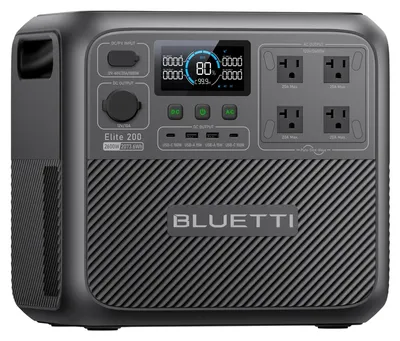
Bluetti Elite 200 V2 (best for headroom)
2,073.6Wh capacity and 2,600W output. On the average draws above, a chest freezer plus a refrigerator, a few lights and a router (about 125W combined) comes to roughly 14 hours on one charge. The trade-off is weight (53.4 lb), price, and that it cannot be expanded. It is overkill if you only need to protect one small freezer.
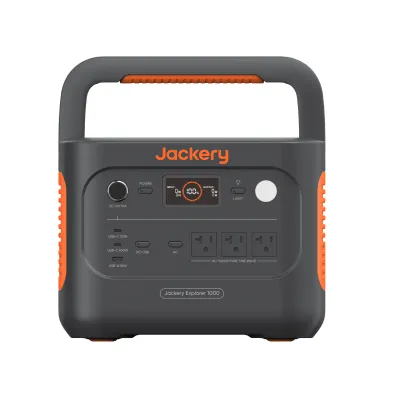
Jackery Explorer 1000 V2 (best for one modern freezer)
1,070Wh capacity. A sensible fit for a single modern chest freezer with a modest LRA. Confirm that Jackery's published surge rating clears your freezer's LRA x 120 before you commit. It has less capacity for adding a fridge on top.
EcoFlow DELTA 3 Plus (1,024Wh) is the third option. Its X-Boost feature is built for loads that need more than the rated output, which is relevant to compressor startups, but confirm the exact limits on EcoFlow’s spec sheet. Our EcoFlow DELTA 3 Plus review covers it against a freezer load.
Sizing a generator to your freezer’s real surge is where most people go wrong: too small and it trips, too big and you overpaid. The Solar Generator Buyer’s Toolkit does the watt math for you.
⚡ Solar Generator Buyer's Toolkit - $19
The surge and running watt math, plus a sizing calculator, so your generator actually starts your freezer the first time.
Get the Toolkit - $19 →❓ FAQ
How many watts does a 7 cubic foot chest freezer use? A 7 cu ft chest freezer typically draws about 85-110 watts while the compressor is running, and 600-800 watts at startup depending on its LRA. Find the LRA on the data plate and multiply by 120 for the surge you need to cover.
How many watts does a chest freezer use per day? Because the compressor cycles on roughly a third of the time, a modern 7 cu ft chest freezer uses about 0.6-0.8 kWh per day. Larger, older or hot-garage units can use twice that or more.
Does a chest freezer use a lot of electricity? Not compared with most large appliances. ENERGY STAR certified chest freezers commonly use about 200-300 kWh a year, which is roughly $26-39 at $0.13/kWh. Chest models generally use less than upright freezers of the same capacity. Your EnergyGuide label has the exact figure.
What size generator do I need for a chest freezer? Choose one whose surge rating clears your freezer’s LRA x 120. For most modern chest freezers that means at least 1,200W of surge capacity. Running capacity of 300-500W is plenty for a single freezer.
You know your surge number. Now what clears it?
A 15 cu ft freezer spiking past 1,200W needs real headroom, not the round number printed on the box. Many units sold as "1,000W" struggle the moment the compressor kicks in.
See which generators actually start a chest freezer →
Why surge watts and running watts are completely different → · How long your food stays safe without power →
About the data
All figures are ranges compiled from manufacturer specification sheets, ENERGY STAR criteria and EnergyGuide labels, plus EIA residential energy statistics. They are not independent lab measurements, and individual freezers vary, so confirm your own numbers on the nameplate and EnergyGuide label. Compiled by Ethan Reynolds. Affiliate-supported; independently researched. Last updated October 2026.