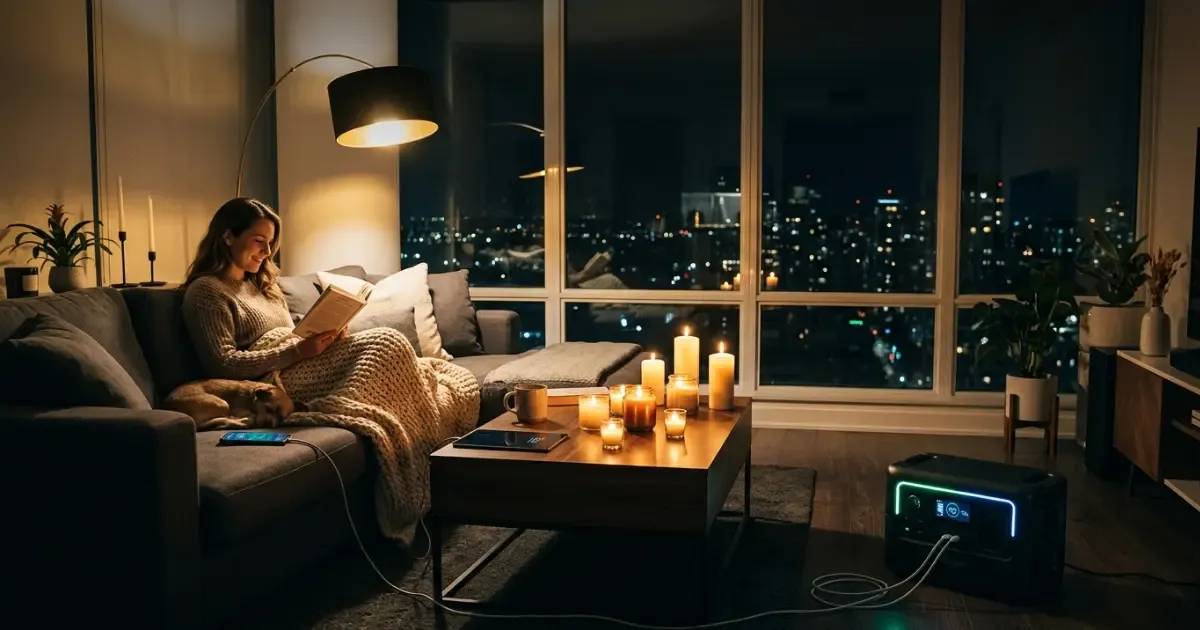
Best Solar Generator for Apartment Living (2026 Guide)
This post contains affiliate links. I earn a small commission if you buy through my links, at no extra cost to you. I only recommend gear I have researched in depth: manufacturer specifications, published teardowns, and aggregated owner reports.
Apartment blackouts have a specific problem: no garage, no balcony space for a noisy gas generator, and neighbours on the other side of every wall.
A battery-based power station suits that situation well. It has no engine and no exhaust, it plugs into a normal outlet, and it needs no installation. This guide shows what it can run in calculated hours, how much a balcony panel really adds, and which of three units fits a small space.
This post contains affiliate links. We earn a small commission if you buy through our links, at no extra cost to you. Specifications come from manufacturer pages and runtimes are our own calculations, not lab tests.
🏠 Apartment renters with no generator option | 👪 Parents in high-rise buildings | 💊 People with medical devices such as a CPAP | 🏙️ Urban dwellers who assumed backup power wasn't possible | 🔧 Minimalists who want simple plug-and-play power
Why Apartments Suit Battery Power Stations
No installation required. Carry it in, plug it into the wall to charge, and plug your devices into it. No electrician is needed. Check your lease or building rules on anything you attach outside.
No exhaust and no engine noise. Gas generators produce carbon monoxide and must never be used indoors or on a balcony. A battery unit has no combustion. It is not silent: the cooling fans can run when the load is high.
Balcony solar can add real energy. A foldable panel in sun adds a few hundred watt-hours a day. See the math below.
Portable between rooms. At 23.8 lb for the Jackery and 27.6 lb for the EcoFlow, both can be moved by one adult, though not casually.
If you plan to run a fridge or window AC, the startup surge decides whether your unit trips or holds.
→ Surge Watts vs Running Watts Explained
What Can You Run in an Apartment?
Apartment essentials draw far less than a whole-house setup. Hours below assume a 1,000Wh unit with a 15% buffer (850Wh usable) and the average draws shown. Compressor appliances only run part of the time, so their average is lower than their label rating.
| Appliance | Assumed average draw | Hours on 1,000Wh |
|---|---|---|
| Wi-Fi router | 10W | 85.0 h |
| Laptop | 55W | 15.5 h |
| Phone charging (x4) | 30W | 28.3 h |
| LED lights (x4) | 30W | 28.3 h |
| Mini fridge (compressor cycling) | 40W | 21.2 h |
| Full-size fridge (compressor cycling) | 60W | 14.2 h |
| CPAP machine, humidifier off | 30W | 28.3 h |
| Window AC (5,000 BTU), running | 475W | 1.8 h |
These are planning figures. Measure your own appliances with a plug-in watt meter for a real number.
What it looks like on each unit
| Setup | Total draw | Jackery 1000 V2 (1,070Wh) | EcoFlow DELTA 3 Plus (1,024Wh) | Bluetti Elite 200 V2 (2,073.6Wh) |
|---|---|---|---|---|
| Mini fridge + router + lights + phones | 110W | 8.3 h | 7.9 h | 16.0 h |
| Full-size fridge + router + lights + phones | 130W | 7.0 h | 6.7 h | 13.6 h |
| Window AC, running | 475W | 1.9 h | 1.8 h | 3.7 h |
A realistic small-apartment setup of a mini fridge, router, lights and phones comes to about 110W, which is 7.7 hours on 850Wh usable.
Balcony Solar: The Real Math
Daily energy from a panel is roughly: panel watts × peak sun hours × 0.75. The 0.75 covers real-world losses, and peak sun hours depend on where you live and the season. At 4 peak sun hours:
- 100W panel: about 300Wh a day
- 200W panel: about 600Wh a day
That extends a battery but does not run a fridge around the clock by itself. A 110W setup uses about 2.6 kWh in 24 hours, so a panel covers only a share of it. Treat solar as a way to stretch a multi-day outage, and charge from the wall before the storm.
Practical notes for a balcony:
- Place panels outside glass if you can. A window cuts output noticeably.
- Check your lease and building rules before fixing anything to a railing, and secure panels against wind.
- Route the cable so it does not pinch in a door, and keep it clear of exits.
The 3 Best Solar Generators for Apartments in 2026
1. Jackery Explorer 1000 V2: Lightest, Best for Most Apartments
- 1,070Wh, 1,500W output, 3,000W surge, 23.8 lb.
- Accepts up to 400W of solar and recharges from the wall in about 1.6 hours.
- Has a smartphone app. It does not expand.
Best for: a small apartment with a mini fridge, devices and lights.
2. EcoFlow DELTA 3 Plus: Fastest Recharge
- 1,024Wh, 1,800W output, 3,600W surge, 27.6 lb.
- About 56 minutes from the wall, and two 500W solar inputs.
- Has a smartphone app, and expands up to 5 kWh. X-Boost helps with some resistive loads, not with motors such as a window AC.
- 4 lb heavier than the Jackery.
Best for: areas with rolling outages, where fast recharge when the grid returns briefly matters.
3. Bluetti Elite 200 V2: Most Capacity, Fixed Spot
- 2,073.6Wh, 2,600W output, up to 1,000W of solar input, 53.4 lb.
- It does not expand, and Bluetti publishes no motor surge rating, so check the startup draw of a window AC before relying on it.
- At 53.4 lb it should stay in one place. The Bluetti AC200L we used to list is discontinued.
Best for: a larger apartment where you want a big buffer in one spot, for example fridge plus a CPAP overnight.
Head-to-Head Apartment Comparison
| Jackery Explorer 1000 V2 | EcoFlow DELTA 3 Plus | Bluetti Elite 200 V2 | |
|---|---|---|---|
| Battery | 1,070Wh | 1,024Wh | 2,073.6Wh |
| Weight | 23.8 lb | 27.6 lb | 53.4 lb |
| Output | 1,500W | 1,800W | 2,600W |
| Surge | 3,000W | 3,600W | None published |
| Solar input | up to 400W | two 500W inputs | up to 1,000W |
| Wall recharge | about 1.6 hours | about 56 minutes | not compared here |
| Expandable | No | Yes | No |
| Best for | Lightest pick | Quick recharge | Largest buffer |
Plan Ahead for Long Outages
In a high-rise, a long outage can also stop elevators and leave stairwells and hallways dark, and building management may not offer backup power to individual units. Charge your unit fully before a storm, keep a flashlight within reach, and check your building's rules on batteries and balcony items. Do not charge or store a power station in a stairwell or exit path.
How to Charge a Solar Generator in an Apartment
Option 1: Balcony panel. A foldable 100 to 200W panel in direct sun adds roughly 300 to 600Wh a day at 4 peak sun hours. Angle it toward the sun and secure it against wind.
Option 2: Window panel. Panels behind glass lose a noticeable share of output but work when no balcony is available.
Option 3: Wall outlet (fastest). The EcoFlow lists about 56 minutes and the Jackery about 1.6 hours. Keep it topped up during storm watches so it is full before the outage.
Option 4: Car charging. Each of these units accepts DC input from a 12V car outlet. It is slow, but it works during a long outage if you have a vehicle.
Know your food-safety window before the outage. A full fridge and a half-full one have different timelines.
→ How Long Does Food Last Without Power?
Don’t Forget Your Emergency Kit
A power station handles your power. A complete apartment outage plan also covers first aid, medication storage, water and 72-hour food supplies.
→ Best Solar Generators for Home Backup Power (2026) → Best Solar Generator Under $1000 → Best Solar Generator for a CPAP Machine → How to Prep Your Home for a Power Outage
🔋 Solar Generator Buyer's Toolkit — $19
A sizing calculator, an appliance wattage reference sheet and a side-by-side comparison worksheet built from manufacturer specs.
Get the Toolkit — $19 →Frequently Asked Questions
Can you use a solar generator in an apartment? Yes. A battery power station has no exhaust and no engine, so it is designed for indoor use. Follow the manual on ventilation and keep it dry, and check your building’s rules on batteries and anything you attach to a balcony.
What size solar generator do I need for an apartment? Add up the average watts of what you want to run, multiply by the hours you need, and divide by 0.85. A mini fridge, router, lights and phone charging come to about 110W, which a 1,000Wh unit covers for roughly 7 to 8 hours. A window AC needs far more: about 1.8 hours on 1,000Wh.
Can I charge a solar generator on my apartment balcony? Yes, if the balcony gets direct sun. Panel watts × peak sun hours × 0.75 gives a daily estimate: about 300Wh from a 100W panel and 600Wh from a 200W panel at 4 peak sun hours. Check your lease first.
Is a solar generator safe to use indoors? It has no combustion, so there is no carbon monoxide. Follow the manufacturer’s manual: keep the vents clear, keep it dry and away from heat, and do not charge or store it in an exit path.
Will a solar generator run a window AC unit? A typical 5,000 BTU window AC draws roughly 475W while running, so a 1,000Wh unit gives about 1.8 hours. That is not enough to cover a night, and the compressor has a startup surge, so check its LRA against the unit’s surge rating. X-Boost does not apply to motors.
Can I use a solar generator for my CPAP machine in an apartment? Yes. With the heated humidifier off, a CPAP at a 30W average uses a 1,000Wh unit for around 3 to 4 nights. See our CPAP guide for the full math.
Specifications are the manufacturers’ published figures and can change. Runtimes are calculated, not measured. Last updated October 2026.