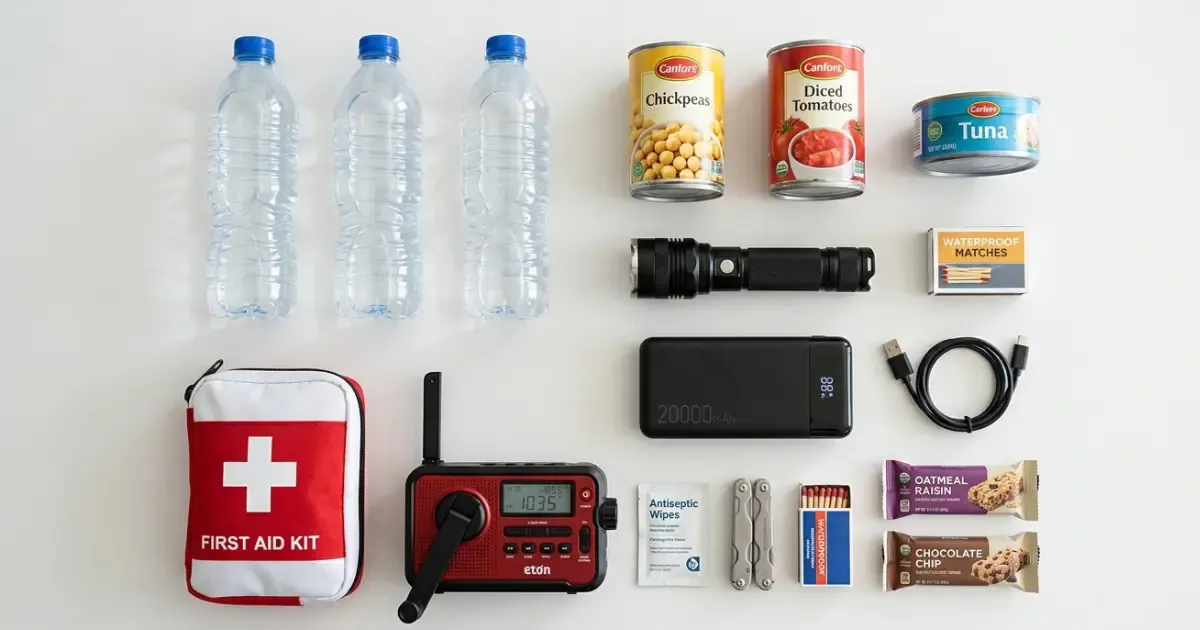
How to Prep Your Home for a Power Outage (2026 Guide)
This post contains affiliate links. I earn a small commission if you buy through my links, at no extra cost to you. I only recommend gear I have researched in depth: manufacturer specifications, published teardowns, and aggregated owner reports.
The night before a big storm, the shelves are empty. Flashlight batteries are sold out, you are left with candles you have never used, your phone is at 40%, and you are unsure whether the freezer will survive. Outages like that are mostly avoidable.
This guide covers what to put in place beforehand so the next outage is boring instead of miserable.
🏠 Homeowners prepping for power outages | 🚐 RV owners needing off-grid power | 👪 Parents keeping families safe | 🌱 Homesteaders building grid independence | 🌀 Florida residents prepping for hurricane season
Most guides give you a generic list. This one is organized by how urgent each item is — what you need before the storm, what you set up the day of, and what protects you during a multi-day outage.
| Category | Minimum prep | Full prep |
|---|---|---|
| Water | 3 gallons stored | 1 gal/person/day for 7 days |
| Food | 3 days non-perishable | 2 weeks shelf-stable |
| Light | 2 flashlights + batteries | Rechargeable lanterns + headlamps |
| Power | 1 power bank charged | Solar generator + panels |
| Heat/Cool | Extra blankets | Propane heater + solar fan |
| Communication | Battery radio | Hand crank + NOAA weather radio |
| Medical | First aid kit | 30-day prescription supply |
Step 1 — Water First, Everything Else Second
Water is the one prep that cannot be improvised. You cannot drink from your hot water tank easily, you cannot purify tap water that isn’t running, and you cannot buy water when every store within 20 miles is sold out.
How much water do you actually need
The FEMA standard is 1 gallon per person per day for drinking and basic sanitation. For a family of 4 that is 4 gallons per day, 12 gallons for 3 days, 28 gallons for a week.
Store water in:
- Factory-sealed water jugs (longest shelf life)
- WaterBOB bathtub bladder (100 gallons filled before storm)
- 5-gallon stackable containers (cheapest per gallon)
Do not store water in milk jugs — the plastic degrades and leaches into the water within weeks.
The freezer water trick
Fill every empty space in your freezer with water-filled containers and freeze them solid. This serves double duty: it extends your freezer food safety window from 24 hours to 48+ hours during an outage, and gives you water as it slowly thaws. A full chest freezer keeps food safe for 48 hours without power. A half-full freezer only lasts 24 hours.
For the full breakdown on freezer food safety during outages see the how long does a freezer last without power guide.
Step 2 — Food That Does Not Require Power
What to stock
The goal is food that requires no refrigeration, minimal water, and ideally no cooking. Prioritize calorie density over variety.
Tier 1 — no prep needed:
- Peanut butter and crackers
- Canned fish (tuna, salmon, sardines)
- Nuts and trail mix
- Protein bars
- Shelf-stable whole milk or oat milk
Tier 2 — requires water only:
- Instant oatmeal
- Ramen noodles
- Instant mashed potatoes
- Freeze-dried meals
Tier 3 — requires cooking:
- Canned beans and vegetables
- Pasta and rice (if you have a propane stove)
What most people forget
Manual can opener. Every single preparedness guide mentions it and every single outage produces someone with 40 cans of soup and no way to open them. Buy three. Put one in the kitchen, one in your go bag, one in your car.
If you want a ready-built emergency kit that covers food, first aid, water purification, and communication in one package, SurviveX makes first aid kits that cover the first aid layer of an outage kit; build food, water and light around them.
Step 3 — Light and Communication
Lighting
Candles are a fire hazard during stressful situations. LED lanterns and headlamps are the right answer.
The minimum setup:
- 2 LED headlamps per person (hands-free lighting for cooking, reading, moving around safely)
- 1 large LED lantern per room you will use at night
- Rechargeable batteries or USB-C charging (eliminates the scramble for AA batteries)
Communication
Your phone dies. Your cell tower loses power. Your local news website is down. This scenario happens in every major outage and people are completely isolated from information.
A hand-crank NOAA weather radio costs $30 and requires no batteries, no power, and no internet connection. It receives official emergency broadcasts from the National Weather Service. Buy one and keep it charged.
Step 4 — Power Backup
This is where most people either over-invest or under-invest. Here is the honest breakdown.
What a power bank covers
A 20,000mAh power bank ($30-50) charges your phone 4-6 times and powers a small fan or LED light for hours. It handles 90% of the discomfort of a short outage (under 12 hours). Buy one and keep it plugged in permanently.
What a solar generator covers
A 1,000Wh solar generator like the Jackery Explorer 1000 V2 runs your chest freezer for 14+ hours, charges all devices, and powers a CPAP machine through the night. Paired with a 200W solar panel it recharges during the day and runs indefinitely.
This is the right tool for outages over 12 hours or for households with medical equipment, chest freezers full of food, or family members who cannot tolerate heat.
What nothing covers
Central air conditioning (3,000-5,000W) and electric water heaters (4,500W) cannot run on a portable solar generator. For these you need a whole-home generator or you need a plan to manage without them.
Step 5 — Heat and Cooling
Cold weather outages
Losing heat in winter is dangerous within hours for infants, elderly family members, and pets. Prepare before you need it.
- Mr. Heater Portable Buddy — indoor-safe propane heater, heats a room for 6 hours on one 1lb canister
- Extra blankets — wool or down, one per person minimum
- Layered clothing — thermal base layers stored with your prep supplies
- Identify a warm refuge — a friend’s house, hotel, or community shelter within 30 minutes
Hot weather outages
Heat is more immediately dangerous than cold. A home can reach dangerous temperatures within hours in summer without AC.
- Battery-powered fans (USB or rechargeable)
- Solar generator running a window AC unit on low (1,000Wh handles a small window AC for 3-4 hours)
- Identify a cool refuge — library, mall, or community cooling center
Step 6 — The Day-Of Checklist
When a storm warning is issued, run through this in order:
2-3 days before:
- Fill frozen water containers and pack freezer solid ✓
- Charge all power banks and solar generators to 100% ✓
- Fill car gas tank ✓
- Withdraw $200 cash (ATMs go down) ✓
- Refill any prescriptions due within 30 days ✓
Day of warning:
- Tape freezer lid shut ✓
- Move flashlights and headlamps to accessible locations ✓
- Note the time power went out ✓
- Drape moving blankets over freezer ✓
- Charge phones to 100% ✓
During outage:
- Do not open freezer ✓
- Use headlamps instead of candles ✓
- Check in with neighbors ✓
- Monitor temperature if elderly or infant in home ✓
The Honest Truth About Prepping
Most people wait until a storm is 48 hours away and then panic-buy everything that is already sold out.
The supplies are not the hard part. The hard part is doing it before you need it, when the urgency does not feel real yet.
Keep a running list of what you used during each outage and restock within a week of power coming back. That discipline — not any particular product — is what makes the difference between an outage being an inconvenience and being a crisis.
For families with specific needs — medical equipment, infants, elderly family members, or chest freezers full of food — a solar generator is the single upgrade that changes the experience the most. The best solar generators for home backup guide covers the options at every budget.
🔋 72-Hour Power Outage Survival Kit — $27
Printable checklist + solar generator sizing guide + 7-day no-fridge meal plan.
Get the Kit — $27 →Frequently Asked Questions
How do I prepare my house for a power outage? Start with water (1 gallon per person per day for 3 days minimum), then non-perishable food for 3 days, then light sources and a charged power bank. Fill your freezer with frozen water containers to extend food safety. These four steps cover 90% of what makes outages miserable.
What should I do to prepare for a power outage at home? Fill your freezer completely with frozen water jugs before any storm warning. Charge all devices and power banks to 100%. Tape your freezer shut the moment power cuts. Keep a battery-powered or hand-crank radio for emergency broadcasts. These actions take 30 minutes and cost almost nothing.
How long should I prep for a power outage? FEMA recommends preparing for 72 hours minimum. Most urban outages resolve within 24-48 hours. For rural areas or regions prone to major storms, prepare for 7-14 days. If you have medical equipment or a full chest freezer, invest in a solar generator rated at 1,000Wh or higher.
What is the most important thing to have during a power outage? Water is the most critical. After water, a way to charge your phone (for emergency communication), a light source, and a plan for your freezer food. Everything else improves comfort but these four cover safety.
How do I keep my food safe during a power outage? Keep your freezer sealed and do not open it. A full chest freezer stays safe for 48 hours without power. A full refrigerator stays safe for 4 hours. Fill empty freezer space with frozen water containers before any storm to extend this window. Use a coin-in-cup test to verify if food thawed and refroze while you were away.
What size solar generator do I need for home backup? For essential loads — chest freezer, refrigerator, router, phone charging, and lights — a 1,000Wh solar generator with a 2,000W inverter handles most households. The Jackery Explorer 1000 V2 and EcoFlow DELTA 3 Plus are the top picks at this capacity. See the best solar generators under $1000 for a full comparison.
— Ethan Reynolds is a homeowner who has experienced 11 power outages since 2019. He tests solar generators and emergency power systems for households in regions with unreliable grid power.
Published: Apr 26 2026