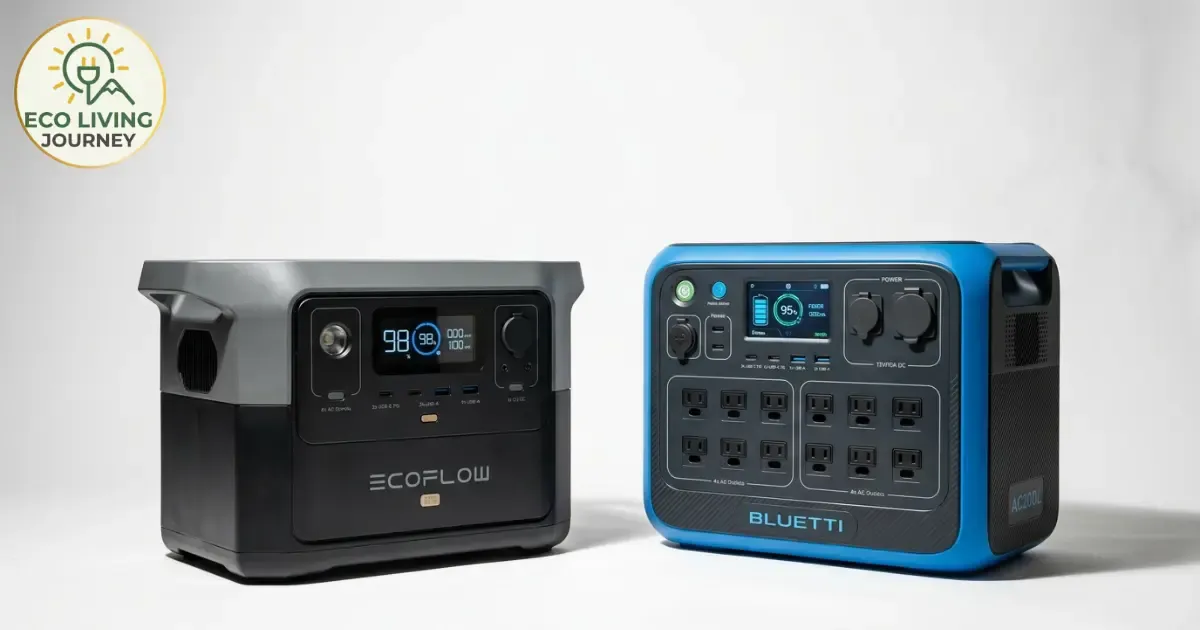
EcoFlow vs Bluetti (2026): DELTA 3 Plus vs Elite 200 V2
This post contains affiliate links. I earn a small commission if you buy through my links, at no extra cost to you. I only recommend gear I have researched in depth: manufacturer specifications, published teardowns, and aggregated owner reports.
This comparison is built from the manufacturers’ published specifications and from calculations, not from lab testing. Runtimes are calculated from battery capacity and typical appliance draw, and each figure is explained so you can check it yourself. Last updated October 2026.
Specs Side by Side
| EcoFlow DELTA 3 Plus | Bluetti Elite 200 V2 | |
|---|---|---|
| Capacity | 1,024Wh | 2,073.6Wh |
| Battery | LiFePO4, 4,000 cycles to 80% | LiFePO4, 6,000+ cycles to 80% |
| AC output (continuous) | 1,800W | 2,600W |
| Surge / boost | 3,600W surge. X-Boost for heating loads up to 2,200W (US) | Resistive loads up to 3,900W. No motor-surge figure on Bluetti’s page |
| AC input | 1,500W | 1,800W max |
| Max solar input | 2 × 500W (1,000W) | 1,000W (12-60V, 20A) |
| Weight | 27.6 lb (12.5 kg) | 53.4 lb (24.2 kg) |
| Expandable | Yes, up to 5 kWh | No |
| UPS switchover | under 10 ms | 15 ms or less |
| Warranty | 5 years | 5 years |
| App | Wi-Fi and Bluetooth | Wi-Fi and Bluetooth |
Specifications come from EcoFlow’s and Bluetti’s published product pages, including Bluetti’s own comparison of the Elite 200 V2 with the AC200L. Regional versions differ slightly, so confirm the figures on the page you buy from.
Which One Fits Your Situation
| Your situation | Better fit | Why |
|---|---|---|
| Home outages of 1-3 days | EcoFlow DELTA 3 Plus | Lighter, refills in under an hour, enough for a fridge or a freezer |
| Hurricane zone, multi-day outages | Bluetti Elite 200 V2 | Twice the capacity before you need solar |
| Full-time RV, daily solar recharge | EcoFlow DELTA 3 Plus | Half the weight and two solar inputs |
| Bigger loads, more outlets in use at once | Bluetti Elite 200 V2 | 2,600W continuous against 1,800W |
| A system you plan to grow | EcoFlow DELTA 3 Plus | It expands to 5 kWh. The Elite 200 V2 does not expand |
| CPAP backup only | Either | A CPAP draws far less than either supplies, so pick the lighter EcoFlow |
| Medical equipment | Bluetti Elite 200 V2 | More capacity means more margin. Check your device’s draw first |
How Long Each Unit Runs a Chest Freezer
A chest freezer’s compressor cycles on and off, so what matters is its average draw over a full day, not its running watts. These figures use three average draws and a 15% battery buffer. They are calculated estimates, not measurements. The averages come from the chest freezer wattage chart.
| Scenario | Avg draw | EcoFlow DELTA 3 Plus | Bluetti Elite 200 V2 |
|---|---|---|---|
| Efficient modern freezer | 30W | 29 hours | 59 hours |
| Typical freezer | 45W | 19 hours | 39 hours |
| Older freezer or hot garage | 65W | 13 hours | 27 hours |
| Typical freezer plus a fridge (about 90W combined) | 90W | 10 hours | 20 hours |
What this means: without solar, neither unit covers a fridge and a freezer for a full 24 hours. The Bluetti comes closest at about 20 hours, while the EcoFlow covers about 10. For a single freezer, the EcoFlow gets you through most overnight outages, and the Bluetti through more than a day.
Before you buy, check that the unit can start your freezer. Multiply the freezer’s LRA by 120 to get its startup surge, as explained in our guide to what LRA means and in surge watts vs running watts.
Recharge Speed: Faster Fill or More Watts per Hour
| EcoFlow DELTA 3 Plus | Bluetti Elite 200 V2 | |
|---|---|---|
| From the wall | 0-100% in 56 min (1,500W input) | About 1.2 hours (calculated from 1,800W input) |
| Maximum solar | Full in about 70 min with 2 × 500W (EcoFlow’s figure) | About 2.1 hours at 1,000W (calculated, ideal conditions) |
| With 400W of panels (calculated, assuming 75% real-world output) | about 3.4 hours | about 6.9 hours |
The EcoFlow finishes sooner because its battery is half the size. Measured in watt-hours added per hour, the two are close: the Bluetti takes in a little more from the wall (1,800W against 1,500W), and both accept 1,000W of solar. If you recharge every day on the road, a smaller battery that fills quickly is convenient. If you need the most stored energy, the Bluetti’s larger battery is the point.
Power Output and Surge
The Bluetti Elite 200 V2 supplies 2,600W continuous, and Bluetti says it handles resistive loads such as kettles and heaters up to 3,900W. The EcoFlow DELTA 3 Plus supplies 1,800W continuous with a published 3,600W surge. Its X-Boost mode can run resistive loads above its rated output, up to 2,200W on US models, but it does not raise the output for motor loads.
In practice, both start a typical chest freezer. Bluetti’s product page does not publish a surge figure for motor loads such as a well pump or a large window AC unit, so check the nameplate of the appliance and the maker’s spec sheet before you rely on either unit for one.
Capacity, Weight and Expansion
The Bluetti stores twice the energy and weighs about 26 lb more. Only the EcoFlow can be expanded, with extra batteries up to 5 kWh. The Elite 200 V2 is a fixed 2,073.6Wh, so you commit to its capacity when you buy. If the unit stays in one spot such as a garage, weight matters little. If you move it between a vehicle, a campsite and the house, the EcoFlow’s 27.6 lb is a real advantage.
Battery Life
At one full cycle a day, 4,000 cycles lasts about 11 years and 6,000 cycles about 16 years. EcoFlow rates the DELTA 3 Plus at 4,000 cycles to 80% capacity, and Bluetti rates the Elite 200 V2 at 6,000+ cycles. Both list a 5-year warranty. Real battery life depends on temperature, depth of discharge and how often you cycle the unit.
Cost per Watt-Hour
Divide the price by the capacity to compare. The Bluetti usually costs less per watt-hour because it packs twice the battery into one unit, while the EcoFlow costs less to buy. Prices change often and both brands run sales, so compare current prices at the links below. If you only need a night or two of backup, the cheaper EcoFlow can be the better value. If you want the most stored energy for the money, the Bluetti usually wins.
For more options by budget, see the best solar generator under $1,000 and the best solar generator for home backup.
What Happened to the Bluetti AC200L
Bluetti lists the AC200L as discontinued, and its product page shows every variant that way. If you still find one at a retailer, here is how it compares with its current counterpart, based on Bluetti’s own comparison table:
| Bluetti AC200L (discontinued) | Bluetti Elite 200 V2 | |
|---|---|---|
| Capacity | 2,048Wh | 2,073.6Wh |
| AC output | 2,400W | 2,600W |
| Cycle life | 3,000+ cycles to 80% | 6,000+ cycles to 80% |
| Max solar input | 1,200W | 1,000W |
| Expandable | Yes, with Bluetti battery packs | No |
| Weight | 62.4 lb | 53.4 lb |
The Elite 200 V2 is lighter, has more output and a longer rated life, but it gives up the AC200L’s expansion and 200W of solar input. Our Bluetti AC200L review still covers the older model in detail.
Verdict
Most homeowners who want to protect a fridge or a single freezer through a one- or two-night outage are well served by the 1,024Wh EcoFlow DELTA 3 Plus: it is light, refills fast and starts typical freezers. Buy the Bluetti Elite 200 V2 if you want multi-day capacity without solar or need to run larger loads together. Buying the bigger unit “to be safe” when you only need 1,024Wh means paying for, and carrying, capacity you will not use.
For a closer look at each unit, read our EcoFlow DELTA 3 Plus review and the EcoFlow vs Jackery comparison.
Emergency Kit for Extended Outages
Whichever unit you choose, pair it with a complete emergency kit for multi-day outage readiness.
Frequently Asked Questions
Is EcoFlow better than Bluetti? Neither is better overall. The EcoFlow DELTA 3 Plus is lighter (27.6 lb vs 53.4 lb), refills from the wall in 56 minutes and can be expanded, which suits home backup and RV use. The Bluetti Elite 200 V2 has twice the capacity and more output (2,600W vs 1,800W), which suits multi-day outages and bigger loads.
Which lasts longer, EcoFlow or Bluetti? Both use LiFePO4 batteries. EcoFlow rates the DELTA 3 Plus at 4,000 cycles to 80% capacity and Bluetti rates the Elite 200 V2 at 6,000+ cycles. At one cycle a day that is roughly 11 years and 16 years, though real life depends on temperature and use. Both carry a 5-year warranty.
Can the Bluetti Elite 200 V2 run a whole house? No. With 2,073.6Wh and 2,600W it can run essential circuits such as a refrigerator, a freezer, lights and device charging. It cannot run central air conditioning, an electric water heater or an electric range, which typically need 3,000-5,000W.
Is the Bluetti AC200L still available? Bluetti lists the AC200L as discontinued. Its current counterpart is the Elite 200 V2, which is lighter and has a longer rated cycle life but cannot be expanded.
Which is better for an RV? The EcoFlow for most RV owners, because it weighs about half as much and has two solar inputs. The Bluetti suits long off-grid stays where you want the most stored energy and can carry the extra weight.
How long will each unit run a chest freezer? On a calculated estimate for a typical freezer (45W average draw), about 19 hours on the EcoFlow DELTA 3 Plus and about 39 hours on the Bluetti Elite 200 V2, using a 15% battery buffer. See the runtime table above for other scenarios.
About These Figures
Specifications come from manufacturer product pages and retailer listings for the US versions. Runtimes and recharge times marked as calculated are derived from capacity, input power and typical appliance draw, and are estimates, not test results. Compiled by Ethan Reynolds. Affiliate-supported; independently researched.
Published May 12, 2026. Last updated October 6, 2026.