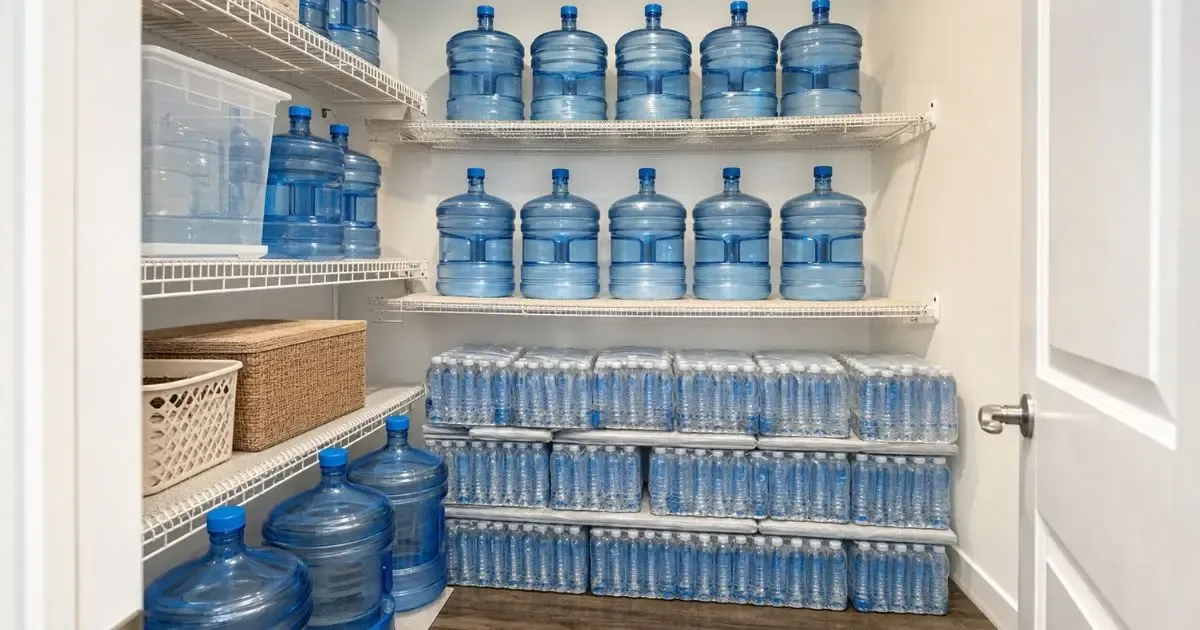
Emergency Water Storage: How Much You Really Need
This post contains affiliate links. I earn a small commission if you buy through my links, at no extra cost to you. I only recommend gear I have researched in depth: manufacturer specifications, published teardowns, and aggregated owner reports.
Many people spend months on backup power and never think about the one thing a household needs more urgently than electricity. You can survive weeks without power. You can survive only about three days without water.
Affiliate disclosure: some links below are affiliate links. We earn a commission at no extra cost to you.
This guide covers how much water to store, the main storage methods, and how to keep it safe.
⚡ Quick Answer: Store one gallon per person per day, for a minimum of 14 days (FEMA says 3 days; 3 days is not enough for a real event). For a family of four, that’s 56 gallons minimum. Store it in food-grade containers, keep it out of sunlight, and rotate every 6–12 months. Commercially sealed bottled water lasts indefinitely if unopened and stored cool.
💧 How Much Water Do You Actually Need?
The standard emergency guidance is one gallon per person per day. That number covers drinking plus basic hygiene and cooking. Here’s how it scales:
| Household | Per day | 3 days (FEMA min) | 14 days (realistic) | 30 days (serious prep) |
|---|---|---|---|---|
| 1 person | 1 gal | 3 gal | 14 gal | 30 gal |
| 2 people | 2 gal | 6 gal | 28 gal | 60 gal |
| 4 people | 4 gal | 12 gal | 56 gal | 120 gal |
| Family + pet | ~5 gal | 15 gal | 70 gal | 150 gal |
Don’t forget pets. A medium dog needs about 0.5–1 gallon per day. Add it to your total.
Our take: FEMA’s 3-day standard exists because it’s achievable for everyone, not because it’s enough. Outages after major hurricanes can run well beyond three days (after Hurricane Ian in 2022, some Florida customers were out for more than two weeks, per the U.S. Energy Information Administration), so a 14-day supply is a sensible target if you have the space.
SurviveX discount: 10% off everything
Use code GETREADY10 at checkout
Plus free shipping on orders over $50
Code valid through 30 November 2026. Cannot be combined with other offers.
🕐 How Long Does Stored Water Last?
This is the question that surprises people most.
Commercially bottled water: Effectively indefinite if unopened and stored cool and dark. The “expiration” date on bottled water is about plastic quality and taste, not safety. I’ve drunk 3-year-old sealed bottles with no issue.
Tap water you store yourself: 6 months before you should rotate it, because your tap water isn’t sterile-sealed. It doesn’t go “bad” so much as flat and stale — and any bacteria present will slowly multiply.
Water in food-grade storage barrels: 6–12 months with proper treatment, longer if you add a water preserver concentrate.
| Storage type | Safe duration | Rotate every |
|---|---|---|
| Sealed store-bought bottles | Indefinite | 2 years (taste) |
| Home-stored tap water | 6 months | 6 months |
| Treated barrel water | 6–12 months | 12 months |
| Water with preserver additive | Up to 5 years | 5 years |
🛢️ Best Ways to Store Emergency Water
Here are four common storage methods.
1. Cases of bottled water — easiest. Buy flats, stack them in a closet, done. Downside: bulky and expensive per gallon. Best for the first 3–5 days of supply where grab-and-go matters.
2. 5–7 gallon jugs (stackable) — best balance. Food-grade containers like the Reliance Aqua-Tainer are the sweet spot: portable enough to carry, big enough to matter. This is a good starting point for most families.
3. 55-gallon barrels — best value per gallon. One barrel = a week of water for a family of four. But full, it weighs ~450 lbs and can’t be moved. You need a siphon pump and a permanent spot for it.
4. WaterBOB (bathtub storage) — best for incoming storms. A food-grade bladder that fills your bathtub with up to 100 gallons when you know a hurricane is coming. Single-use, but brilliant for short-notice events.
Never store water in: old milk jugs (they degrade and leak), containers that held non-food chemicals, or anything not labeled food-grade. Milk jug plastic breaks down within months and the residual sugars grow bacteria.
🧪 How to Store Tap Water Safely (Step by Step)
If you’re filling your own containers, do it right:
- Clean the container with dish soap and rinse thoroughly.
- Sanitize with a solution of 1 teaspoon unscented household bleach per quart of water; swirl to coat, then rinse.
- Fill from a safe tap (municipal treated water — it already contains chlorine).
- If using well or untreated water, add 2 drops of unscented bleach per gallon and let it stand 30 minutes.
- Seal tightly, label with the date, and store somewhere cool and dark.
- Rotate every 6 months.
Heat and light are the enemies. A garage that hits 90°F in summer will degrade stored water and its container faster than a closet inside the house.
🌀 Water Storage for Hurricanes & Disasters
Hurricanes are the scenario where water storage saves the day, because municipal water often gets contaminated or loses pressure when the grid goes down and pumping stations fail.
Your hurricane water plan should layer three tiers: grab-and-go bottles for evacuation, stored jugs or barrels for sheltering in place, and a WaterBOB filled the moment a storm enters the forecast cone. Filling the tub before a named storm costs almost nothing.
Pair this with the rest of your prep. Our full hurricane preparedness checklist covers power, food, and medical alongside water, and what to do during a power outage walks through the first-hour priorities.
👨👩👧 Family & Kids: Don’t Underestimate Usage
Real families can use more water than the calculators suggest. Kids spill, formula needs mixing, and someone always wants to wash up. The common planning baseline is 1 gallon per person per day for drinking and basic hygiene, so build in a buffer for a family.
Build in a buffer. If the math says 56 gallons for two weeks, consider storing 70. Water is the cheapest insurance in your entire prep, and running short is the one shortage you can’t improvise your way out of.
💰 What It Costs (The Cheap Insurance)
Here’s the cost reality that makes water storage a no-brainer:
| Method | Approx cost | Cost per gallon |
|---|---|---|
| Bottled water flats | ~$5 per 24-pack (3 gal) | ~$1.65/gal |
| 7-gallon Aqua-Tainer | ~$17 each | one-time, reusable |
| 55-gallon barrel + pump | ~$90 setup | pennies/gal after |
| WaterBOB | ~$35 | reusable-ish (100 gal) |
For under $100 you can store two weeks of water for a family of four using reusable containers. Compare that to a solar generator or a full emergency kit — water is by far the highest-value dollar in prepping.
🧰 Beyond Storage: Purification Backup
Storage covers you for days to weeks. For anything longer, you need a way to make water safe. Keep at least one backup method: a quality gravity filter, water purification tablets, or the ability to boil (rolling boil for 1 minute kills pathogens). A filter plus stored water is the combination that turns “two weeks” into “as long as you need.”
A solar generator helps here too — it can boil water on an electric kettle or run a purification setup when the gas is out. If you don’t have backup power yet, start with our guide to emergency power at home.
🧰 72-Hour Power Outage Survival Kit — $27
The complete printable checklist for the first 72 hours — water, power, food, and medical — built from real outages, not generic templates.
Get the Kit — $27 →Water is tier one — but a full emergency kit covers the rest. SurviveX makes first aid kits that cover the injuries outages usually bring.
Free shipping on orders $50+. 10% off your first order with newsletter signup.
Shop SurviveX Kits →
❓ Frequently Asked Questions
How much water should I store per person? One gallon per person per day covers drinking, cooking, and basic hygiene. For a realistic emergency, store 14 days’ worth — 14 gallons per person. FEMA’s 3-day minimum is a floor, not a target.
Does stored water expire? Commercially sealed bottled water doesn’t expire for safety purposes if kept cool and dark — the date is about taste and plastic quality. Home-stored tap water should be rotated every 6 months.
Can I store tap water in old milk jugs? No. Milk jug plastic degrades within months and residual sugars promote bacterial growth. Use food-grade containers designed for water storage.
How do I purify water if I run out of stored supply? Boil at a rolling boil for 1 minute, use unscented household bleach (2 drops per gallon, wait 30 minutes), water purification tablets, or a quality gravity filter. Keep at least one backup method on hand.
How long can a person survive without water? Roughly three days, though this varies with heat, exertion, and health. This is why water is the single highest priority in any emergency plan — well ahead of food or power.
How much does emergency water storage cost? Under $100 covers two weeks of water for a family of four using reusable food-grade containers. It’s the cheapest high-value item in any preparedness plan.
How much water do I need for a hurricane specifically? Minimum 14 days per person, because outages and water contamination after major storms routinely last a week or more. Fill a WaterBOB in your tub the moment a storm enters the forecast.
Do I need to add anything to stored tap water? Municipal tap water already contains chlorine and needs nothing extra for 6-month storage. For well or untreated water, add 2 drops of unscented bleach per gallon before sealing.
🔗 Related Reading
- Hurricane Preparedness Checklist
- What to Do During a Power Outage
- Emergency Power at Home
- Best Emergency Kit for Power Outages
About Ethan
Ethan Reynolds writes about emergency and backup power for households. Specifications come from manufacturers and official guidance, and calculations are shown so you can check them.
Last updated: October 2026