Carbon Monoxide Safety During a Power Outage: Generator Rules
This post contains affiliate links. I earn a small commission if you buy through my links, at no extra cost to you. I only recommend gear I have researched in depth: manufacturer specifications, published teardowns, and aggregated owner reports.
Carbon monoxide (CO) is the quiet danger of a power outage. It is colorless and odorless, and the usual source is a gas generator, a grill, a camp stove or a heater used indoors. The CDC says more than 400 Americans die each year from unintentional CO poisoning, and outages are a known time for it to happen.
How the numbers work: wattages are typical ranges from manufacturer spec sheets and efficiency labels, so check the label on your own appliance. Runtimes are calculated, not lab-tested: usable energy = rated Wh × 0.85, divided by average watts.
⚡ Quick Answer
- Never run a generator inside a home, garage, basement, shed or any partly enclosed space.
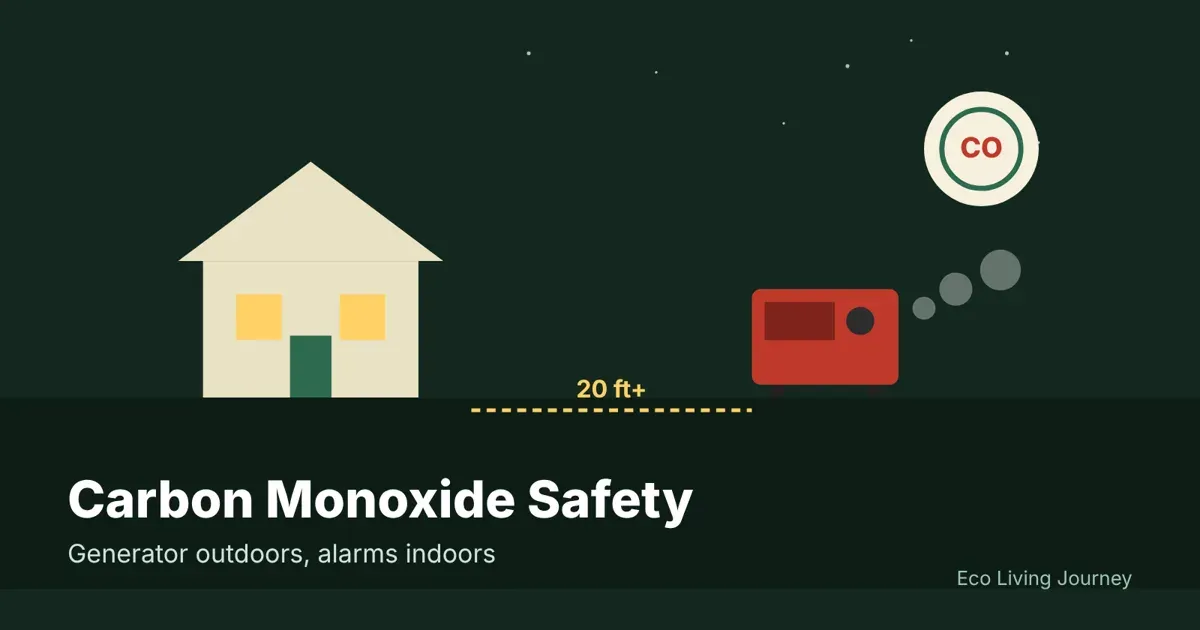
- Keep it outdoors and at least 20 feet from windows, doors and vents (CDC guidance). The Red Cross adds that opening doors and windows or running fans will not stop CO building up indoors.
- Install CO alarms with battery backup near every sleeping area and test them monthly. A plug-in alarm alone does nothing when the power is out.
- Never burn charcoal, or use a camp stove, grill or gas oven, to heat the home.
- A battery power station makes no exhaust, so it cannot make CO. That is the main safety reason to use one for indoor loads.
🚨 Symptoms to Know
The CDC lists the common symptoms of CO poisoning as headache, dizziness, weakness, upset stomach, vomiting, chest pain and confusion. People who are asleep or have been drinking can die before they notice any symptoms. If you suspect CO poisoning, get everyone outside into fresh air and call 911. In the US, Poison Help (1-800-222-1222) can also advise.
🏠 Safe Rules for Gas Generators
- Place it outside, downwind, 20+ feet from the house, with the exhaust pointing away from windows, doors and vents.
- Never run it in a garage, even with the door open.
- Keep it dry under a proper generator cover or canopy, not in the rain.
- Let it cool before refueling and store fuel outside living areas, in approved containers.
- Run cords to appliances instead of moving the generator closer. See can you plug a power station into a wall outlet for the cord and backfeeding rules.
🔋 The Battery Alternative
A portable power station is silent and has no exhaust, so you can run a router, phone chargers, lights, a CPAP or a fridge from inside the house without any CO risk. The trade-off is capacity: a battery holds a fixed amount of energy, while a generator keeps going as long as it has fuel. Our power station vs gas generator comparison goes through the trade-offs in detail, and the fridge runtime guide shows how long a typical unit lasts.
Quick picks
EcoFlow DELTA 3 Plus (1,024Wh, 1,800W): silent, no-fumes power for indoor essentials. Check the current listing on EcoFlow's site.
Bluetti Elite 200 V2 (2,073.6Wh, 2,600W): longest runtime of the three in this guide. Check Bluetti Elite 200 V2 Price
Jackery Explorer 1000 V2 (1,070Wh, 1,500W, 3,000W surge): lighter and cheaper. Check Jackery Explorer 1000 V2 Price
🔥 Heating Is the Other Big Risk
Many CO incidents in winter involve heat sources, not generators. Do not use a gas oven, a charcoal grill or a camp stove for heat. Our winter outage guide covers safer ways to stay warm, and can a power station run a space heater explains why electric heat drains a battery fast.
✅ Bottom Line
Generator outdoors and far from the house, battery-backed CO alarms in sleeping areas, and no fuel-burning appliances for heat. For the wider plan, see what to do during a power outage.
A first aid kit belongs next to your backup power. SurviveX kits are designed in Falls Church, VA, reviewed in-house by a former EMT/firefighter, qualify for FSA/HSA spending, carry a lifetime warranty, and ship free over $50 (per survive-x.com). See SurviveX First Aid Kits
🔗 Related Guides
- Power station vs gas generator
- Can you plug a power station into a wall outlet?
- How to stay warm in a winter outage
- Can a power station run a space heater?
- What to do during a power outage
- Emergency power at home
❓ Frequently Asked Questions
How far should a generator be from the house?
The CDC says to keep a generator at least 20 feet from windows, doors and vents, outdoors, with the exhaust pointing away from the house. Never run it in a garage, basement or shed.
Can I run a generator in the garage with the door open?
No. Open doors and windows and fans do not prevent carbon monoxide from building up indoors, according to the Red Cross. A generator belongs outdoors only.
What are the symptoms of carbon monoxide poisoning?
The CDC lists headache, dizziness, weakness, upset stomach, vomiting, chest pain and confusion. If you suspect CO poisoning, get outside to fresh air and call 911.
Do I need a CO alarm with battery backup?
Yes. CO alarms should be near every sleeping area, and a battery or battery-backup model keeps working when the power is out. Test the batteries monthly.
Does a portable power station give off carbon monoxide?
No. A battery power station has no combustion and no exhaust, so it cannot produce carbon monoxide.