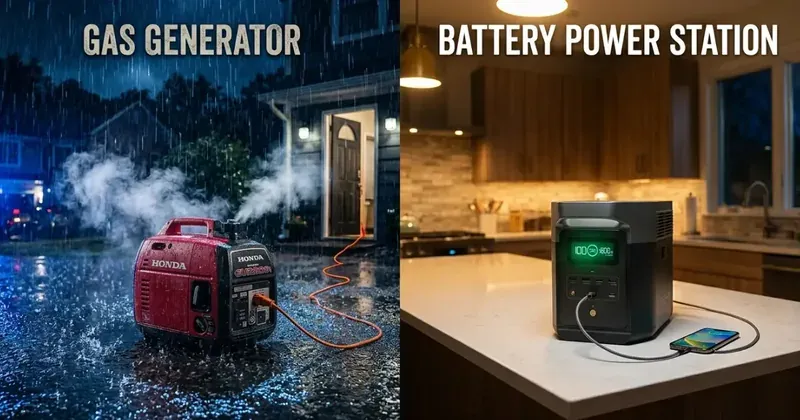
Portable Power Station vs Gas Generator: The True Cost Math
This post contains affiliate links. I earn a small commission if you buy through my links, at no extra cost to you. I only recommend gear I have researched in depth: manufacturer specifications, published teardowns, and aggregated owner reports.
A gas generator sitting in the garage with stale fuel and a gummed-up carburetor is one of the most common ways a backup plan fails. This guide compares a portable power station with a gas generator on cost, noise, safety and practicality, and says plainly where the gas generator still wins.
This post contains affiliate links. We earn a small commission if you buy through our links, at no extra cost to you. Specifications come from manufacturer pages. The cost figures below are illustrative assumptions, not measured data, so use your own prices.
The 30-Second Answer
For the loads a power station can handle, such as a chest freezer, refrigerator, router, lights and devices, a power station can cost less than a gas generator over ten years once fuel and maintenance are counted, and it is quieter and safer to use. A gas generator wins on raw output and on long outages, especially for 240V loads like well pumps and central AC.
The Cost Comparison (Illustrative Assumptions)
We compare a 3,500W gas generator at about $600 with the EcoFlow DELTA 3 Plus at about $1,000. Prices vary, so swap in current figures.
Gas Generator, 10-Year Cost
| Cost Item | Assumption | Amount |
|---|---|---|
| Purchase price | $600 | |
| Fuel | 5 gallons at $4 per outage, 3 outages a year | $600 over 10 years |
| Maintenance | Oil, plugs, stabilizer, $80 a year | $800 over 10 years |
| Carburetor cleaning | $150 every 3 to 4 years | about $450 over 10 years |
| 10-year total | about $2,450 |
EcoFlow DELTA 3 Plus, 10-Year Cost
| Cost Item | Assumption | Amount |
|---|---|---|
| Purchase price | about $1,000 | |
| Electricity | About 1kWh per charge at $0.15, 3 charges a year | about $5 over 10 years |
| Maintenance | None scheduled | $0 |
| 10-year total | about $1,005 |
Under these assumptions the power station costs less than half as much over ten years even though it costs more upfront, and the extra purchase price pays back in roughly two to three years.
An important caveat: the two units are not equal in capability. A 3,500W gas generator can supply far more power and run for as long as you have fuel. The DELTA 3 Plus has 1,024Wh of storage, about 870Wh usable, so the comparison only holds for the loads it can serve, and for longer outages you need solar recharging or a larger setup.
Head-to-Head Practical Comparison
| Factor | Gas Generator | Portable Power Station |
|---|---|---|
| Upfront cost | Lower | Higher |
| 10-year cost (assumptions above) | Higher | Lower |
| Maximum output | Much higher | Limited (1,800W continuous, 3,600W surge for the DELTA 3 Plus) |
| Indoor use | Never; carbon monoxide risk | Safe; no exhaust |
| Noise | Loud | Quiet |
| Startup | Manual or electric start, needs fresh fuel | Plug in and switch on |
| Fuel storage | Required | None |
| Maintenance | Regular | Minimal |
| Solar recharge | No | Yes |
| Long outages | Strong, if fuel is available | Needs solar or a larger system |
What an Outage Night Looks Like (Illustrative)
With a gas generator
The storm hits at 11 PM. The fuel is old, so it takes several pulls to start. It has to run outdoors, well away from windows and doors, never in a garage, with an extension cord back to the fridge. It is loud, it needs refuelling every few hours, and a fuel run in the middle of the night may be impossible if stations are closed.
With a power station
You plug the freezer, router and phones into the unit and go to sleep. It runs silently indoors. With a freezer averaging 45W it runs about 19 hours on the DELTA 3 Plus (870Wh usable ÷ 45W), and a solar panel can extend that in good sun.
When the Generator Actually Wins
| Use Case | Better choice |
|---|---|
| 240V well pump | Gas generator on a transfer switch |
| Central air conditioning | Gas generator or a whole-home system |
| Very long outages without solar | Gas generator, if you have fuel |
| Multiple large appliances at once | Gas generator |
| Chest freezer and basics | Power station |
| Quiet or indoor use | Power station |
For central AC, large 240V well pumps or very long outages without sun, a gas generator is the right tool. Connecting a generator to household wiring needs a transfer switch or interlock installed by a licensed electrician. For a chest freezer, refrigerator and basic devices, a power station is a good fit.
The Safety Issue
Carbon monoxide poisoning from portable generators is a leading cause of death after storms, and the US Consumer Product Safety Commission reports dozens of deaths each year, mostly when generators run in garages or near open windows.
A portable power station produces no exhaust and can run in any room. Never run a gas generator indoors, in a garage, or near windows, doors or vents, and keep a battery-powered CO detector on every floor.
Our Recommendation
If your goal is to keep a chest freezer, refrigerator and devices going through a typical outage of several hours to a day, a portable power station is the simpler, safer choice. Check your freezer’s LRA first: multiply it by 120 and add 20% to compare to the surge rating. Our LRA guide shows how.
If you have a 240V well pump or central AC you must run, use a properly installed gas generator for those loads and a power station for the indoor essentials.
Not sure what your setup needs? Use the free Solar Generator Sizing Calculator.
FAQ
What about propane generators? Are they better than gas? Propane stores for years without going stale, unlike gasoline, which can go stale in a few months. For a household with an existing propane supply, a propane or dual-fuel generator is more reliable than a gasoline one. A power station still wins on noise, emissions and maintenance.
Can I use both a generator and a power station? Yes. Use the generator for heavy 240V loads like well pumps and central AC, with a transfer switch installed by a licensed electrician, and the power station for indoor loads like the freezer, fridge and devices.
How long does gasoline last in a stored generator? Untreated gasoline can degrade in as little as a month or two and is unreliable after about three months. With a fuel stabilizer, treated gasoline can remain usable for a year or more. Stale fuel is a leading cause of generator startup failures. Check your generator’s manual.
What is the maintenance schedule for a portable generator? Follow your manual. A common pattern is an oil change every year or every 50 hours, air filter cleaning, a spark plug check, and fuel system care if the unit sits with fuel in it. Many owners skip this, which is why generators fail when they are needed.
Is a portable power station worth the higher upfront cost? Under the assumptions above, the 10-year cost is about $1,445 lower. Your numbers depend on how often you have outages and what you pay for fuel, and a power station can only serve the loads and hours its battery allows.
Costs are illustrative assumptions, specifications are the manufacturer’s published figures, and runtimes are calculated. Last updated October 2026.