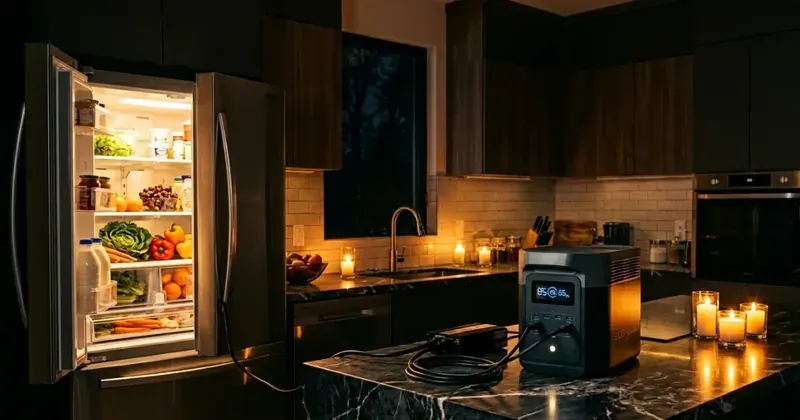
What Kitchen Appliances Can a Power Station Run? (Wh per Use)
This post contains affiliate links. I earn a small commission if you buy through my links, at no extra cost to you. I only recommend gear I have researched in depth: manufacturer specifications, published teardowns, and aggregated owner reports.
Kitchen appliances are the high-wattage, short-duration loads. A microwave or kettle draws 1,000-1,500W, which sounds like trouble, but you only run it for a few minutes. What matters is watt-hours per use.
How the numbers work: wattages are typical ranges from manufacturer spec sheets and efficiency labels, so check the label on your own appliance. Runtimes are calculated, not lab-tested: usable energy = rated Wh × 0.85, divided by average watts.
📊 Watt-Hours per Use
Typical wattages and run times. Check your own appliance’s label.
| Appliance | Typical watts | Typical use | Energy per use | Uses per 1,000Wh (85% usable) |
|---|---|---|---|---|
| Microwave | 1,000W | 5 minutes | about 83Wh | about 10 |
| Coffee maker | 900W | 10 minutes | about 150Wh | about 5 |
| Electric kettle | 1,500W | 4 minutes | about 100Wh | about 8 |
| Toaster | 1,000W | 3 minutes | about 50Wh | about 17 |
| Slow cooker | 200W | 8 hours | about 1,600Wh | 0.5 |
| Induction cooktop | 1,800W | 15 minutes | about 450Wh | about 2 |
Takeaways: quick-heat appliances are fine on a modest battery, slow cookers eat a full day’s budget, and an induction cooktop is only worth running for a few short meals.
⚡ Output Matters More Than Capacity Here
A 1,500W kettle needs an output rating above 1,500W. The Jackery Explorer 1000 V2 is rated 1,500W continuous, which leaves no headroom; the EcoFlow DELTA 3 Plus (1,800W) and Bluetti Elite 200 V2 (2,600W) have more margin. A small unit like the Bluetti EB3A (600W) cannot run these appliances.
Quick picks
EcoFlow DELTA 3 Plus (1,800W): covers most kitchen appliances one at a time. Check the current listing on EcoFlow's site.
Bluetti Elite 200 V2 (2,073.6Wh, 2,600W): longest runtime of the three in this guide. Check Bluetti Elite 200 V2 Price
Jackery Explorer 1000 V2 (1,070Wh, 1,500W, 3,000W surge): lighter and cheaper. Check Jackery Explorer 1000 V2 Price
🔥 Cooking Safely in an Outage
- Never use a charcoal grill, camp stove or gas oven indoors. The CDC warns these produce carbon monoxide.
- Stagger heavy loads. Run the microwave, then the kettle, not both together.
- Keep the fridge first. Reserve capacity for the fridge before the coffee maker. See how long a battery runs a fridge.
A first aid kit belongs next to your backup power. SurviveX kits are designed in Falls Church, VA, reviewed in-house by a former EMT/firefighter, qualify for FSA/HSA spending, carry a lifetime warranty, and ship free over $50 (per survive-x.com). See SurviveX First Aid Kits
🔗 Related Guides
- Full appliance wattage guide
- Refrigerator watts
- What to do during a power outage
- Best units under $1,000
❓ Frequently Asked Questions
Can a power station run a microwave?
Yes, if its output is above the microwave’s wattage (typically about 1,000W). A 5-minute run uses roughly 83Wh, so a 1,000Wh class unit gives about 10 uses.
How many watts does a coffee maker use?
About 900W while heating. A 10-minute brew is roughly 150Wh.
Can I run an electric kettle on a battery?
Yes with a unit rated above 1,500W continuous. A 4-minute boil is roughly 100Wh.
Can a power station run an induction cooktop?
Only a larger unit with output above about 1,800W, and only for short meals, since 15 minutes of cooking uses about 450Wh.
Is it safe to cook indoors with a grill during an outage?
No. Charcoal grills, camp stoves and gas ovens used indoors produce carbon monoxide, according to the CDC.