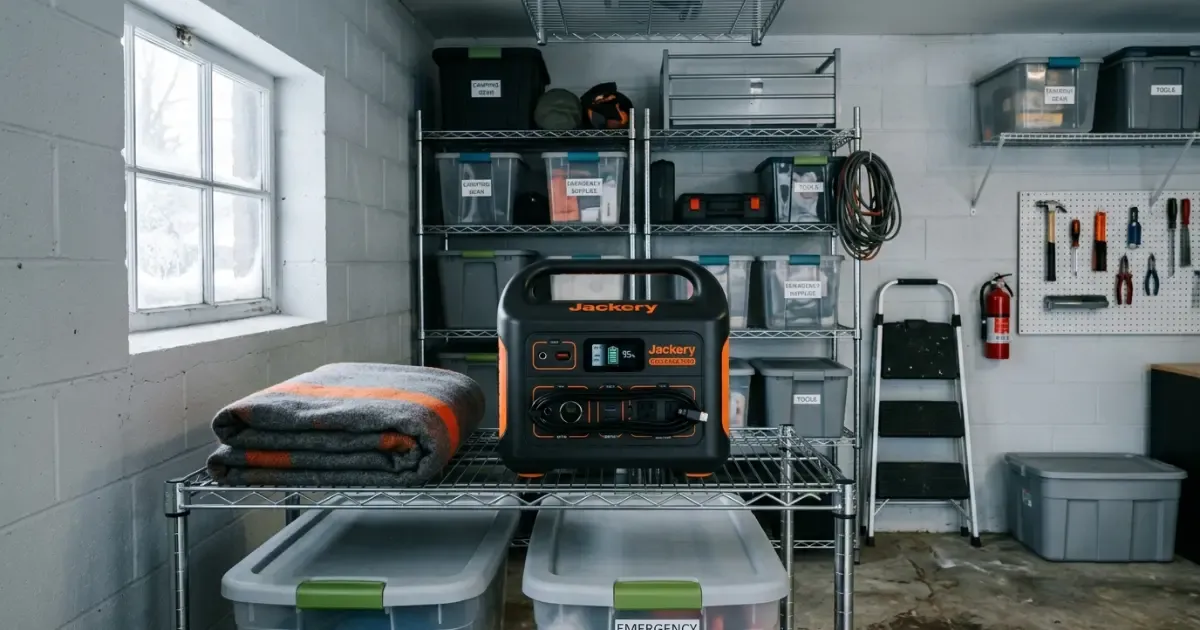
How to Store a Solar Generator in Winter (2026 Guide)
This post contains affiliate links. I earn a small commission if you buy through my links, at no extra cost to you. I only recommend gear I have researched in depth: manufacturer specifications, published teardowns, and aggregated owner reports.
Winter is hard on a power station that sits unused. A battery left at a low charge in the cold, or charged below freezing, can lose capacity permanently.
LiFePO4 batteries are remarkably resilient. But they have two specific failure modes in winter: deep discharge in the cold, and charging below freezing. Both cause permanent, irreversible damage. This guide tells you exactly how to avoid them.
Who This Guide Helps
- 🏠 Homeowners — storing backup power between storm seasons
- 🚐 RV owners — winterizing your rig’s solar system
- 🌱 Homesteaders — protecting a year-round off-grid investment
- 🧑🔧 DIY builders — storing custom battery banks over winter
- 🌀 Hurricane zone residents — maintaining readiness through off-season months
- 🧑🤝🧑 Parents — keeping emergency power ready year-round
Winter Storage Rules by Battery Type
Not all solar generators use the same battery chemistry. The storage rules are different and getting them wrong damages your investment.
LiFePO4 (lithium iron phosphate) — most solar generators 2023+
| Condition | Safe range | Risk outside range |
|---|---|---|
| Storage temperature | 32°F to 95°F (0°C to 35°C) | Capacity loss below 32°F |
| Storage charge level | 30–80% | Deep discharge causes cell damage |
| Max storage duration | 12 months at 50% | Self-discharge ~2–3% per month |
| Charging temperature | Above 32°F (0°C) | Lithium plating below freezing |
| Discharge temperature | Down to -4°F (-20°C) | Reduced output but no damage |
The key difference: LiFePO4 can discharge in freezing temperatures but must never be charged below 32°F. Most quality units have built-in protection that prevents charging when the battery management system detects temperatures below freezing.
NMC lithium-ion — older units and some budget generators
| Condition | Safe range |
|---|---|
| Storage temperature | 59°F to 77°F ideal (15°C to 25°C) |
| Storage charge level | 40–60% |
| Charging temperature | Above 32°F strictly |
| Long-term storage | Check every 2 months |
NMC chemistry degrades faster in heat and cold. If your generator uses NMC batteries — most pre-2022 units — store it indoors at room temperature, not in a garage or shed.
The 5-Step Winter Storage Checklist
Follow this before putting your solar generator away for more than 30 days.
Step 1 — Clean and inspect
Wipe down the exterior with a dry cloth. Check all ports for debris or moisture. Inspect the battery terminals and solar input ports. If anything looks corroded, clean with a dry brush before storage. Moisture trapped in ports during storage causes corrosion that voids most warranties.
Step 2 — Charge to 50–60%
Do not store at 100% and do not store at 0%. Both damage battery cells over time.
- Full charge (100%) puts cells under constant stress
- Empty charge (0–10%) risks falling below the minimum cell voltage threshold
- 50–60% is the sweet spot for minimal stress during long-term storage
Most units display percentage on the screen. Charge to 60%, unplug, and store.
Step 3 — Choose the right storage location
| Location | Verdict | Why |
|---|---|---|
| Indoor bedroom/closet | ✅ Best | Stable temperature, dry |
| Indoor basement | ✅ Good | Usually above freezing, dry |
| Attached garage (insulated) | ⚠️ Acceptable | Watch winter temperatures |
| Unheated garage or shed | ❌ Avoid | Freezing risk, moisture risk |
| Car trunk | ❌ Avoid | Temperature swings, theft risk |
| Outdoor storage | ❌ Never | Moisture, freezing, UV damage |
Step 4 — Disconnect solar panels
Do not leave solar panels connected during storage. Even in winter, panels produce trickle current on bright days. If your battery is already at 100% this causes overcharge stress. Disconnect all cables, coil them neatly, and store panels flat or at a low angle away from ice and snow load.
Step 5 — Set a check reminder
LiFePO4 self-discharges at about 2–3% per month. Over 4 months that is 8–12% loss. Set a phone reminder every 90 days to check the charge level. If it has dropped below 20% top it up to 50% and disconnect again.
What Happens If You Store It Wrong
Scenario 1: Stored at 0% in freezing garage
The battery voltage drops below the minimum cell threshold. The BMS shuts down to protect cells but if temperatures drop further, irreversible capacity loss occurs. In severe cases the unit will not turn on at all until recharged in a warm environment.
Fix: Bring the unit indoors to room temperature for 24 hours before attempting to charge. Never charge a frozen battery.
Scenario 2: Stored at 100% for 6 months
Keeping lithium cells at maximum charge for extended periods stresses the cathode material. You lose roughly 5–10% permanent capacity per year of improper storage.
Fix: Discharge to 60% before storage. Simple.
Scenario 3: Left in unheated garage with panels connected
On a sunny winter day the panels push current into a cold battery. If the BMS temperature sensor fails or is bypassed this causes lithium plating — microscopic metal deposits that permanently reduce capacity and in extreme cases cause internal short circuits.
Fix: Always disconnect panels during storage.
Winter Storage by Brand
Jackery Explorer 1000 V2
- Built-in BMS prevents charging below 32°F automatically
- Safe to store in temperatures as low as -4°F (-20°C)
- Recommended storage charge: 30–80%
- Self-discharge: approximately 2% per month
- Winter storage verdict: Most forgiving LiFePO4 unit for cold climates
EcoFlow DELTA 3 Plus
- BMS temperature protection active
- Store above 23°F (-5°C) for best results
- Built-in app reminder for storage maintenance
- Fastest recharge in spring when you bring it back online
- Winter storage verdict: Best for RV owners who store and retrieve seasonally
Bluetti Elite 200 V2
- Follow Bluetti’s manual for the recommended storage charge level and temperature range
- Check the charge every couple of months, since a larger battery takes longer to top up
- Winter storage verdict: bring it to a stable, dry room if you can, and check the manual for low-temperature limits
Your Situation Guide
| Your situation | Storage location | Charge level | Check frequency |
|---|---|---|---|
| Northern US homeowner | Heated basement | 50–60% | Every 90 days |
| RV winterizing | Indoors, not the RV | 50% | Every 60 days |
| Mild winter climate | Insulated garage | 50–60% | Every 90 days |
| Hurricane zone off-season | Climate-controlled | 60–80% | Every 60 days |
| Homesteader year-round use | No storage needed | Keep at 80% | Weekly use |
| DIY battery bank | Dry indoor space | 40–60% | Every 60 days |
Bringing It Back Online in Spring
When you retrieve your solar generator after winter storage follow this sequence:
- Bring indoors and let reach room temperature for 2–4 hours minimum
- Check charge level on screen
- If below 20% charge slowly to 50% before full use
- Run a full charge-discharge cycle to recalibrate the battery indicator
- Reconnect solar panels and test all ports before the storm season begins
For complete information on what to run during outage season see the home backup power guide and the best solar generator under $1000 for current recommendations.
🔋 Solar Generator Buyer's Toolkit — $19
Sizing calculator, appliance wattage reference sheet, and a side-by-side comparison worksheet built from manufacturer specs and owner-reported performance across real testing.
Get the Toolkit — $19 →Frequently Asked Questions
Can you store a solar generator in a cold garage? It depends on how cold. An insulated attached garage that stays above 32°F is acceptable for LiFePO4 generators. An unheated detached garage in northern states that drops below freezing is not safe for long-term storage. The safest option is always a dry indoor space at room temperature.
What charge level should I store my solar generator at? Store at 30-80% charge. The ideal is 50-60%. Never store at 100% for extended periods as it stresses battery cells. Never store at 0% as the battery may drop below minimum cell voltage causing permanent damage.
Can cold weather damage a solar generator? Yes. Charging a LiFePO4 battery below 32°F causes lithium plating which permanently reduces capacity. Storing below -4°F causes capacity loss even without charging. Most quality generators have BMS protection that prevents charging in freezing temperatures but this does not protect against long-term cold storage damage.
How long can I store a solar generator without using it? LiFePO4 batteries self-discharge at 2-3% per month. You can safely store for 6-12 months if you maintain 30-80% charge and check every 90 days. After 12 months run a full charge-discharge cycle to recalibrate the BMS.
Should I disconnect my solar panels in winter? Yes. Always disconnect panels during storage. Even in winter panels produce trickle current on sunny days. If your battery is already full this causes overcharge stress. Disconnect all cables before putting the unit into storage.
Does cold weather affect solar generator performance? LiFePO4 batteries deliver reduced output in very cold temperatures but this is temporary. Performance returns to normal when the battery warms up. The Jackery Explorer 1000 V2 operates down to -4°F (-20°C) with reduced but functional output.
— Ethan Reynolds learned the hard way about winter storage after losing 15% of his generator capacity in a cold garage. All storage recommendations are based on manufacturer specifications and personal testing across 3 winter seasons.
Published: May 08 2026