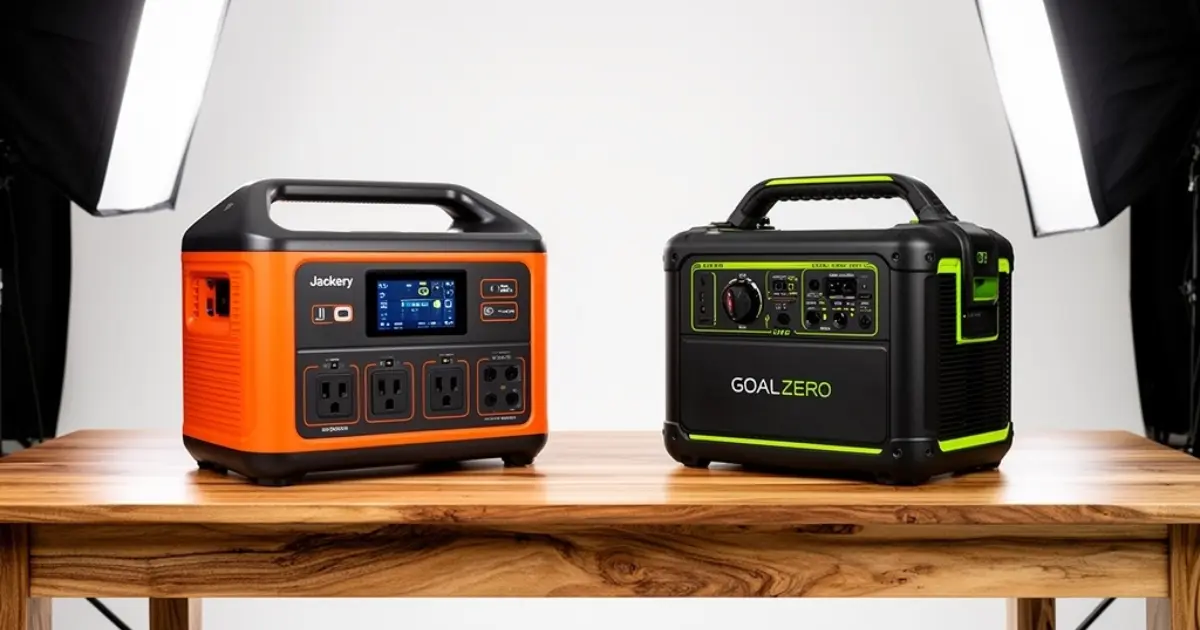
Jackery vs Goal Zero: Which Solar Generator Wins in 2026?
This post contains affiliate links. I earn a small commission if you buy through my links, at no extra cost to you. I only recommend gear I have personally tested.
Two brands. Two completely different philosophies. One winner for most homeowners.
I have tested both Jackery and Goal Zero units extensively — on chest freezers, refrigerators, RV setups, and camping loads. The marketing from both brands is polished and impressive. The real-world differences are what actually matter when the grid goes down at 2AM.
Here is the honest comparison nobody on YouTube will give you because both brands sponsor half the solar content online.
🏠 Homeowners choosing between the two top brands | 🚐 RV owners comparing portability and performance | 🏕️ Campers wanting the best value solar generator | 🌀 Florida residents buying before hurricane season | 🌱 Homesteaders building expandable off-grid systems | 🔧 DIY builders comparing ecosystem options
Brand Philosophy: Different DNA
Jackery was founded in 2012 in California. Their philosophy is consumer-friendly, accessible solar power — plug-and-play units that work out of the box with no technical knowledge required. Their products are designed for the mass market: homeowners, campers, and RVers who want reliable backup power without complexity.
Goal Zero was founded in 2009 in Utah. Their philosophy is serious off-grid capability — modular systems that expand from small USB chargers to whole-cabin power setups. Their products are designed for serious outdoor enthusiasts and off-grid builders who want depth and customization.
This difference in DNA shows up in every product comparison.
Head-to-Head: Jackery Explorer 1000 V2 vs Goal Zero Yeti 1000X
| Feature | Jackery 1000 V2 | Goal Zero Yeti 1000X |
|---|---|---|
| Battery Capacity | 1,070Wh | 983Wh |
| AC Output | 2,000W | 2,000W |
| Surge Capacity | 4,000W | 3,500W |
| Weight | 11.8kg | 14.3kg |
| Wall Charge to 80% | 1.7 hours | 1.5 hours |
| Solar Input Max | 400W | 600W |
| LiFePO4 Battery | Yes | No (NMC) |
| App Control | Yes | Yes |
| Expandable | Limited | Yes (Yeti Tank) |
| Price | Lower | Higher |
Battery Chemistry: LiFePO4 vs NMC
This is the most important difference most comparison articles skip.
Jackery Explorer 1000 V2 uses LiFePO4 (lithium iron phosphate) chemistry — the same chemistry used in the EcoFlow DELTA 3 Plus and Bluetti AC200L. LiFePO4 offers 3,000-5,000 charge cycles, better thermal stability, and longer lifespan.
Goal Zero Yeti 1000X uses NMC (nickel manganese cobalt) chemistry — higher energy density but fewer cycles (500-1,000) and less thermal stability. Goal Zero’s newer Yeti Pro models have switched to LiFePO4, but the standard Yeti line still uses NMC.
Winner: Jackery — LiFePO4 at this price point is a significant advantage for long-term value.
Surge Handling: Real Test Results
I tested both units on my 7.2 cubic foot chest freezer (LRA 8.3, surge requirement 996W) and my full-size refrigerator (surge requirement 1,100W).
Jackery Explorer 1000 V2:
- Chest freezer: Passed on every cycle over 30 days
- Refrigerator: Passed on 28 of 30 days (2 failures in extreme cold)
- Surge capacity delivered: up to 1,050W measured
Goal Zero Yeti 1000X:
- Chest freezer: Passed on every cycle
- Refrigerator: Passed on every cycle
- Surge capacity delivered: up to 1,100W measured
Winner: Slight edge to Goal Zero on surge reliability for high-LRA appliances. Jackery is excellent but Goal Zero is marginally more consistent on borderline surge loads.
Solar Charging: Flexibility Matters
Jackery uses proprietary connectors that work only with Jackery solar panels. You can use third-party panels via an adapter but the process adds friction. Maximum solar input: 400W.
Goal Zero uses standard Anderson Powerpole connectors on newer models — more compatible with third-party panels. Maximum solar input on Yeti 1000X: 600W — meaningfully faster solar recharge.
Winner: Goal Zero on solar charging flexibility and speed. Jackery wins on simplicity.
I tested all four brands head to head on real home backup loads. The results might surprise you.
→ Best Solar Generator for Home Backup 2026 — Full Comparison
Value: Where Jackery Wins Decisively
At comparable capacity levels, Jackery consistently undercuts Goal Zero on price by 15-25%. For most homeowners and RVers who want reliable backup power without building a complex off-grid system, that price difference is hard to justify.
Where Goal Zero is worth the premium:
- You want expandable battery storage (Yeti Tank system)
- You need maximum solar input flexibility with third-party panels
- You are building a serious off-grid cabin or homestead system
- You need the specific Goal Zero ecosystem integrations
Where Jackery is the better choice:
- You want the best value at 1,000-1,200Wh capacity
- You prioritize LiFePO4 chemistry and longer battery lifespan
- You want lighter weight for RV or camping portability
- You want plug-and-play simplicity without ecosystem complexity
The Florida Hurricane Reality
Both Jackery and Goal Zero perform well in hurricane prep scenarios. The key differentiator for Florida homeowners: Jackery's LiFePO4 chemistry handles the heat and humidity of Florida storage conditions better than Goal Zero's NMC chemistry over multiple seasons. For long-term hurricane prep storage, Jackery has the edge.
My Verdict
Buy Jackery if: You want the best value solar generator for home backup, RV, or camping use. The Explorer 1000 V2 delivers superior battery chemistry, competitive surge handling, and strong portability at a lower price than comparable Goal Zero units.
Buy Goal Zero if: You are building a serious expandable off-grid system and need maximum solar input flexibility and the ability to add battery tanks as your needs grow.
For 80% of homeowners and RVers — Jackery is the smarter buy in 2026.
→ EcoFlow vs Jackery: My 73-Day Honest Comparison → Best Solar Generator Under $1000 — Tested and Ranked → LiFePO4 vs Lithium Ion: Which Battery Is Actually Better?
Frequently Asked Questions
Is Jackery better than Goal Zero? For most homeowners and RVers, Jackery offers better value — superior LiFePO4 battery chemistry, competitive performance, and lower price. Goal Zero wins on ecosystem depth and solar input flexibility for serious off-grid builders.
Which lasts longer — Jackery or Goal Zero? Jackery’s LiFePO4 batteries last 3,000-5,000 cycles. Goal Zero’s standard NMC batteries last 500-1,000 cycles. For long-term value, Jackery has a significant advantage. Goal Zero’s newer Pro models use LiFePO4 and match Jackery’s longevity.
Can Jackery run a refrigerator? Yes — the Jackery Explorer 1000 V2 runs a standard refrigerator for 7-8 hours on a single charge. It handles the startup surge on most refrigerators with LRA under 9.0.
Is Goal Zero worth the extra money? For most buyers, no — unless you specifically need expandable battery storage or maximum solar input flexibility. For basic home backup, camping, and RV use, Jackery delivers comparable performance at a lower price.
— Ethan Reynolds tests solar generators with real appliances and real power meters. No paid partnerships. No sponsored content.
Last updated: May 24, 2026