How to Keep Your House Cool During a Power Outage (No AC Needed)
This post contains affiliate links. I earn a small commission if you buy through my links, at no extra cost to you. I only recommend gear I have researched in depth: manufacturer specifications, published teardowns, and aggregated owner reports.
Heat-wave outages teach something that is not said clearly enough: heat kills faster than almost anything else that can go wrong during an outage.
In 2023, the CDC reported over 1,300 heat-related deaths in the United States — and heat waves are getting longer and more intense. A power outage during a July heat wave in Florida, Texas, or the Southwest is not an inconvenience. It is a genuine health emergency, especially for elderly adults, young children, and people with medical conditions.
This guide gives you everything I have tested and learned about keeping a house cool during a power outage — from free zero-cost strategies to the right backup power setup for running actual AC.
🌡️ Homeowners in summer heat without backup AC | 👴 Seniors most vulnerable to heat-related illness | 👪 Parents keeping young children safe in heat | 🌀 Florida and Southern residents — summer outages are the most dangerous | 🏕️ RV owners managing heat in mobile living spaces | 🌱 Homesteaders building heat management into off-grid systems
Why Heat Management Matters More Than You Think
Your body starts struggling at indoor temperatures above 80°F. Heat exhaustion begins at prolonged exposure above 90°F. Heat stroke — a life-threatening emergency — can occur in under one hour at temperatures above 104°F indoors.
During a summer power outage in Florida or Texas, an unventilated home can reach 95-100°F indoors within hours. For elderly adults, infants, and people with heart or respiratory conditions, this is a medical emergency.
Know the warning signs:
- Heavy sweating or no sweating (hot, dry skin is more dangerous)
- Dizziness, confusion, or slurred speech
- Nausea or fainting
- Body temperature above 103°F
If any of these appear: cool the person immediately with wet towels on pulse points and seek emergency help.
12 Strategies to Keep Cool Without Power
Strategy 1: Cross-Ventilation (Most Effective Free Method)
Open windows on opposite sides of the house to create airflow. Hot air rises and exits through upper windows. Cool night air enters through lower windows on the shaded side of the house.
Best practice: Close all windows and blinds during the day. Open everything at night when outdoor temperature drops below indoor temperature — typically after 9-10PM.
Strategy 2: Block All Sunlight During the Day
Up to 40% of indoor heat gain comes through windows. Blackout curtains, closed blinds, or even cardboard over south and west-facing windows dramatically reduce indoor temperature.
Cost: $0 with existing blinds. $20-40 for blackout curtains.
Strategy 3: Go Low
Heat rises. The ground floor or basement is significantly cooler than upper floors. Move sleeping areas to the lowest level of the house during heat emergencies.
Measurement: Upper floors can be 10-15°F hotter than ground level during a summer outage.
Strategy 4: Wet Towel Cooling
Wet a towel with cool water and place on pulse points — wrists, neck, ankles, and forehead. The evaporative cooling effect drops perceived body temperature significantly.
Enhanced version: Hang wet sheets in doorways. As air moves through them, evaporative cooling reduces air temperature by 5-10°F.
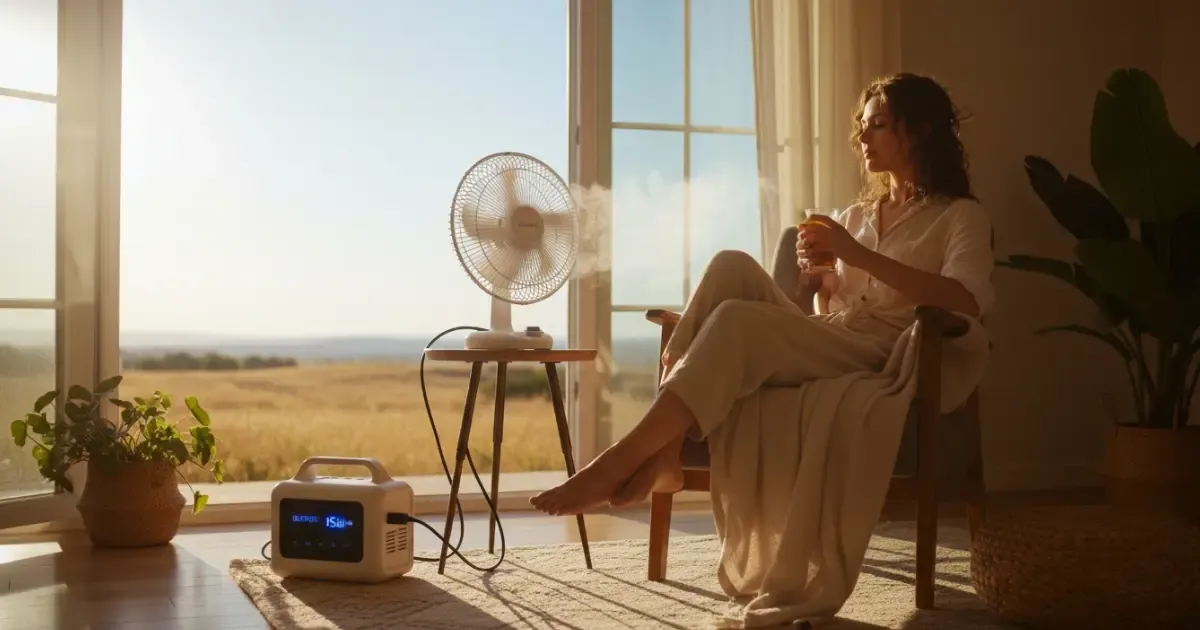
Strategy 5: Battery-Powered Fans
A quality battery-powered fan draws only 20-50W — dramatically less than AC — and can run for 8-20 hours on a 1,000Wh solar generator.
Fan + wet towel combination: Pointing a fan at a wet towel creates an improvised evaporative cooler that can reduce the area temperature by 10-15°F with zero AC.
| Fan Type | Power Draw | Runtime on 1000Wh |
|---|---|---|
| Small personal fan (6”) | 10-20W | 50-100 hours |
| Medium box fan (12”) | 30-50W | 20-33 hours |
| Large floor fan (20”) | 50-100W | 10-20 hours |
| Tower fan | 40-60W | 16-25 hours |
A 5,000 BTU window AC surges to 1,200-1,500W at startup. Most generators trip on this. Here is which units have the surge headroom to handle it.
→ Can a Solar Generator Run a Window AC?
Strategy 6: Freeze Water Bottles
Fill water bottles and freeze them before the outage. During the outage, place frozen bottles in front of a battery fan — the air passing over them creates cold airflow. Place bottles wrapped in a cloth against pulse points for direct cooling.
Strategy 7: Cool Showers
A 5-minute cool shower drops core body temperature by 1-2°F and provides relief for 30-60 minutes. Multiple family members cycling through cool showers is one of the most effective heat management strategies during an extended outage.
Strategy 8: Identify Your Coolest Room
Before any summer storm, identify the coolest room in your house — typically a basement, interior bathroom, or north-facing room with no direct sun exposure. Move all sleeping activities there during an outage.
Strategy 9: Minimize Heat Generation
Every appliance you run generates heat. During an outage, eliminate unnecessary heat sources:
- No cooking indoors — use outdoor propane grill
- Minimize phone and laptop use (screens generate heat)
- Turn off any inverter loads you are not actively using
Strategy 10: Wet the Roof
If safe to do so, wetting the roof surface with a garden hose before an outage (while water pressure is still available) delays heat transfer through the ceiling for several hours.
Strategy 11: Know Your Community Cooling Centers
Every major city operates cooling centers during heat emergencies — typically libraries, community centers, and malls. Know the nearest location before any storm season. They are free and can be life-saving during extended outages.
Strategy 12: The Car AC Option
A modern car AC system can cool a vehicle interior to 68°F in minutes. During extreme heat emergencies, spending 2-3 hours in a parked car with AC running provides critical cooling and recharges your phone simultaneously. Keep the car out of direct sun with windows cracked when using this method.
When Free Strategies Are Not Enough: Running AC Off Solar
For elderly adults, infants, and people with heat-sensitive medical conditions — fans and passive cooling may not be sufficient. Here is what actually works for running window AC off a solar generator:
What you need:
- Window AC (5,000 BTU): 1,200-1,500W surge, 450-500W running
- Generator surge capacity: minimum 2,000W (with soft starter) or 3,000W+ (without)
The EcoFlow DELTA 3 Plus has a 3,600W surge rating, which covers most small window ACs. Runtime: about 2 hours of a 450W AC per charge (about 870Wh usable). X-Boost applies to resistive loads, not motors, so do not count on it for an AC.
The Bluetti Elite 200 V2 has the larger battery (2,073.6Wh), giving about 3.9 hours of a 450W AC. Bluetti publishes no motor surge rating, so confirm your AC’s LRA with Bluetti first.
The Florida Summer Outage Reality
Florida summer heat + power outage is one of the most dangerous combinations in America. Indoor temperatures can reach 100°F+ within hours. Elderly residents are most at risk. The strategies in this guide are not optional comfort measures — they are life safety protocols. Know your cooling center location, have a battery fan ready, and if you have elderly family members, set up window AC backup power before June 1.
→ Can a Solar Generator Run a Window AC Unit? (2026 Test) → 72-Hour Power Outage Survival Guide → Best Solar Generator for Seniors — Easy to Use and Reliable
☀️ Heat emergencies do not wait for you to get organized
Knowing the tricks is one thing. Having the plan printed and on the fridge before the grid goes down in August is another. My 72-Hour Kit covers heat, water, food, power and medical in printable checklists anyone in the house can follow.
72-Hour Power Outage Survival Kit — $27
Get the 72-Hour Kit →Frequently Asked Questions
How do you stay cool in a house without power? The most effective free strategies: cross-ventilate at night, close all blinds during the day, use wet towels on pulse points, stay on the lowest floor, and use battery-powered fans. Identify your local cooling center as a backup option.
How hot does a house get without AC during a power outage? In summer heat, an unventilated house gains approximately 1-2°F per hour with windows closed. Starting at 75°F indoor temperature, a house can reach 90°F+ within 8 hours on a hot summer day. Upper floors heat faster than ground level.
Can a solar generator run air conditioning? Yes — with the right unit. A 5,000 BTU window AC typically needs about 1,500W or more of surge capacity to start, so check your AC’s LRA × 120 plus 20%. The EcoFlow DELTA 3 Plus is rated for 3,600W surge. Runtime is about 2 hours per charge for a 450W AC.
What temperature is dangerous during a power outage? Sustained indoor temperatures above 90°F cause heat exhaustion risk. Above 100°F, heat stroke risk increases significantly — especially for elderly adults, infants, and people with cardiovascular conditions. Prioritize cooling measures and evacuation to cooling centers in extreme heat.
Do fans help cool a house without AC? Fans do not reduce air temperature — they create a wind chill effect that makes you feel cooler. Combined with wet towels on pulse points, fans provide meaningful relief up to about 95°F. Above that temperature, fans alone are insufficient and evacuation to a cooled environment should be considered.
— Ethan Reynolds tests solar generators and backup power systems for real households. No paid partnerships. No sponsored content.
Last updated: June 4, 2026