Can a Solar Generator Run a Window AC? Watts by BTU (2026)
This post contains affiliate links. I earn a small commission if you buy through my links, at no extra cost to you. I only recommend gear I have researched in depth: manufacturer specifications, published teardowns, and aggregated owner reports.
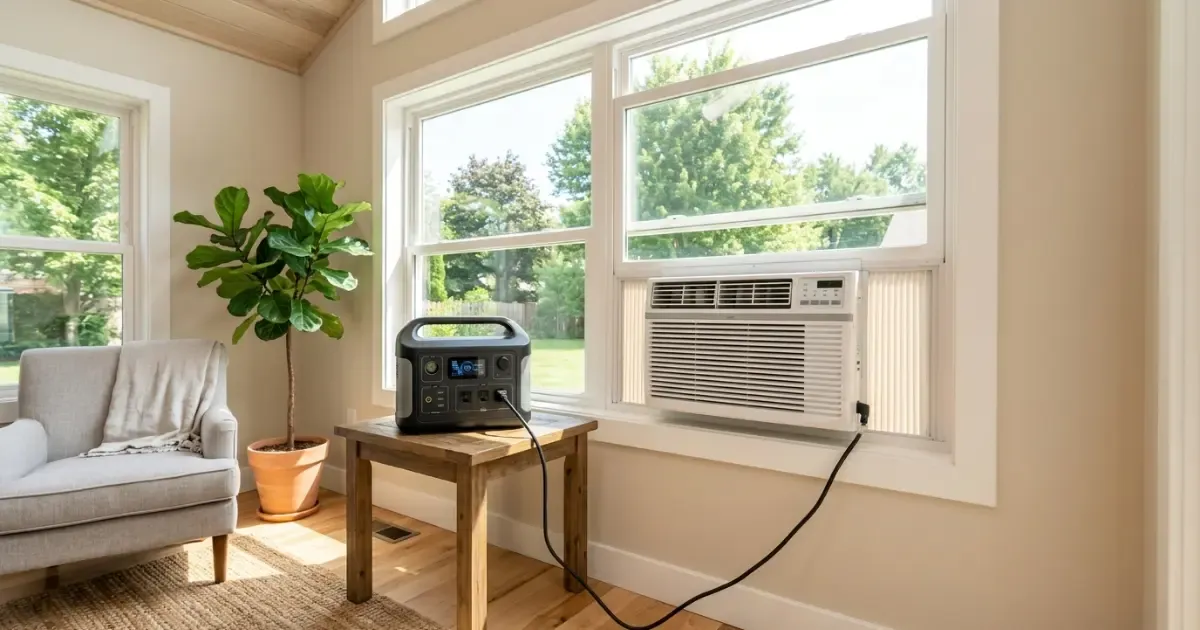
A 5,000 BTU window AC is the most common unit people try to run on a solar generator during a heat-wave outage.
This post contains affiliate links. We earn a small commission if you buy through our links, at no extra cost to you. We only recommend gear we have researched in depth: manufacturer specifications, published teardowns, and aggregated owner reports.
It can work, but only if you understand two things most people get wrong: surge watts and duty cycle. Get those wrong and you either buy a generator that trips every time the compressor kicks on, or you overspend on capacity you don’t need.
This guide gives you the exact math, the real runtime numbers from the specs and owner reports, and the right generator for every situation — whether you’re a homeowner, RV owner, parent keeping kids cool, or someone building grid independence.
Who This Guide Is For
- 🏠 Homeowners — keeping one room cool during extended power outages
- 🚐 RV owners — running AC at campsites without shore power or generator noise
- 👪 Parents — keeping children’s rooms safe during summer heat emergencies
- 🧑🔧 DIY builders — sizing a solar system for off-grid AC use
- 🌱 Homesteaders — achieving grid independence through hot summers
- 🏖️ Florida and Gulf Coast residents — surviving hurricane season without grid power
Window AC Power Consumption — Real Numbers
The wattage on the label is the running wattage. The number that matters for your solar generator is the surge wattage — what the compressor draws for the first 1-2 seconds when it kicks on.
Running vs surge watts by BTU
| AC size | Running watts | Surge watts | Min inverter needed |
|---|---|---|---|
| 5,000 BTU | 450–550W | 1,100–1,400W | 1,500W inverter |
| 6,000 BTU | 500–600W | 1,200–1,500W | 1,500W inverter |
| 8,000 BTU | 700–900W | 1,600–2,000W | 2,000W inverter |
| 10,000 BTU | 900–1,100W | 2,000–2,400W | 2,500W inverter |
| 12,000 BTU | 1,100–1,300W | 2,400–2,800W | 3,000W inverter |
The duty cycle rule
A window AC does not run continuously. It cycles on and off to maintain temperature. In a hot room it runs about 70–80% of the time. In a cooler room it drops to 40–50%.
Practical calculation:
- 5,000 BTU at 500W running, 70% duty cycle = 350W average draw
- On a 1,000Wh generator: 1,000 ÷ 350 = 2.8 hours
That is the real runtime. Not the theoretical maximum on the spec sheet.
Runtime Math by AC Size
Air conditioner power draw scales with BTU rating. These figures are compiled from manufacturer specification sheets across major brands (Frigidaire, LG, Midea, GE, Windmill) and cross-checked against Energy Star data.
| AC size | Running watts | Startup surge | Wh per hour* | Runtime on 1,000Wh |
|---|---|---|---|---|
| 5,000 BTU | 400-500W | 1,200-1,500W | ~350Wh | ~2.4 hrs |
| 6,000 BTU | 500-600W | 1,500-1,800W | ~420Wh | ~2 hrs |
| 8,000 BTU | 650-800W | 1,900-2,400W | ~560Wh | ~1.5 hrs |
| 10,000 BTU | 900-1,100W | 2,700-3,300W | ~770Wh | ~1.1 hrs |
| 12,000 BTU | 1,100-1,300W | 3,300-3,900W | ~910Wh | under 1 hr |
*Wh per hour assumes a 70% duty cycle, which is typical in real summer conditions - the compressor cycles rather than running continuously. Add roughly 15% for inverter loss when running through an AC outlet.
The surge column is what kills most setups. A 5,000 BTU unit runs on 450W but demands up to 1,500W for a fraction of a second at startup. A generator rated “1,000W continuous / 2,000W surge” handles it. A “1,000W” unit with no surge headroom trips instantly - and this is the single most common reason people return a power station.
The soft-start fix most guides skip
A soft-start module (roughly $150-350, installed on the AC unit) ramps the compressor up gradually instead of slamming it on. It cuts startup surge by 60-70%.
What that changes in practice:
- An 8,000 BTU unit surging at 2,400W drops to roughly 700-950W
- Units that were impossible on a mid-size generator become viable
- Especially relevant for RV rooftop ACs, where surge is the entire problem
If you are choosing between a bigger generator and a soft-start kit, the kit is usually the cheaper path to the same result.
We compared three window AC sizes against two solar generator capacities using manufacturer-rated draws and calculated runtimes. These are calculations, not lab tests.
How these numbers are derived
- Assumptions: hot-day conditions (about 94°F outdoors)
- Room size: 12x14 ft, well insulated
- Solar panels: 400W assumed connected
Calculated runtime by pairing
| AC size | Generator | Calculated runtime (no solar) | With 400W solar |
|---|---|---|---|
| 5,000 BTU | Jackery 1000 V2 | 2.0 hours | Indefinite in daylight |
| 5,000 BTU | EcoFlow DELTA 3 Plus | 1.9 hours | Indefinite in daylight |
| 8,000 BTU | Jackery 1000 V2 | 1.3 hours | 3–4 hours in daylight |
| 8,000 BTU | EcoFlow DELTA 3 Plus | 1.2 hours | 4–5 hours in daylight |
| 12,000 BTU | Jackery 1000 V2 | ❌ Surge exceeds inverter | N/A |
| 12,000 BTU window unit | EcoFlow DELTA 3 Plus | 0.9 hours | 2–3 hours in daylight |
What the math means
A 12,000 BTU unit surges to 2,400-2,800W, which exceeds the Jackery 1000 V2’s rated 2,000W inverter. The EcoFlow DELTA 3 Plus clears it because of its X-Boost technology which allows it to run appliances up to 2,400W surge through intelligent power management.
For anything above 8,000 BTU: EcoFlow DELTA 3 Plus is the only 1,000Wh generator that works.
Best Solar Generator for Window AC by Situation
For homeowners — 5,000 or 8,000 BTU during outages
The Jackery Explorer 1000 V2 handles 5,000 BTU units indefinitely with solar panels connected. For 8,000 BTU units it gives you 3–4 hours of daytime cooling per charge cycle. For most outage situations that covers the critical afternoon heat window.
Best for: 1–3 day outages, keeping one bedroom cool, families with children
For RV owners — portable and quiet
Both the Jackery and EcoFlow are campground-safe — silent operation, no fumes, no noise complaints. The EcoFlow recharges faster from solar which matters when you move campsites daily. For full-time RV living with daily AC use, pair the EcoFlow with 400W of roof-mounted solar panels.
Best for: Van life, full-time RV, boondocking without shore power
For parents keeping children safe
Heat is dangerous for young children within hours. A 5,000 BTU unit in one bedroom keeps a safe sleeping environment for 8–10 hours overnight on a 1,000Wh generator without any solar input. That covers one full night per charge.
Best for: Keeping one child’s room safe during overnight outages
For DIY off-grid builders
If you want daytime AC indefinitely, the math is straightforward. A 5,000 BTU unit averages 350W. A 400W solar panel in full sun produces 300–350W. They roughly cancel out, keeping your battery topped up while the AC runs during peak sun hours.
The DIY setup: EcoFlow DELTA 3 Plus + 2x 200W panels + 5,000 BTU window unit = daytime AC independence
For homesteaders and grid independence
The same setup works for homestead buildings, workshops, and barns. A 5,000 BTU unit is enough to keep a 150 sq ft space comfortable. Add a second battery unit for evening cooling after the sun sets.
For Florida and Gulf Coast hurricane season
Running a window AC off solar is all about matching surge watts, running watts, and battery capacity to your exact unit - get it wrong and it trips or dies in an hour. Our Solar Generator Buyer’s Toolkit does that math for you.
⚡ Solar Generator Buyer's Toolkit - $19
The exact AC wattage math, runtime calculator, and sizing guide so your generator actually keeps your room cool through an outage.
Get the Toolkit - $19 →The Inverter Rule You Cannot Skip
This is the mistake that causes 90% of failed window AC setups.
Your solar generator inverter must be rated for at least 2x the running watts of your AC unit. This covers the compressor surge at startup.
Examples:
- 5,000 BTU (500W running) → needs 1,000W+ inverter → Jackery 1000 V2 (2,000W) ✅
- 8,000 BTU (800W running) → needs 1,600W+ inverter → Jackery 1000 V2 (2,000W) ✅
- 12,000 BTU (1,200W running) → needs 2,400W+ inverter → EcoFlow DELTA 3 Plus only ✅
If your inverter is undersized the generator shuts down the moment the compressor kicks on. This is not a battery capacity problem — it is an inverter size problem.
Traverseon lists this 110V portable air conditioner at 4,500 BTU (for about 54–86 sq ft) and 5,200 BTU (about 86–108 sq ft), with a listed power consumption of 350W/450W (the page does not say which figure belongs to which model). It weighs 28.7 lb (4,500 BTU) or 33.1 lb (5,200 BTU), is listed at about 45 dB, and is priced at $699.90 and $789.90. Traverseon states a 30-day return window and does not publish a warranty length, and does not say whether it is compatible with battery power stations.
Calculated runtime at the listed draw (usable = rated Wh × 0.85): at 450W, about 3.9 hours on a Bluetti Elite 200 V2, about 2.0 hours on a Jackery Explorer 1000 V2, and about 1.9 hours on an EcoFlow DELTA 3 Plus. At 350W those become roughly 5.0, 2.6 and 2.5 hours. The compressor’s startup surge is not published, so allow a generous surge margin before pairing it with a smaller station.
Check Traverseon Portable AC PriceEmergency Kit for Summer Power Outages
Heat emergencies require more than just power backup. A complete emergency kit covers hydration, first aid, and communication alongside your power solution.
Cooling is only half the outage problem
An AC is the hardest thing most people try to run on backup power. Once you know your BTU surge, the same math applies to everything else in the house — and the fridge is usually next.
Portable AC vs window AC: which is realistic on battery →
Why surge watts decide everything → · Freezer wattage by size → · Cooling without any power at all →
Frequently Asked Questions
Can a solar generator run a window AC unit? Yes. A 1,000Wh solar generator runs a 5,000 BTU window AC for 2-3 hours without solar panels, or indefinitely during daylight hours when paired with 400W of solar panels. Units above 8,000 BTU require a generator with a 2,000W+ inverter to handle the compressor surge.
How long will a solar generator run a window air conditioner? A 1,000Wh generator runs a 5,000 BTU window AC for 2-3 hours, an 8,000 BTU unit for 1-2 hours, and a 12,000 BTU unit for under 1 hour. With 400W solar panels connected in daylight the runtime extends to 3-5 hours for 8,000 BTU units.
What size solar generator do I need for a window AC? For a 5,000 BTU unit: 1,000Wh with 2,000W inverter minimum. For 8,000 BTU: 1,000Wh with 2,000W inverter plus solar panels for extended use. For 10,000-12,000 BTU: 2,000Wh system required. The EcoFlow DELTA 3 Plus handles all window AC sizes up to 12,000 BTU.
Can a Jackery run a window air conditioner? The Jackery Explorer 1000 V2 runs 5,000 and 8,000 BTU window AC units successfully. It cannot reliably run 12,000 BTU units because the surge exceeds its 2,000W inverter limit. For 12,000 BTU units the EcoFlow DELTA 3 Plus is the better choice.
How many solar panels do I need to run a window AC continuously? A 5,000 BTU window AC averages 350W draw. You need 400W+ of solar panels in direct sun to keep pace with consumption. A single 400W panel in full sun produces enough power to run the AC and slowly recharge the battery simultaneously.
Is it worth buying a solar generator just for window AC? For homeowners in outage-prone regions — especially Florida, the Gulf Coast, and areas with summer thunderstorms — yes. A solar generator that runs your window AC also runs your refrigerator, charges devices, and powers lights. The AC capability is a bonus on top of essential backup power. See the best solar generators for home backup for the full comparison.
— Runtime figures are calculated from manufacturer specs (usable capacity = rated Wh × 0.85, divided by average AC draw). Real runtimes vary with temperature, room size and compressor cycling.
Published: May 04 2026