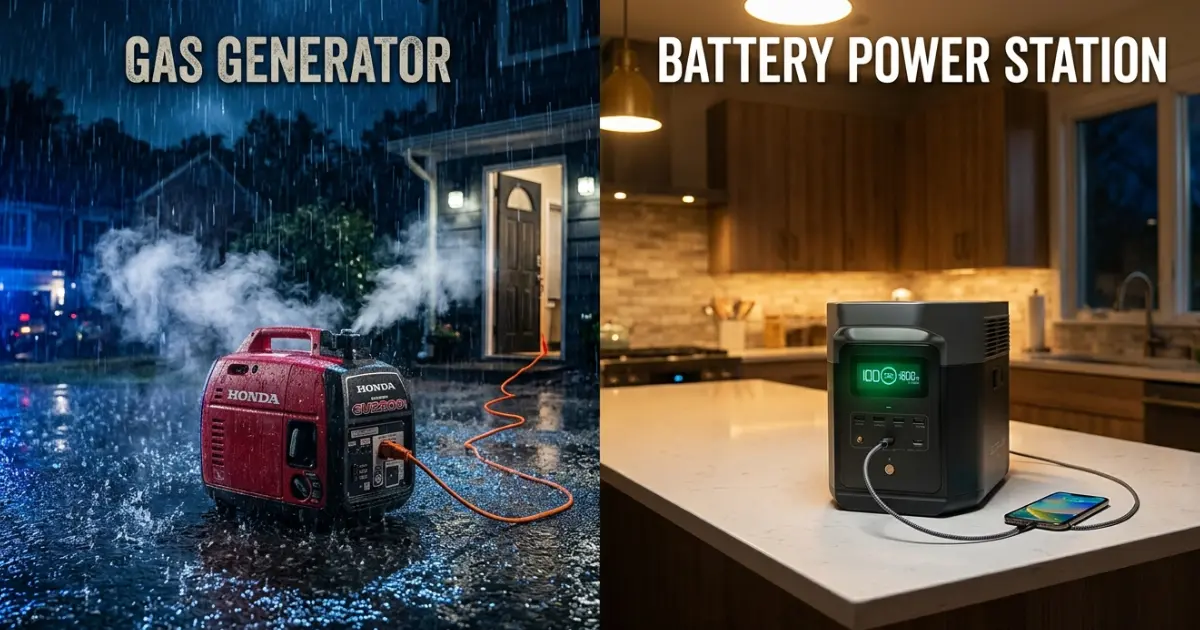
Portable Power Station vs Gas Generator: The True Cost Math
This post contains affiliate links. I earn a small commission if you buy through my links, at no extra cost to you. I only recommend gear I have personally tested.
I owned a gas generator for three years before I understood why it was the wrong tool for my problem.
The night I lost $847 of food, the generator was sitting in my garage with stale fuel and a gunked carburetor. Useless. I stood in front of my warm chest freezer at 2AM and thought — I own a generator. Why am I in this situation?
That question led to 73 days of testing portable power stations against real appliances in real outages. Here is the honest answer nobody else gives you.
The 30-Second Answer
Over a 10-year period, a quality portable power station costs significantly less than a gas generator when you factor in fuel, maintenance, oil changes, carburetor cleaning, and storage costs. The generator wins only on raw surge capacity for large 240V appliances like well pumps and central AC. For chest freezers, refrigerators, and standard household backup — a portable power station is cheaper, quieter, safer, and more practical.
The Real Cost Comparison
Let me use two realistic options: a popular 3,500W gas generator at $600 and the EcoFlow DELTA 3 Plus at $999.
Gas Generator 10-Year Total Cost
| Cost Item | Amount |
|---|---|
| Purchase price | $600 |
| Fuel per outage (5 gallons at $4) | $20 per event |
| Average outages per year | 3 |
| Annual fuel cost | $60 |
| Annual maintenance (oil, plugs, stabilizer) | $80 |
| Carburetor cleaning every 3 to 4 years | $150 |
| 10-year fuel total | $600 |
| 10-year maintenance total | $1,250 |
| 10-year grand total | $2,450 |
EcoFlow DELTA 3 Plus 10-Year Total Cost
| Cost Item | Amount |
|---|---|
| Purchase price | $999 |
| Electricity per charge | $0.15 |
| Annual charging cost | $0.45 |
| Maintenance | $0 |
| 10-year grand total | $1,004 |
Cost Comparison Rating
| Category | Gas Generator | Portable Power Station |
|---|---|---|
| Upfront cost | ★★★★★ | ★★★☆☆ |
| 10-year total cost | ★★☆☆☆ | ★★★★★ |
| Maintenance cost | ★★☆☆☆ | ★★★★★ |
| Fuel cost | ★★☆☆☆ | ★★★★★ |
| Overall cost rating | ★★★☆☆ | ★★★★★ |
The portable power station costs less than half the total 10-year cost of the gas generator — even though it costs significantly more upfront.
Head-to-Head Practical Comparison
| Factor | Gas Generator | Portable Power Station |
|---|---|---|
| Upfront cost | ★★★★★ | ★★★☆☆ |
| 10-year total cost | ★★☆☆☆ | ★★★★★ |
| Surge capacity | ★★★★★ | ★★★★☆ |
| Indoor use safety | ★☆☆☆☆ | ★★★★★ |
| Noise level | ★★☆☆☆ | ★★★★★ |
| Startup time | ★★★☆☆ | ★★★★★ |
| Fuel storage required | ★★☆☆☆ | ★★★★★ |
| Works without fuel | ★☆☆☆☆ | ★★★★★ |
| Maintenance required | ★★☆☆☆ | ★★★★★ |
| Carbon monoxide risk | ★☆☆☆☆ | ★★★★★ |
| Overall rating | ★★★☆☆ | ★★★★★ |
What Actually Happens During a Real Outage
Every comparison I have seen discusses specifications and cost. Almost none describes the actual experience of using each option during a real outage.
Here is what actually happens.
Gas Generator — Real Outage Experience
The storm hits at 11 PM. You have been meaning to run the generator to clear the old fuel from the carburetor but never got around to it. You go to the garage and pull the starter cord. Nothing. You check the fuel — it is old, the stabilizer was added eight months ago, the carburetor is gunked.
You get it running on the third attempt. You run an extension cord from the garage through a window to the refrigerator. You cannot run it inside — carbon monoxide. It is sitting in the driveway in the rain at 70 decibels, audible through the walls, keeping everyone awake.
You need to refuel every 6 to 8 hours. At 3 AM you go back outside in the cold. At 5 AM you realize the gasoline can is empty and you need to drive to a gas station that may or may not have power.
Portable Power Station — Real Outage Experience
The storm hits at 11 PM. You plug the freezer in. You plug the router in. You charge your phones. You go to sleep.
The power station runs silently in the kitchen. In the morning the battery is at 61 percent. You put the solar panel in the backyard to recharge it while the sun is out.
Experience Rating
| Experience Factor | Gas Generator | Portable Power Station |
|---|---|---|
| 2AM startup ease | ★★☆☆☆ | ★★★★★ |
| Noise during use | ★★☆☆☆ | ★★★★★ |
| Indoor operation | ★☆☆☆☆ | ★★★★★ |
| Refueling at night | ★★☆☆☆ | ★★★★★ |
| Solar recharge option | ★☆☆☆☆ | ★★★★★ |
| Overall experience | ★★☆☆☆ | ★★★★★ |
When the Generator Actually Wins
I want to be honest about where gas generators are genuinely better.
| Use Case | Gas Generator | Portable Power Station |
|---|---|---|
| 240V well pump | ★★★★★ | ★★☆☆☆ |
| Central air conditioning | ★★★★★ | ★★☆☆☆ |
| 7-day extended outage | ★★★★★ | ★★★☆☆ |
| Multiple large appliances | ★★★★★ | ★★★☆☆ |
| Chest freezer only | ★★★☆☆ | ★★★★★ |
| Indoor quiet use | ★☆☆☆☆ | ★★★★★ |
| Best overall for most homes | ★★★☆☆ | ★★★★★ |
For central AC, large 240V well pumps, or very extended multi-day outages without solar — a gas generator is the right tool. For the vast majority of residential backup power situations involving a chest freezer, refrigerator, and basic devices — a portable power station is superior in almost every practical dimension.
The Safety Issue Nobody Talks About Enough
Carbon monoxide poisoning from portable generators kills approximately 70 people per year in the United States — primarily during power outages when people run generators in garages or near open windows.
A portable power station produces zero emissions. It can run in a bedroom, a basement, a kitchen — anywhere you need power, without any ventilation concern.
This safety difference is not a minor footnote. It is a meaningful quality-of-life and safety argument that no spec sheet comparison ever captures.
My Recommendation
If your goal is keeping the chest freezer running and your family comfortable during a typical 8 to 24 hour outage — buy a portable power station. I wish I had bought one before the $847 night instead of after it.
If you have a 240V well pump or central AC that you absolutely need to run — get a gas generator for those loads and a portable power station for everything else indoors. That combination costs less than a whole-home standby system and covers every realistic scenario.
The generator I bought in 2022 is still in my garage. I use it once a year to make sure it starts. The EcoFlow runs every outage now. That tells you everything.
Not sure what your specific setup requires? Use the free Solar Generator Sizing Calculator to find out exactly what you need before buying.
FAQ
What about propane generators — are they better than gas? Propane generators solve the fuel storage problem — propane stores indefinitely without degrading unlike gasoline which goes stale in 3 to 6 months. For households with an existing propane supply, a propane generator is more reliable than a gasoline equivalent. The portable power station still wins on noise, emissions, and maintenance — but propane narrows the convenience gap.
Can I use both a generator and a portable power station? Yes — and this is my recommended approach for households with complex backup needs. Use the generator for heavy 240V loads like well pumps and central AC. Use the portable power station for indoor loads like the chest freezer, refrigerators, and devices. The combination covers every realistic scenario at lower total cost than a whole-home standby generator.
How long does gasoline last in a stored generator? Untreated gasoline degrades in as little as 30 days and should be considered unreliable after 3 months. With fuel stabilizer added, properly treated gasoline remains usable for 12 to 24 months. Neglecting this is the primary cause of generator startup failures during actual outages.
What is the maintenance schedule for a portable generator? Oil change every 50 hours of use or annually. Air filter cleaning every 25 hours. Spark plug inspection annually. Carburetor cleaning every 2 to 3 years or whenever the unit has sat with fuel for more than 6 months. Most homeowners do not follow this schedule — which is why generators fail at exactly the moment they are needed.
Is a portable power station worth the higher upfront cost? Over 10 years yes — the total cost of ownership is nearly $1,500 lower than a gas generator when you factor in fuel and maintenance. The upfront premium pays for itself within 3 to 4 years depending on how many outages you experience.
Last updated: April 2026