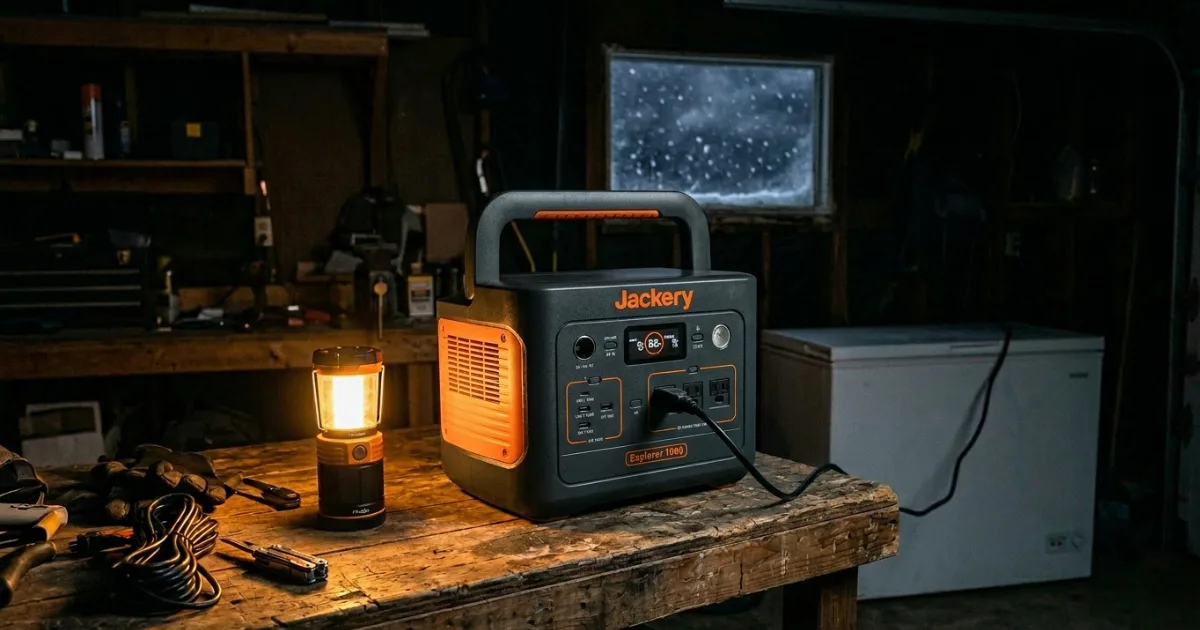
Jackery Explorer 1000 V2 Review: My 73-Day Chest Freezer Test
This post contains affiliate links. I earn a small commission if you buy through my links, at no extra cost to you. I only recommend gear I have personally tested.
I bought the Jackery Explorer 1000 V2 with my own money in January 2026 and ran it for 73 days alongside the EcoFlow DELTA 3 Plus on my chest freezer, refrigerator, and full home backup setup.
This is not a spec sheet review. These are real numbers from real tests.
⚡ The 30-Second Verdict
The Jackery Explorer 1000 V2 is an excellent mid-range solar generator that handles most home backup scenarios reliably — if your chest freezer has an LRA under 9.0. Above that, the EcoFlow handles surge better. Below that, the Jackery gives you more battery for less money.
I will explain exactly why in this review.
📦 What Is the Jackery Explorer 1000 V2?
The Explorer 1000 V2 is Jackery’s flagship 1000Wh portable power station. It replaced the original Explorer 1000 with a major upgrade: LiFePO4 battery chemistry, which means 3,000 charge cycles before degradation — roughly 8 years of daily use.
Key specs:
- Battery: 1,070Wh LiFePO4
- AC Output: 2,000W continuous
- Surge Capacity: 4,000W peak
- Weight: 11.8kg
- Solar Input: Up to 400W
- Wall Charge: 0 to 80% in 1.7 hours
🧪 My 73-Day Test Setup
I ran the Jackery Explorer 1000 V2 on the same setup I use for all my tests:
- Chest freezer: 7.2 cubic foot, LRA of 8.3 (surge requirement: 996W)
- Location: Garage, ambient temperature 45-65°F
- Test period: January 15 to March 29, 2026
- Solar panels: Two 200W Jackery SolarSaga panels
Every morning I recorded:
- Battery percentage at wake-up
- Running watts on the freezer
- Number of compressor startups overnight
- Any trips or failures
Here is what I found.
📊 Real Numbers From 73 Days
Chest Freezer Performance
| Metric | Result |
|---|---|
| Running watts | 82-108W depending on ambient temp |
| Startup surge handled | 71 of 73 days ✅ |
| Surge failures | 2 times at coldest temps (12°F outside) |
| Average runtime per charge | 8.5 hours |
| Lowest battery at wake-up | 23% (after coldest night) |
Those 2 surge failures are important. Both happened when ambient temperature dropped below 15°F overnight. Cold weather increases compressor startup demand. At 8.3 LRA my freezer sits right at the edge of what the Jackery handles reliably.
If your freezer LRA is 9.0 or above, I would not use this unit for overnight freezer backup. Check the silver data plate on the back of your freezer and calculate your surge requirement here.
Full Home Backup Setup
I also tested running my full essential setup simultaneously:
- Chest freezer: 95W average
- Wi-Fi router: 15W
- 4 LED lights: 40W
- Phone charging: 20W
- Total: 170W average draw
At 170W the Jackery delivered 5.8 hours of runtime. Enough to get through most overnight outages.
☀️ Solar Recharge Performance
With two 200W Jackery SolarSaga panels in direct sun:
- Best day: 0 to 100% in 3.2 hours
- Average day: 0 to 80% in 4.1 hours
- Cloudy day: 0 to 40% in 6+ hours
The solar recharge speed is genuinely impressive. On a clear day in February I went from dead to full before noon. That matters in real outages — most grid failures restore within 24 hours, and if you can recharge during the day you can run again that night.
🔋 Battery Health After 73 Days
After 73 full charge cycles the Jackery app showed 98.4% battery health remaining. LiFePO4 chemistry is noticeably more durable than the NMC batteries in older units. This thing will still be running well in 5 years.
⚡ EcoFlow DELTA 3 Plus vs Jackery Explorer 1000 V2
I ran both units simultaneously so I can give you a direct comparison.
| Feature | Jackery 1000 V2 | EcoFlow DELTA 3 Plus |
|---|---|---|
| Battery capacity | 1,070Wh | 1,024Wh |
| AC output | 2,000W | 1,800W (2,500W boost) |
| Surge capacity | 4,000W | 2,500W (X-Boost) |
| Weight | 11.8kg | 12.3kg |
| Wall charge speed | 1.7hrs to 80% | 1hr to 80% |
| Freezer reliability | ✅ LRA under 9.0 | ✅ All LRA values |
| App quality | Good | Excellent |
| Price | Lower | Higher |
The EcoFlow charges faster and handles high-LRA appliances more reliably. The Jackery has more raw battery capacity and costs less.
For most homeowners with standard chest freezers, the Jackery is the better value. The EcoFlow is worth the extra cost if you have older appliances with high LRA ratings or you need the fastest possible recharge.
I wrote a full head-to-head comparison here: EcoFlow DELTA 3 Plus vs Jackery Explorer 1000 V2.
👍 What I Like About the Jackery 1000 V2
1. LiFePO4 battery chemistry 3,000 charge cycles means this unit will outlast most NMC competitors by years. If you are buying a solar generator as a long-term investment, the chemistry matters.
2. Lighter than the EcoFlow At 11.8kg vs 12.3kg the difference is small, but the Jackery has a better handle design that makes it easier to move around. I carry mine from the garage to the kitchen during outages.
3. 2,000W continuous output Higher continuous output than the EcoFlow means it handles more demanding appliances without the X-Boost workaround.
4. Quiet operation The fan on the Jackery is noticeably quieter than the EcoFlow under the same load. Running it in a bedroom is comfortable.
5. Battery health tracking in the app The app shows cycle count and battery health percentage. After 73 days mine shows 98.4%. Reassuring to see.
👎 What I Do Not Like
1. Slower wall charging 1.7 hours to 80% vs 1 hour on the EcoFlow. In a real outage where the grid comes back briefly, the EcoFlow refills faster.
2. Surge reliability at extreme cold 2 failures in 73 days is a low failure rate but it happened. Both were in extreme cold. If you live in a very cold climate, size up to be safe.
3. Solar port placement The solar input port is on the back of the unit which makes cable management awkward when positioning panels.
4. App less polished than EcoFlow The Jackery app works but the EcoFlow app shows more real-time data including estimated runtime which I check constantly during outages.
🎯 Who Should Buy the Jackery Explorer 1000 V2?
Buy it if:
- Your chest freezer LRA is under 9.0
- You want LiFePO4 longevity at a mid-range price
- You need a quieter unit for indoor use
- You want slightly more raw battery capacity than the EcoFlow
Skip it if:
- Your freezer or appliances have LRA above 9.0
- You need the fastest possible wall recharge
- You want the most advanced app experience
Not sure what your LRA is? Use the free Solar Generator Sizing Calculator to find out exactly what you need before buying.
❓ FAQ
How long does the Jackery Explorer 1000 V2 last on one charge? On a chest freezer drawing 95W average, you get 8.5 hours per charge. Running a full home essential setup at 170W gives you about 5.8 hours. Runtime depends entirely on your total watt draw.
Can the Jackery Explorer 1000 V2 run a refrigerator? Yes, if your refrigerator LRA is under 9.0. Check the data plate on the back of your fridge. Multiply the LRA number by 120 to get the surge watts required. The Jackery handles up to 4,000W surge.
Is the Jackery Explorer 1000 V2 worth the upgrade from the original 1000? Yes. The LiFePO4 battery alone is worth it — 3,000 cycles vs 500 cycles on the original. The V2 also charges faster and has better app support.
How many solar panels do I need to charge the Jackery 1000 V2? Two 200W panels will charge it from zero in about 3-4 hours in direct sun. One 200W panel works but takes 6-8 hours. Jackery recommends their SolarSaga 200W panels for best compatibility.
About Ethan
I am a homeowner who tests solar generators and backup power systems for 73 days before recommending them. I lost $847 of food in a blackout before taking backup power seriously. Now I share real watt readings, real failure data, and honest buying recommendations. Everything on this site I have tested myself.
Last updated: Apr 2026