Will a Solar Generator Run a Chest Freezer? (The Blackout Math)
This post contains affiliate links. I earn a small commission if you buy through my links, at no extra cost to you. I only recommend gear I have personally tested.
🧊 Will a Solar Generator Run a Chest Freezer? (The Blackout Math)
The Short Answer: Yes, a solar generator can easily run a chest freezer, but you must size the battery inverter for the compressor's surge wattage (Locked Rotor Amps), not just the running wattage. A standard 7-cubic-foot chest freezer runs on about 150 watts but can violently surge up to 800+ watts on startup. If your backup battery cannot handle this initial surge spike, it will trip and shut off entirely.
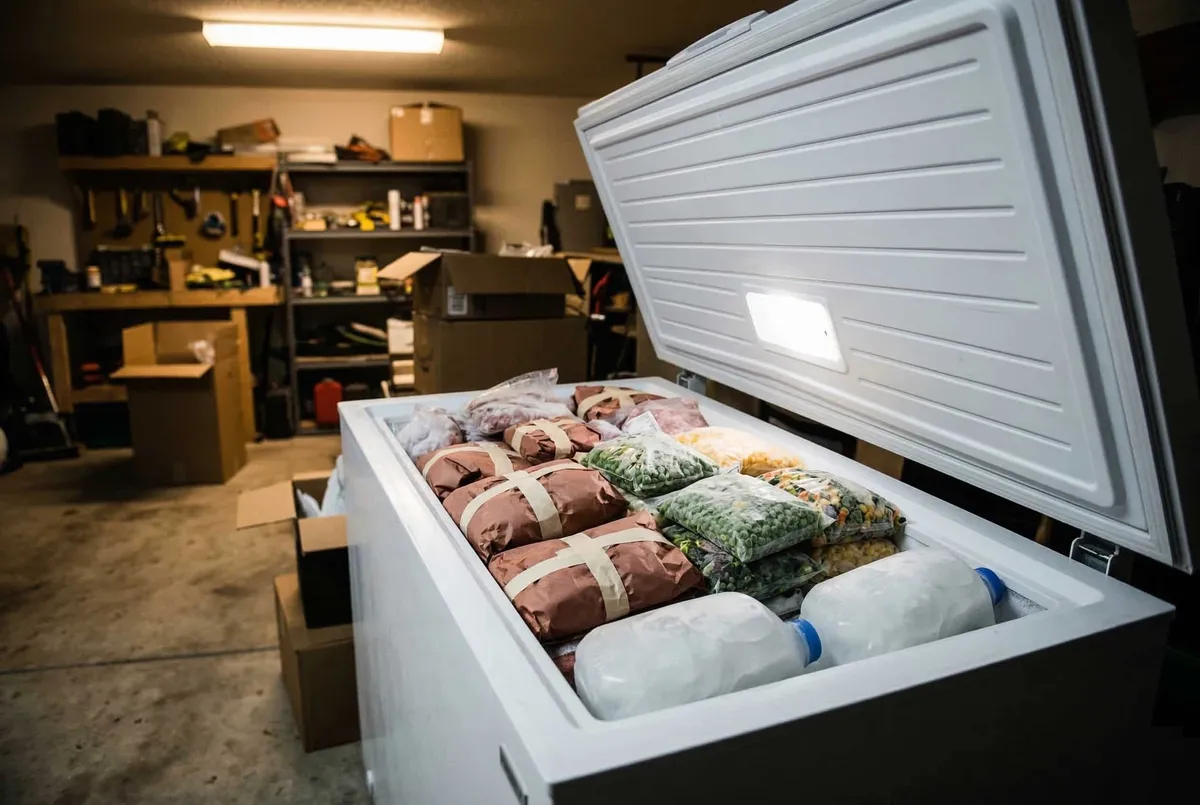
I see it happening all over the prepping and homesteading forums right now. With everyone panicking about food shortages, supply chain issues, and grid stability, people are rushing out to buy chest freezers. They bring them home to the garage, plug them in, and stock them with hundreds—sometimes thousands—of dollars worth of expensive meat, frozen vegetables, and emergency meals.
Then, they jump on Amazon and buy a standard 1kWh portable battery, thinking they have effectively built a bulletproof, off-grid food preservation system for the winter.
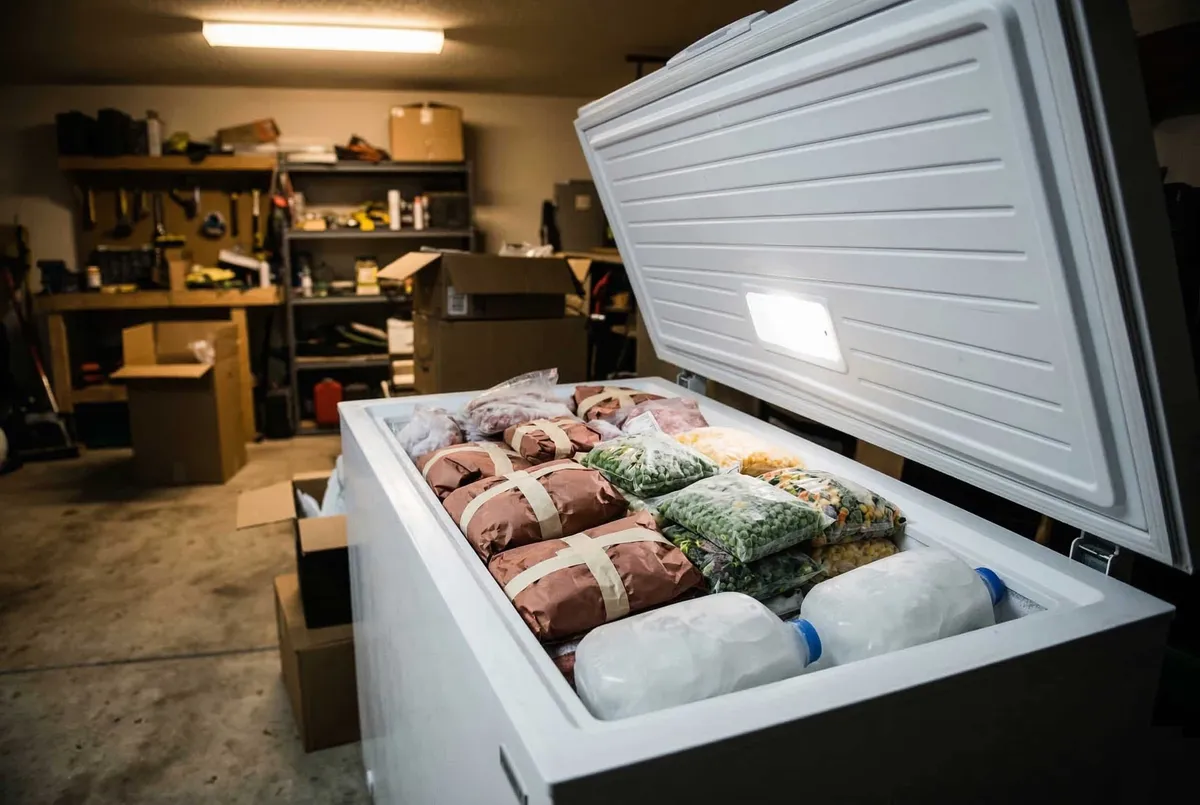
Honestly, I almost made this exact same mistake. I was looking at the energy guide sticker on the back of my own deep freezer. I saw that it only pulled about 150 watts of electricity, and my brain immediately did the simple math: "Okay, 150 watts going into a 1,000-watt-hour battery means this thing will run for almost a week straight!"
But then I sat down, dug into the actual electrical manuals, and did the real "Blackout Math." That is when I realized I was about to set myself up for a devastating $1,000 disaster.
⚡ The $1,000 Emergency Food Mistake: Running Watts vs. Surge Watts
Here is the dirty little secret that portable battery companies don't put on their glossy marketing flyers: Locked Rotor Amps (LRA).
A chest freezer does not use electricity like a lightbulb does. A lightbulb turns on, pulls a steady 60 watts, and stays there. A chest freezer uses a heavy-duty mechanical compressor motor to pump refrigerant through the walls of the unit.
When that compressor kicks on to cool things down, it is fighting against pressurized gas from a dead stop. It requires a massive, split-second jolt of violent electricity to break the inertia and get the motor spinning. This is what electricians call the "surge wattage" or Locked Rotor Amps.
Even if your freezer only uses 150W to stay cold once it is running, that initial startup surge can easily spike to 800 watts, 1,000 watts, or even more. If you buy a budget battery station and its internal inverter is only rated for a 500W maximum surge, the moment your freezer compressor kicks on, the battery's safety breaker will instantly trip to protect itself.
Imagine the grid goes down in the middle of a winter freeze. You plug your freezer into your brand-new battery, see the green LCD screen light up, and go back to sleep. An hour later, the freezer warms up, the compressor cycles on, the battery trips, and shuts down completely. You wake up two days later to a garage full of thawing, rotting food.
🔍 How to Find Your Freezer's Secret "Surge Number"
Before you even look at buying a solar generator, you have to find out exactly what your specific freezer pulls. You cannot guess this number. Every manufacturer is different, and older freezers pull significantly more power than modern ones.
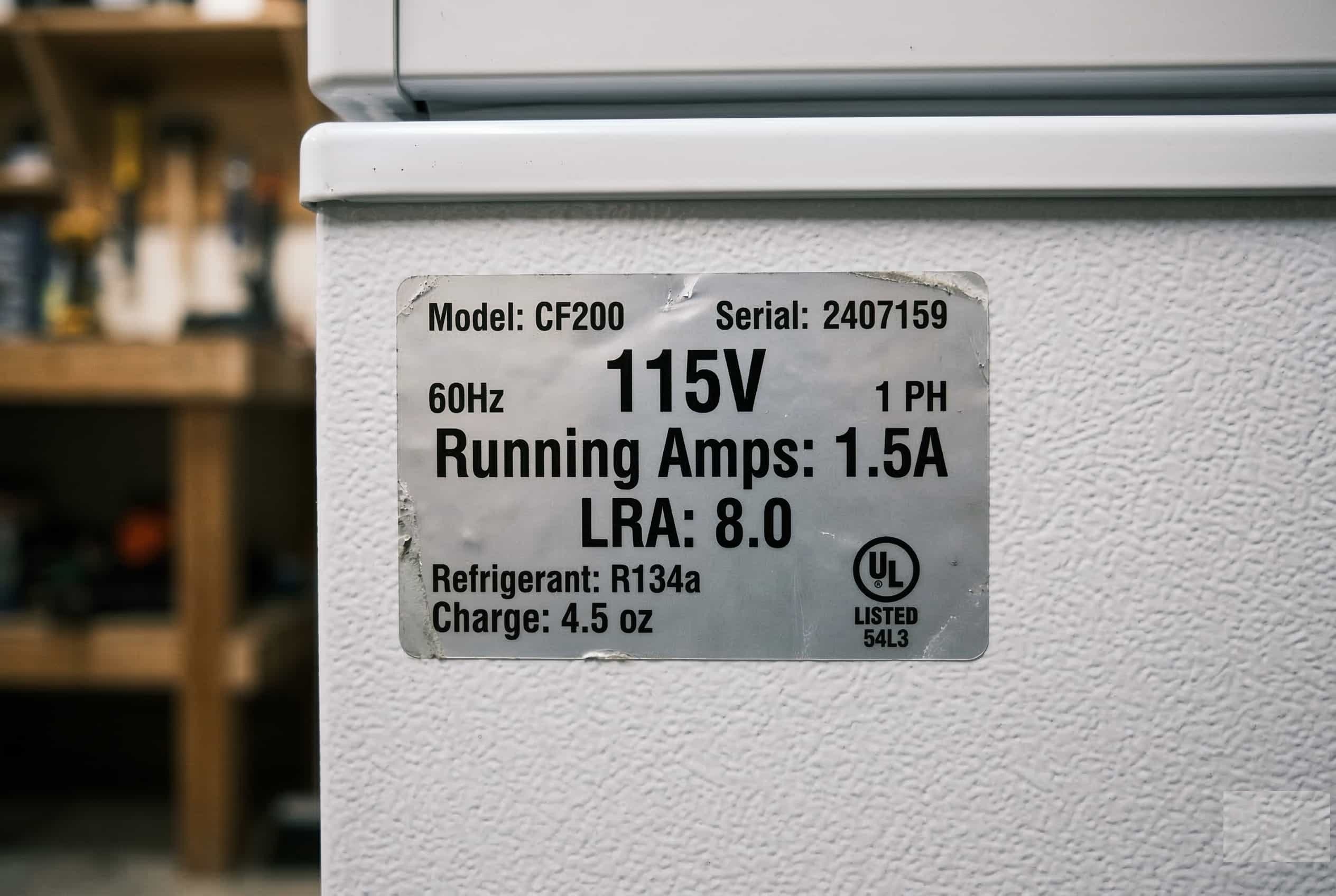
Here is exactly how you find your numbers:
- Locate the Data Plate: Look on the back of your freezer, or sometimes on the inside lip of the lid. You are looking for a silver or white sticker.
- Find the Amps: It will usually list "Volts" (115V or 120V in the US) and "Amps" (e.g., 1.5A). Multiply Volts x Amps to get your Running Watts (120V x 1.5A = 180 Watts).
- Find the LRA: Look closely for a number labeled "LRA" (Locked Rotor Amps). If it says LRA: 8.0, multiply that by 120V to get your Surge Watts (120V x 8.0A = 960 Watts).
📊 Average Chest Freezer Power Consumption (Cheat Sheet)
To give you a baseline, here is a breakdown of standard sizes. Notice how much more efficient chest freezers are compared to standing upright freezers (because cold air sinks, chest freezers don't lose all their cold air when you open the lid).
| Freezer Size & Type | Running Watts | Surge Watts (Danger Zone) |
|---|---|---|
| 5 cu. ft. Chest Freezer | ~100W | ~600W |
| 7 cu. ft. Chest Freezer | ~150W | ~800W |
| 15 cu. ft. Chest Freezer | ~250W | ~1,200W |
| 15 cu. ft. Upright Freezer (Avoid) | ~400W | ~1,600W+ |
⚠️ Stop Guessing Your Surge Math
Don't risk your $1,000 emergency food supply on a guess. I built a free calculator tool for myself that does all the heavy lifting. Use it to find the exact surge requirements for your specific appliances before you buy a battery.
🧮 Calculate My Home Surge Load Now →🔋 The Top 3 Solar Generators for Deep Freezers
If you have done your blackout math and realized your current battery isn't going to cut it, here are the three units I personally recommend depending on your budget.
1. The Sweet Spot: EcoFlow DELTA 2
This is honestly the gold standard for most normal households. It features a 1,024Wh LiFePO4 battery, but the real reason this is my top recommendation is its massive 2,700W surge capacity. It will absolutely laugh at a chest freezer compressor kicking on.
🛒 Check Current Price on Amazon ➔
2. The Budget Pick: Jackery Explorer 1000 v2
If you only have a small 5 cubic foot chest freezer and are on a strict budget, the Jackery 1000 v2 will get the job done reliably. It handles up to a 1,500W surge, which gives you plenty of overhead for a small, modern compressor.
🛒 Check Current Price on Amazon ➔3. The Doomsday Pick: EcoFlow DELTA Pro
If you are running a massive 15+ cubic foot meat locker, stop playing around and get the Pro. It packs a jaw-dropping 3,600W running capacity with a 7,200W surge capacity. You could theoretically run your deep freezer, your main kitchen fridge, and a space heater simultaneously without tripping this inverter.
🛒 Check Current Price on Amazon ➔🥶 Pro Tip: How to Keep Your Freezer Cold Longer in a Blackout
To stretch your battery life even further, your ultimate goal is to make sure the freezer compressor kicks on as rarely as possible. Here is how I manage my setup during a major winter storm:
- Thermal Mass is King: A full freezer stays colder way longer than a half-empty one. If you have empty space, fill empty milk jugs or 2-liter soda bottles with water and freeze them.
- The Blanket Trick: Throw heavy moving blankets over the top and sides of the freezer to add an extra layer of thick insulation. (Just don't cover the compressor vents!)
- Tape the Lid Shut: The biggest loss of cold air happens when panicked family members open the lid to "check if things are still frozen." Put a physical piece of duct tape across the lid.
- The Quarter on a Cup Trick: Freeze a small cup of water solid, place a coin on top, and leave it in your freezer. If you evacuate and come back days later, check the cup. If the coin sank to the bottom, your freezer completely thawed and refroze, and the food is not safe to eat.
🏁 The Final Verdict
Taking food security seriously means taking your power math seriously. You cannot buy your way out of a grid failure just by throwing money at a random battery you saw on a Facebook ad. You have to do the work.
Take twenty minutes this weekend, pull your freezer away from the wall, read the sticker, and figure out your Locked Rotor Amps.
Stay safe out there.
- Ethan
Last updated: Apr 2026