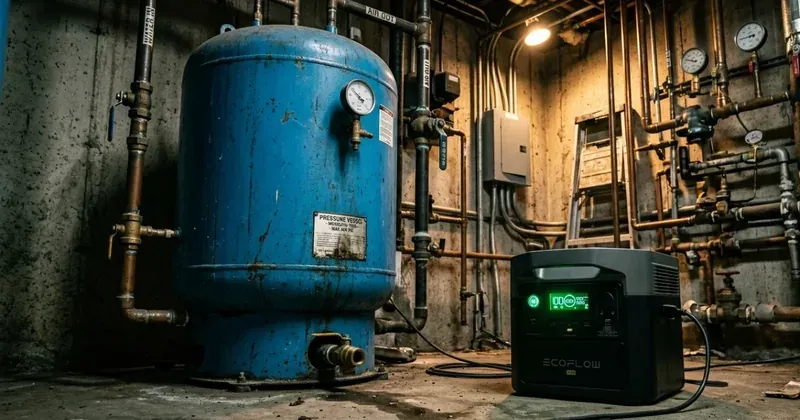
Best Solar Generator for a Well Pump: Surge Numbers Revealed
This post contains affiliate links. I earn a small commission if you buy through my links, at no extra cost to you. I only recommend gear I have researched in depth: manufacturer specifications, published teardowns, and aggregated owner reports.
Most solar generator guides cover chest freezers and refrigerators. Almost none cover well pumps, and a well pump is one of the harder loads a power station will face.
Two things make it hard: the motor needs a large burst of power to start, and many residential pumps run on 240V while portable power stations output 120V. This guide shows how to check both before you spend money.
This post contains affiliate links. We earn a small commission if you buy through our links, at no extra cost to you. Specifications come from manufacturer pages and runtimes are calculations, not our own tests. Work on pump wiring should be done by a licensed electrician.
⚡ The 30-Second Answer
Check your pump’s voltage and LRA (locked rotor amps) on its nameplate first. If the pump is 120V and its startup demand (LRA × 120) fits under a unit’s published surge rating, a power station can work. If the pump is 240V, a standard portable power station will not run it, and a properly installed generator is usually the answer.
💧 Why Well Pumps Are Different
A well pump’s motor pushes water up to your pressure tank. Like a compressor, it draws its biggest current at the instant of startup, before the rotor is spinning. That is its LRA, and for pump motors it can be several times the running draw.
The startup demand is what decides whether a power station trips on the first pump cycle. The running draw decides how long the battery lasts. Our LRA explainer walks through reading the number and the same math for freezers.
🔍 How to Find Your Exact Numbers
Step 1: Find the pump’s nameplate or manual. For a submersible pump this may be in the paperwork from installation, or on the control box.
Step 2: Note the voltage (115/120V or 230/240V), the running amps and the LRA or locked rotor amps.
Step 3: Calculate startup demand: LRA × voltage.
Step 4: Add a 20% margin and compare it to the power station’s surge rating.
Do not guess from horsepower alone. Two pumps with the same rating can have very different startup draws.
⚠️ The 240V Reality Check
Many residential submersible well pumps run on 240V, wired to a two-pole breaker in your panel (usually 15 to 30 amps). The three power stations below output 120V.
How to check your pump voltage:
- Single-pole breaker in the panel usually means 120V
- Double-pole breaker usually means 240V
- Confirm on the data plate on the pump or control box
If the pump is 240V, a standard portable power station will not run it. Also, a pump that is hardwired to your home’s electrical system cannot simply be plugged into a power station. Connecting any backup power source to household wiring needs a properly installed transfer switch or interlock, done by a licensed electrician. Never connect a generator to a wall outlet or panel yourself.
🎯 The Realistic Options
| EcoFlow DELTA 3 Plus | Jackery Explorer 1000 V2 | Bluetti Elite 200 V2 | |
|---|---|---|---|
| Output voltage | 120V | 120V | 120V |
| Continuous output | 1,800W | 1,500W | 2,600W |
| Surge | 3,600W | 3,000W | No motor surge rating published |
| Capacity | 1,024Wh | 1,070Wh | 2,073.6Wh |
🟢 Option 1: EcoFlow DELTA 3 Plus
Best for: 120V pumps whose startup demand (LRA × 120, plus 20%) is under about 3,600W, which in practice means a smaller 120V pump.
It has the highest published surge of the three at 3,600W. X-Boost, EcoFlow’s feature for running some appliances above the rated output, applies to resistive loads like heaters, not motors, so do not count on it for a pump. Capacity is 1,024Wh, enough for several pump cycles but not for long running.
🟡 Option 2: Jackery Explorer 1000 V2
Best for: small 120V pumps with a modest startup demand.
3,000W of published surge covers pumps whose LRA × 120 comes in under about 2,500W after margin. It is the lighter, simpler unit at 23.8 lb.
🟦 Option 3: Bluetti Elite 200 V2
Best for: pumps that run alongside other loads, where capacity matters more than peak surge.
It has the largest battery and output (2,073.6Wh, 2,600W continuous), but Bluetti publishes no motor surge rating. Do not assume it will start a large pump. Confirm with Bluetti support using your pump’s LRA before you buy. The AC200L this guide used to list is discontinued.
⛽ Option 4: Gas Generator With a Transfer Switch
Best for: 240V pumps and anything beyond a small 120V pump.
A properly sized gas generator on a transfer switch can feed 240V loads, which portable power stations cannot. The trade-offs are fuel, noise and maintenance. Run any gas generator outdoors, well away from windows, doors and vents, never in a garage, because of carbon monoxide.
🏆 Our Recommendation
If your pump is 120V and the startup math fits under 3,600W: the EcoFlow DELTA 3 Plus has the most published surge headroom, and it can cover your chest freezer and refrigerator too if you run the numbers.
If your pump is 240V, or its startup math is above about 3,600W: a power station is the wrong tool. Look at a generator on a transfer switch installed by a licensed electrician, or ask a well contractor about options.
Not sure what your setup requires? Use the Solar Generator Sizing Calculator to model your pump alongside your other critical appliances.
❓ FAQ
What size solar generator do I need for a well pump? Multiply the pump’s LRA by its voltage, add a 20% margin, and choose a power station whose published surge rating is above that. The pump must also run on 120V, because portable power stations output 120V.
Can a 1000W solar generator run a well pump? Only if the pump is 120V and its startup demand fits under the unit’s surge rating. The Jackery Explorer 1000 V2 is rated for 3,000W surge, so check your pump’s LRA against it. Many pumps will need more.
How long will a solar generator run a well pump? A 1,024Wh unit with a 15% buffer gives about 50 minutes of continuous pumping at 1,000W. A pump only runs for a few minutes at a time to refill the pressure tank, so average use is far lower than continuous running. Estimate your daily pump minutes to get a real number.
Can I run my well pump and chest freezer at the same time? Possibly, if the combined running watts stay under the unit’s continuous rating and the pump’s startup surge fits while the freezer is running. Use the sizing calculator and start the pump on its own if you can.
Specifications are the manufacturers’ published figures and can change. Runtimes are calculated, not measured. Last updated October 2026.